Since 2008
Based in Belgium and France
+ 60 000 clients
Our blog
A.S.S.
Shopping Cart
Découvrez comment installer, configurer et utiliser WatchPower pour surveiller votre onduleur solaire en temps réel....
Practical guide to reconnect your SMA Sunny Boy inverter to the WiFi network after a change of modem, router or...
Find out how Aiko is revolutionising photovoltaics with its silver-free ABC cells, laser engraving and 0BB...
Ajouter des batteries LiFePO4 neuves à un parc existant exige un équilibrage préalable rigoureux. Découvrez pourquoi...
Find out how the Walloon incentive tariff 2026 and dynamic contracts radically transform the electricity bill of...
Installing photovoltaic panels on a roof or on the ground represents a long-term investment that requires a rigorous approach to structural safety. Eurocode is the European standard guaranteeing the reliability of solar panel mounting systems . In Belgium, as in France, compliance with these technical standards is mandatory for all professional photovoltaic installations.
This technical guide details the Eurocode principles applied to photovoltaic fixings , structural calculation methods, and conformity criteria to guarantee the sustainability of your solar installation in both countries.
“Compliance with Eurocode standards is not optional: it guarantees a safe, durable, and insurable photovoltaic installation for at least 25 years.” – Structural Engineering Firm
Eurocode refers to a set of European standards (EN) governing the design and calculation of building and civil engineering structures. For photovoltaic installations, three Eurocodes are particularly relevant:
These technical standards define the climatic loads (wind, snow, temperature) and the safety factors to be applied when designing photovoltaic mounting systems .
In Belgium , compliance with the Eurocode is required for:
In France , compliance with the Eurocode is mandatory for:
Failure to comply with these standards may result in refusal of connection by the network operator (Enedis, ORES, RESA) and cancellation of manufacturer's warranties.
Pitched roofs (tiles, slate, sheet metal, steel decking) represent 75% of residential installations in Belgium and France. Wattuneed offers several solutions adapted to each type of roofing:
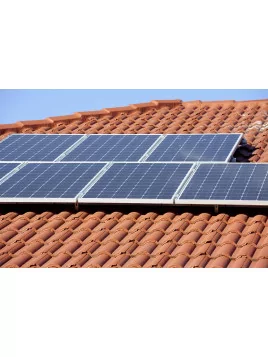
The Wattuneed tile fixing kit includes dual-adjustment hooks to accommodate different tile thicknesses (30-60 mm). Installation maintains the integrity of the waterproofing thanks to a rafter fixing system that requires no drilling into the tiles.
Key technical points:
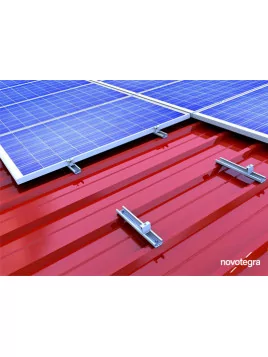
The sheet metal fixing uses specific hooks to maintain the roof's watertightness. The through-fixings are equipped with EPDM seals guaranteeing a 25-year watertight seal.
The steel roofing system is particularly suitable for agricultural and industrial buildings. It allows for rapid installation with landscape or portrait orientation depending on production needs.
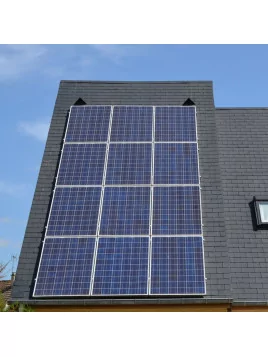
Installation on a slate roof requires careful handling due to the fragility of the material. Special slate hooks distribute the load across several slates to prevent breakage.
On flat roofs , the Blubase mounting systems offered by Wattuneed use weighted systems without drilling , compliant with Eurocode to resist wind uplift forces.
Advantages of weighted systems:
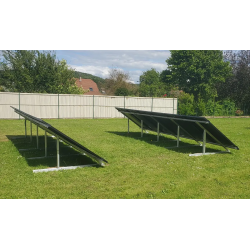
Ground-mounted photovoltaic installations require concrete foundations or screw piles conforming to Eurocode 7 (geotechnical). The anchoring depth depends on the soil type and local wind loads.
Discover all Wattuneed mounting systems
Permanent loads include the weight of the solar panels, mounting rails, and accessories:
The total weight of a photovoltaic installation varies between 21 and 28 kg/m², which is a negligible load compared to the structural resistance of a traditional frame (>100 kg/m²).
Snow loads vary significantly depending on the region and altitude. Here are the reference values for Belgium and France:
In metropolitan France, the territory is divided into 5 snow zones (A1, A2, B1, B2, C1, C2, D, E) according to the national annex of Eurocode 1:
The snow load is applied with a shape coefficient that depends on the roof pitch:
Wind exerts two types of forces on solar panels:
In Belgium, the reference wind speed varies from 26 m/s (coastal Flanders) to 23 m/s (Ardennes). This speed is increased depending on exposure:
In metropolitan France, the territory is divided into 4 wind zones according to Eurocode 1 (NF EN 1991-1-4/NA):
Terrain roughness categories (France and Belgium):
The dynamic wind pressure is calculated using the following formula:
q = 0.5 × ρ × V² × Cr × Ce
Or :
"Roof edge and corner areas are subjected to pressure coefficients 50% higher: particular attention must be paid to reinforcing fixings in these critical areas."
Eurocode requires calculating several combinations of actions to verify the structure's resistance in all possible scenarios:
Fundamental combination (ULS - Ultimate Limit State):
1.35 × G + 1.50 × Q₁ + 1.05 × Q₂
Project: 6 kWp installation (15 panels) in Walloon Brabant, 35° roof, rural exposure.
Critical combination: 1.35 × 750 kg + 1.50 × (1200 Pa × 30 m²) = 55 kN lifting force
Project: 9 kWp installation (20 panels) in the Paris region (wind zone 1, snow zone B2), 30° roof, suburban exposure.
Critical combination: 1.35 × 960 kg + 1.50 × (1000 Pa × 40 m²) = 61 kN lifting force
These loads must be supported by the anchors in the framework , hence the importance of using suitable screws (Ø8-10 mm, length 120-160 mm) and fixing onto solid rafters.
The aluminum rails form the framework of the fastening system. Their dimensions depend on:
The calculation of maximum deflection (deformation) complies with Eurocode 3:
f_max = L/200 (L = span in mm)
For a span of 1200 mm, the deflection must not exceed 6 mm under maximum load.
The fixing hooks must withstand tensile forces (wind uplift) and compressive forces (snow). The selection criteria are:
In exposed areas (Atlantic/Mediterranean coast, plateau), reinforced anti-uplift devices are mandatory:
Consult the detailed assembly diagrams.
Several tools are available to perform Eurocode calculations for photovoltaic mounting systems:
Wattuneed provides an online toolbox including load calculators and mounting system sizing tools.
For installations >10 kWp or in high-risk areas (fragile roofs, extreme exposure), the services of a structural engineering firm are recommended or even mandatory. Deliverables include:
The certified fastening systems offered by Wattuneed undergo laboratory testing according to the following standards:
Mistake #1: Using insufficient hooks or rails to reduce costs.
Consequence: Progressive deformation, tearing in case of storm, cancellation of warranties.
Solution: Strictly follow the manufacturer's instructions and Eurocode calculations.
Mistake #2: Fixing the hooks directly onto the boards or battens without reaching the rafters.
Consequence: Tearing off from the first gusts of wind (resistance <200 N instead of >1500 N).
Solution: Use a rafter detector and screws of sufficient length (120-160 mm).
Error #3: Not checking the seal after drilling the cover (through fixings).
Consequence: Water infiltration, structural deterioration, mold growth.
Solution: Apply polyurethane sealants or use hooks with integrated EPDM seals.
Mistake #4: Installing roof edge panels without reinforcing the fixings.
As a result, the edge areas experience 50% greater wind forces (increased pressure coefficients).
Solution: Reduce the span between rails and double the anchorages in critical areas.
Error #5: Applying snow/wind loads from an incorrect area (confusion of municipality, incorrectly estimated altitude).
Consequence: Dangerous undersizing or unnecessary and costly oversizing.
Solution: Systematically check the exact climate zone via official Eurocode maps or online tools (Eurocodes Tools, Dlubal).
Eurocode recommends annual visual inspections to check:
After each extreme weather event (storm >100 km/h, snowfall >30 cm), a thorough check is mandatory.
Eurocode compliant fastening systems offer a lifespan of >25 years with manufacturer's warranties:
Wattuneed support assists installers and individuals in monitoring and maintaining installations in Belgium and France.
Explore all our technical guides
In Belgium: Yes, for any professional installation >3 kWp and/or requiring a grid connection. Failure to comply may result in refusal of connection and cancellation of warranties. Small self-installations (<3 kWp) are subject to best practices without the requirement for certified calculations.
In France: Yes, for any installation >3 kWp with grid connection or subject to prior declaration/building permit. Installations benefiting from EDF OA contracts must comply with Eurocode. Plug-and-play solar kits (<800 W) are exempt from structural calculations.
Several methods are available: 1) Consult the official maps in the national annexes NF EN 1991-1-3 and NF EN 1991-1-4, 2) Use free online tools (Eurocodes Tools, Dlubal, Lisa.blue) which automatically determine the zone by municipality, 3) Contact your local town hall or a structural engineering firm. Note: the altitude of your project can significantly affect snow loads.
Through-fasteners : These penetrate the roof covering (screws into rafters), guaranteeing the best mechanical resistance but requiring reinforced waterproofing. Non-through-fasteners : Hooks slid under tiles or weighted systems (flat roofs) maintain waterproofing but limit wind resistance. The choice depends on the type of roof and its exposure to the climate.
Standard configuration: 4-6 fixing points per panel (2-3 transverse rails with hooks spaced 0.8-1.2 m apart). In exposed areas (wind zone 3-4 in France, Belgian coast): 6-8 points with a reduced span between rails of 0.8-1.0 m. Edge and corner panels require reinforcement with additional anchors (pressure coefficients increased by 50%).
Technically, yes for small self-built installations (<3 kWp), but with significant caveats: 1) Dangerous work at height, 2) Mandatory knowledge of structural regulations, 3) Manufacturer warranties are often voided, 4) Home insurance may refuse coverage. Wattuneed recommends using a certified installer (QualiPV in France, electrical certification in Belgium) who guarantees Eurocode compliance and airtightness.
A Eurocode-compliant system made with high-quality materials (anodized aluminum, A2/A4 stainless steel) offers a lifespan of over 25 years with minimal maintenance. The aluminum rails and stainless steel hooks are guaranteed for 10-15 years against corrosion and breakage. Annual inspections and post-storm checks allow for the early detection of any damage.
No, each country applies its own national annex to Eurocode 1. Belgium uses a system based on altitude with loads ranging from 0.50 to 1.20 kN/m² (50-120 kg/m²). France uses a system of geographical zones (A1 to E) with loads from 0.45 to 3.50 kN/m² depending on the region and altitude. In practice, flat areas have similar loads (50-65 kg/m²), but mountainous areas in France (Alps, Pyrenees) can have much higher loads.
About WattuneedWattuneed SPRL is the Belgian specialist in photovoltaic and renewable energy solutions. We offer a complete range of Eurocode-certified mounting systems , high-performance solar panels , and hybrid inverters for individuals, installers, and businesses in Belgium and France. Our technical team supports you in sizing, regulatory compliance, and the successful implementation of your solar projects.📍 Headquarters: Belgium | 🌐 Website: www.wattuneed.com | 📞 Technical support: support.wattuneed.com
check_circle
This store asks you to accept cookies for performance, social media and advertising purposes. Social media and advertising cookies of third parties are used to offer you social media functionalities and personalized ads. Do you accept these cookies and the processing of personal data involved?