This guide remains your reference on hybrid inverters. To compare Deye, Sofar, WKS, Huawei, Victron models with current pricing, browse our catalog.
View hybrid inverters →🛒 Looking to buy a hybrid inverter?
Over 50 Deye, Sofar, WKS, Huawei and Victron models in stock at Wattuneed, with manufacturer warranty and 48h shipping.
View hybrid inverters in stock →Complete Guide to Hybrid Inverters 2025
Table of Contents
Introduction
Hybrid inverters represent a major advance for solar photovoltaic installations: in addition to converting the current from the panels, they integrate battery management and intelligent interaction with the electricity grid. They enable surplus energy produced during the day to be stored for use in the evening or at night, increaseself-consumption and, depending on the model, provide a backup mode. In 2025, the market offers high-performance solutions suitable for a wide range of installation profiles.
Choose your hybrid inverter in 30 seconds
- Single-phase or three-phase: depending on your electrical installation.
- Power (kVA): depending on simultaneous consumption and start-up peaks.
- Battery: voltage (often 48V) + BMS compatibility.
- MPPT: 1 simple orientation; 2+ if different orientations/shading.
- AC coupling/backup: useful for adding storage or powering priority circuits.
See available models: hybrid inverters.
How hybrid inverters work
The hybrid inverter is a multifunctional device that combines several technologies to efficiently manage energy flows between different sources and destinations. Its operation is based on a sophisticated architecture that allows it to perform several essential roles simultaneously.
Operating principle
A hybrid inverter manages three main energy flows:
- Solar production: Conversion of direct current (DC) generated by solar panels into alternating current (AC) that can be used by your domestic appliances.
- Battery storage: Intelligent management of battery charging and discharging, allowing excess solar energy to be stored and released when needed.
- Electricity grid: Interaction with the public grid, allowing either surplus energy to be fed into the grid or electricity to be drawn from it when needed.
The hybrid inverter coordinates these flows according to different operating modes, which can be configured according to your priorities:
- Self-consumption priority mode: Solar energy directly powers your appliances, the surplus charges the batteries, and only the remaining surplus is fed into the grid.
- Grid priority mode: Solar energy is first used to charge the batteries, then to power your appliances, thereby reducing your consumption from the grid.
- Backup mode: In the event of a grid outage, the inverter automatically switches to the batteries to maintain power to priority circuits.
Difference from conventional inverters
Unlike conventional inverters, hybrid inverters offer:
- Integrated battery management: No need for a separate charge controller.
- UPS (Uninterruptible Power Supply) function: Uninterrupted power supply in the event of a mains power failure.
- Intelligent energy flow management: Automatic optimisation according to your needs and the availability of solar energy.
- Advanced monitoring: Precise tracking of production, consumption and battery status.
Advantages of hybrid inverters
Hybrid inverters offer many advantages over traditional solutions:
- Maximisation of self-consumption: Optimal use of the energy produced by your solar panels.
- Increased energy independence: Reduced dependence on the electricity grid.
- Protection against power cuts: Maintains power supply to essential circuits in the event of a grid failure.
- Economic optimisation: Ability to consume your own electricity during peak hours when grid tariffs are higher.
- Scalable solution: Ability to add additional batteries or panels as your needs evolve.
- Reduced carbon footprint: Maximum use of locally produced renewable energy.
Criteria for choosing a hybrid inverter
Choosing the right hybrid inverter is a crucial step in ensuring the performance and longevity of your solar installation. Several technical and practical criteria must be taken into account in order to make the choice that best suits your specific needs.
Power and sizing
The power of the inverter must be adapted to your installation and your energy needs:
- Solar panel power: The inverter must be able to handle the maximum power of your photovoltaic installation. Generally, the power of the inverter can be slightly lower than that of the panels (ratio of 0.8 to 1) because the panels rarely reach their maximum theoretical power.
- AC output power: This must correspond to the maximum simultaneous consumption of your appliances, particularly for the circuits you wish to power in the event of a grid failure.
- Overload capacity: Some appliances, such as refrigerators or pumps, require a high starting power. Check that the inverter can handle these temporary peaks.
Number of MPPTs (Maximum Power Point Trackers)
MPPT is a system that continuously optimises the output of solar panels according to sunlight conditions:
- A single MPPT: Sufficient if all your panels are installed with the same orientation and tilt, and are not partially shaded.
- Multiple MPPTs: Required if your panels are spread across different sides of the roof or experience different levels of shading. Each MPPT independently manages a group of panels, thereby maximising overall output.
Single-phase vs three-phase
The choice between a single-phase or three-phase inverter depends on your electrical installation:
- Single-phase: Suitable for most residential installations. Simpler and generally less expensive.
- Three-phase: Required for commercial installations or large homes equipped with three-phase power. Allows for balanced power distribution across all three phases.
Battery compatibility
Battery compatibility is a fundamental aspect of hybrid inverters:
- Battery voltage: Check that the inverter is compatible with the voltage of your batteries (usually 48V for residential installations).
- Battery type: Some inverters are specifically designed for particular technologies (lithium, lead-acid, etc.). Others are more flexible.
- Communication protocol: For lithium batteries, ensure that the inverter can communicate with your batteries' BMS (Battery Management System).
- Maximum capacity: Check the maximum battery capacity supported by the inverter if you plan to expand your storage in the future.
Advanced features
Modern hybrid inverters offer a variety of features that can make a difference:
- UPS function: Switchover time to battery in the event of a mains power failure (the shorter the better).
- Remote monitoring: Mobile apps and web portals to monitor and control your installation.
- Scheduling: Ability to set different operating modes depending on the time of day.
- Feed-in limitation: Ability to limit the power fed into the grid (required in some countries).
- Parallel operation: Ability to connect multiple inverters to increase total power.
- AC coupling: Ability to integrate other AC sources such as micro-inverters.
- Peak shaving: Feature that smooths out consumption peaks by using stored energy.
Comparison of the main brands
The hybrid inverter market in 2025 is dominated by several manufacturers that stand out for their technological specificities, positioning and product ranges. Here is a detailed analysis of the main brands available on wattuneed.com.
 Deye (10 models)
Positioning: Deye has established itself as a major player in the hybrid inverter market, offering a wide range of solutions at competitive prices and distinguishing itself through its rich functionality.
Strengths:
- Wide range of power ratings (from 3.6 kVA to over 10 kVA)
- Advanced features: Deye stands out with capabilities such asAC coupling(allowing easy integration of existing micro-inverters) andpeak shaving(smoothing consumption peaks to reduce costs associated with subscribed power).
- Intuitive user interface
- Compatibility with different types of batteries
- Good value for money
Flagship model: The SUN-3.6K-SG03LP1-EU (£1,593.20 including VAT) offers an excellent balance of performance, advanced features and price for medium-sized residential installations.
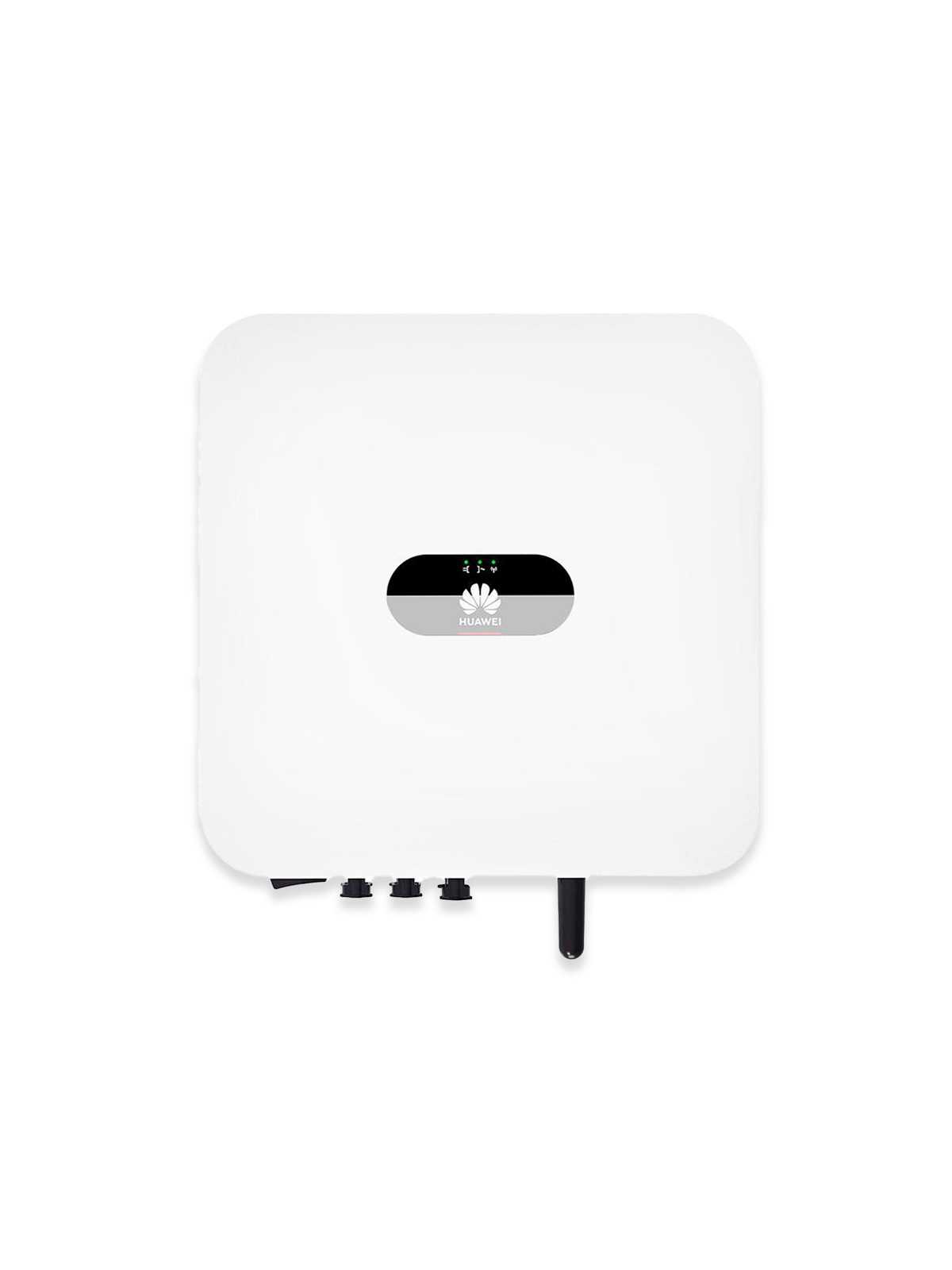 Huawei (4 models)
Positioning: Huawei is positioned in the premium segment, with high-tech hybrid inverters incorporating advanced features.
Strengths:
- Exceptional efficiency (up to 98.4%)
- Comprehensive and intuitive FusionSolar application
- Compact and elegant design
- Recognised reliability
- Regular firmware updates
Flagship models:
- SUN2000-3KTL-L1 (£700.23 incl. VAT): Excellent value for money for small installations
- SUN2000-4KTL-L1 (€981.19 incl. VAT): More powerful version, ideal for family homes
Comparison tables for single-phase hybrid inverters
Detailed comparison of the best hybrid inverters on the market
| BRAND & MODEL | POWER | PRICE INCL. VAT | VOLTAGE | MPPT | EFFICIENCY | FEATURES | STOCK |
|---|---|---|---|---|---|---|---|
| WKS Evo 3kVA Entry level |
3 kVA | £776.40 Best price |
24V | 1 Single MPPT |
93 | AC Coupling | In stock |
| Huawei SUN2000-3KTL-L1 Chinese Premium |
3 kVA | €802.23 Excellent value for money |
48V | 2 Dual MPPT |
98.4% | AC Coupling | In stock |
| Huawei SUN2000-4KTL-L1 4kVA version |
4 kVA | €981.19 More power |
48V | 2 Dual MPPT |
98.4% | AC Coupling | In stock |
| WKS Evo Circle 5.6 kVA High power |
5.6 kVA | £799.99 Excellent power/price ratio |
48V | 1 Single MPPT |
93 | AC Coupling | In stock |
| Sofar Solar HYD3000-EP Advanced features |
3 kVA | £1,341.10 Premium with AC Coupling |
48V | 2 Dual MPPT |
99.9 | AC Coupling (limited) | In stock |
| Deye SUN-3.6K-SG03LP1-EU Advanced technology |
3.6 kVA | €1,593.20 High-end |
48V | 2 Dual MPPT |
97.6% | AC Coupling (Advanced) | Pre-order |
| SolaX X1-HYBRID-3.0-D G4.1 Latest generation |
3 kVA | €1,963.52 European premium |
48V | 2 Double MPPT |
97.8% | AC Coupling (limited) | In stock |
€1,180
Average price
3.6 kVA
Average power
96.9%
Average efficiency
6/7
In stock
(Prices are subject to change depending on adjustments made by our suppliers and current promotions.)
Advanced features of hybrid inverters
Modern hybrid inverters offer much more than simple energy conversion. They now incorporate advanced features that optimise energy management and significantly increase the value of your installation. Let's take a look at these innovative technologies that make all the difference.
Peak Shaving
What is Peak Shaving?
Peak shaving is a feature that limits electricity consumption peaks by using energy stored in batteries. This technique is particularly useful for commercial or industrial installations subject to pricing based on maximum power demand.
How does it work?
- The inverter continuously monitors the building's electricity consumption.
- When a consumption peak is detected or anticipated, the inverter automatically draws power from the batteries
- The power drawn from the grid thus remains below a predefined threshold
- The batteries are then recharged during periods of low consumption
Advantages of peak shaving
- Significant financial savings: Reduction in penalties for exceeding the contracted power
- Optimised sizing: Option to subscribe to a lower power electricity contract
- Grid stability: Contribution to the overall balance of the electricity grid
- Extended equipment life: Less stress on the electrical installation
Compatible inverters
Deye inverters are particularly effective for this function, especially the SUN-3.6K-SG03LP1-EU and higher models. They allow fine tuning of trigger thresholds and intelligent management of battery discharge.
AC Coupling
What is AC Coupling?
AC Coupling is a technology that allows existing micro-inverters or string inverters to be integrated into an energy storage system. This feature is ideal for adding batteries to an existing photovoltaic installation.
Installation examples
To help you better understand how to integrate a hybrid inverter into your energy project, we have prepared four concrete examples of installations adapted to different needs. These examples will allow you to visualise the possibilities and estimate the associated costs.
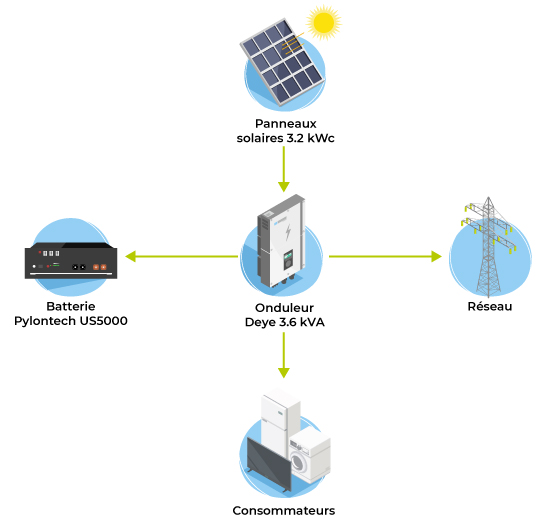
Example 1: Basic residential installation (3-4 kW)
Recommended configuration
- Inverter: Deye SUN-3.6K-SG03LP1-EU (3.6 kVA)
- Battery: Pylontech US5000 (4.8 kWh)
- Solar panels: 8 x 400 Wp panels (3.2 kWp total)
- Installation type: Single-phase, self-consumption with storage
Installation diagram
- Deye 3.6 kVA inverter:€1,593.20 incl. VAT
- Pylontech US5000 battery:€1,199.99 incl. VAT
- Solar panels (8 x 400 Wp): approximately£1,600 including VAT
- Accessories and cabling: approx. £450 incl. VAT
- Installation: approx. £1,500 incl. VAT
- Approximate total: £6,393.19 including VAT
Advantages of this configuration
- Ideal solution for a small house (80-120 m²)
- Excellent AC coupling function for integrating micro-inverters
- Estimated self-consumption rate: 70-80%
- Autonomy in the event of a power cut: approximately 8-12 hours (depending on consumption)
- Estimated return on investment: 7-9 years (depending on region and consumption)
Conclusion and recommendations
Choosing a hybrid inverter is an important decision that will have a significant impact on the performance and profitability of your solar installation. In 2025, the market offers a wide variety of high-performance, reliable models, but it is essential to clearly define your needs and carefully compare the different options.
Summary of key points
- Maximising self-consumption: The main objective is to use as much of the energy you produce as possible.
- Smart storage: Batteries are essential for storing surplus energy and using it at night or in bad weather.
- Advanced features: Options such as backup mode, time programming, remote monitoring,peak shavingandAC couplingadd value.
- Compatibility: Ensure compatibility between the inverter, panels and batteries.
- Warranties and support: Choose brands that offer good warranties and local support.
Recommendations by user profile
Small budget / Simple installation
WKS models (Evo 3kVA) offer excellent value for money for beginners.
Standard residential / Advanced features
Deye (SUN-3.6K) is an excellent, well-balanced choice, offering advanced features such as AC coupling and peak shaving. Huawei (SUN2000-3KTL/4KTL) remains a high-performance option with an excellent interface.
High performance / Flexibility
Sofar Solar (HYD-EP) or SolaX (X1-HYBRIDE) will satisfy demanding users.
Professional installation / Three-phase / High power
The Multisolar II 15kW is a robust and versatile solution. The three-phase models from Sofar Solar and Deye are also suitable.
Next steps
- Accurately assess your consumptionand your power and storage needs.
- Have a personalised study carried outby a qualified installer.
- Compare quotes, taking all criteria into account (equipment, installation, warranties).
- Choose the hybrid inverterthat best suits your project and your budget.
Investing in a high-quality hybrid inverter is a decisive step towards energy independence and reducing your carbon footprint. Take the time to choose carefully so that you can enjoy the benefits of solar energy for many years to come.