Brand
Inverter type
Phase
Number of MPPT
Inverter power in VA
Price
On-grid PV inverters
Grid inverters (also called string inverters) convert the direct current from your solar panels into sinusoidal alternating current synchronised to the 50 Hz grid frequency — for self-consumption or grid injection, without battery storage. In the event of a grid fault or overvoltage, the inverter disconnects automatically (anti-islanding protection). Available in single-phase and three-phase, from 1 to 100 kW, with brands including SMA, SolaX and Sofar Solar. If you're considering storage now or later, go for a hybrid inverter instead.
Choose in 30 seconds
- Your goal: self-consumption or grid injection without a battery → grid inverter. If you want storage (now or later) → hybrid inverter.
- Single-phase or three-phase: check your electrical panel. Single-phase for most homes, three-phase for large installations or commercial use.
- Power (kW): must match your PV power. Practical rule: inverter = 80 to 110% of panel peak power. Use the solar simulator to validate.
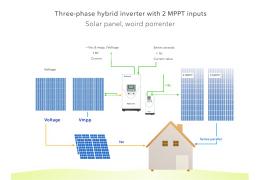
- Number of MPPTs: 1 MPPT is enough if all your panels share the same orientation. As soon as you have 2 orientations (east/west, partial shading), go for 2 MPPTs or more.
- Grid injection or zero export: depending on your country and grid contract, you can inject surplus power or block it to zero via a CT sensor.







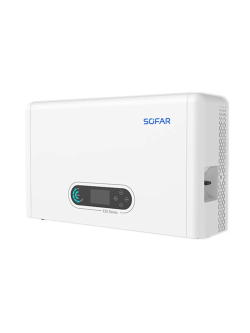



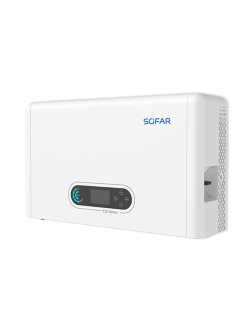







Related posts

FAQ - Grid-tie inverters
Grid solar inverter: complete guide to making the right choice
A grid inverter — also called a string inverter or on-grid inverter — is the component that converts the direct current (DC) produced by your solar panels into alternating current (AC) at 230V or 400V, compatible with your home wiring and the public grid. It is the simplest and most cost-effective solution for a self-consumption installation without storage: fewer components, faster installation, lower maintenance.
Grid inverter vs hybrid inverter: which one to choose?
- Grid inverter: ideal if you simply want to produce and consume in real time, without storing. You use your solar production first, then inject any surplus to the grid (or limit to zero depending on your setup). Lower purchase price, simpler to install.
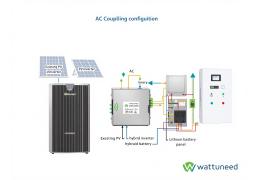
- Hybrid inverter: required as soon as you want to add a battery — now or in the future. If you have any doubt about adding storage later, go straight to a hybrid: replacing an inverter two years later costs more than the initial price difference.
Key technical criteria
Single-phase or three-phase
First step: open your electrical panel and count the phase breakers. Single-phase = 1 phase (230V), the case for the vast majority of residential homes. Three-phase = 3 phases (400V), typically for homes with high subscribed power, commercial buildings, or large heat pump installations. A single-phase inverter cannot work on a three-phase grid — and vice versa.
Power in kW: the overpanelling rule
Your grid inverter's power rating doesn't have to exactly match your panel peak power. In practice, panels rarely reach their nominal output — temperature, irradiance, and angle of incidence all reduce real production. It is therefore common and technically justified to "overpanel" slightly: install 10 to 20% more PV power than the inverter's nominal rating. This improves the production curve at low-irradiance hours (morning, evening, winter) with no risk to the inverter. See our MPPT sizing technical guide for detailed calculations.
Number of MPPTs and string management
Each MPPT independently optimises a group of panels (a "string"). If all your panels are on the same roof section with the same orientation and no shading, 1 MPPT is sufficient. As soon as you have:
- 2 different orientations (east/west, south + façade)
- Partial shading on some panels
- Different tilts on several roof sections
...you need at least 2 MPPTs to avoid one string dragging down the other. Our grid inverters offer 1 to 4 MPPTs depending on the model.
Grid injection, self-consumption and zero export
- Full injection: everything you produce is sent to the grid and compensated (feed-in tariff). Increasingly rare for new residential installations.
- Self-consumption with surplus injection: you use your production first and export the excess. The most common setup in France and Belgium.
- Zero export: via a CT clamp connected to the inverter, your production is throttled in real time to never exceed your instantaneous consumption. Required in some cases in Belgium.
Brands available at Wattuneed
SMA
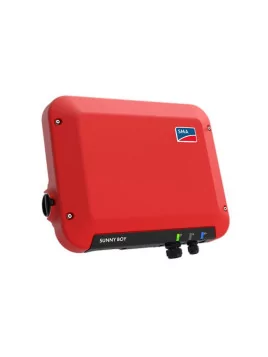
The German benchmark, renowned for long-term reliability and durability. SMA Sunny Boy (single-phase) and Sunny Tripower (three-phase) inverters are among the most robust on the market, with monitoring via the SMA Energy platform. The go-to choice for installations that need to run trouble-free for 20 years.
SolaX
Excellent value for money with a complete mono and three-phase range. SolaX is particularly appreciated for its easy configuration and monitoring via the SolaX Cloud app. Compatible with many retrofit storage solutions.
Sofar Solar
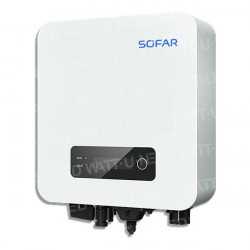
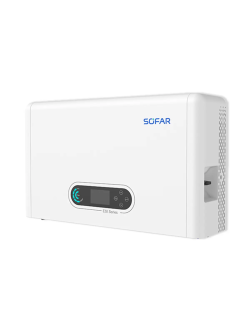
A complementary grid range alongside our Sofar hybrid inverters. Sofar grid models are particularly competitive at mid-range power levels (3 to 10 kW) with solid Sofar monitoring integration.
Hoymiles (micro-inverters)
Technically micro-inverters rather than string inverters, Hoymiles units enable panel-by-panel optimisation. Find them in our dedicated micro-inverters category.
Installation and regulations
- In France: planning declaration required above 3 kWp, grid connection agreement with Enedis for injection, Consuel compliance certificate recommended.
- In Belgium: approved electrician mandatory for commissioning, Synergrid-approved inverter required, notification to the grid operator (Ores, Fluvius...).
- In Luxembourg: mandatory notification to the local grid operator before installation.
See our wiring diagrams to visualise typical installation architectures.