Since 2008
Based in Belgium and France
+ 60 000 clients
Our blog
A.S.S.
Shopping Cart
Guide complet pour connecter votre onduleur Solax à Internet via WiFi et configurer l'application SolaX Cloud pour...
ORES rejects 27 high-voltage substations and warns of 10,000 vulnerable circuits. The much-vaunted PV + heat pump duo...
Maîtrisez l'application SOLARMAN Smart pour piloter et surveiller votre onduleur depuis votre smartphone ou PC en...
Guide expert pour le démarrage automatique de groupe électrogène (AGS). Comparatif des configurations sur Victron...
Systèmes all-in-one (Zendure, EcoFlow, Bluetti, Marstek) vs modulaires (Deye, Victron + Pylontech) : comparatif...
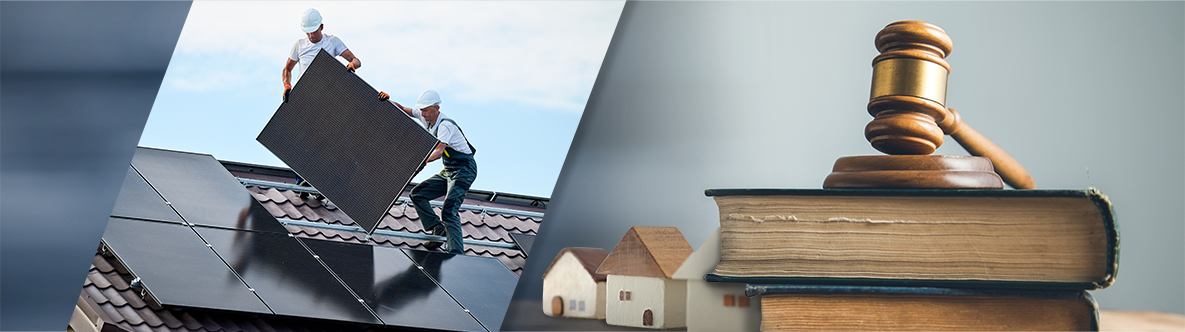
French legislation on photovoltaic installations: the complete guide Solar panels are becoming increasingly popular as a way of producing clean electricity and reducing energy bills. But in France, installing photovoltaic panels is subject to specific rules. This educational article reviews the legislation governing the different categories of photovoltaic installations - from small-scale self-consumption on a private home to industrial solar power plants - and details the regulatory procedures, technical thresholds, tax obligations and other formalities (town planning, CONSUEL, Enedis connection, sales contracts, etc.) that you need to know about. Aimed at both the general public and installers, this guide clearly explains the legal obligations at each stage, with practical examples and useful links to official resources. Categories of photovoltaic installations In France, the regulatory framework varies according to the type of solar array. The main categories are: self-consumption without feed-in (you consume all your production and nothing is fed into the grid), self-consumption with feed-in (you reinject the surplus and sell some or all of it), off-grid stand-alone installations, and high-power "industrial" installations. Each has its own specific constraints, which we describe below. Self-consumption without injection (zero grid injection) This is where all the solar-generated electricity is consumed on site, without any surplus being fed back into the public grid. Technically, either a device is used to limit the power or store the surplus, or the installation is sized so that it is less than the instantaneous requirements. This mode is suitable for people who simply want to reduce their electricity bill, but do not want to sell their electricity. Administrative formalities: Even without injection, you still need to comply with town planning formalities. If you want to install panels on your roof, you generally need to obtain a preliminary works declaration (DP) from the town hall. In unprotected areas, there is an exception for very small ground-mounted installations: if the output does not exceed 3 kWp and the panels are no more than 1.80 m high, no authorisation is required*. However, in a protected area (heritage site, surroundings of a historic monument, etc.), a PD is required regardless of size*. For projects integrated into a new build, remember to include the panels in the building permit. As far as the grid operator (Enedis) is concerned, a convention d'autoconsommation sans injection (CACSI) must be drawn up to formalise that your installation will send nothing to the grid(Convention d'autoconsommation sans injection pour une installation ...). This agreement (a simple form) must be completed via the Enedis portal before commissioning. It commits the self-producer to blocking the injection of any surplus, generally by means of a parameterised inverter or a management device*. In practice, Enedis installs a Linky meter capable of distinguishing between extraction and injection, but in this "zero injection" mode, the meter should never register any injected energy. Consuel and compliance: The good news is that small, fully self-consumed installations can be exempted from the Consuel certificate under certain conditions. Consuel certification is not compulsory if the output power (inverter power) of the installation does not exceed 3 kVA and there is no storage battery *◘. Below this threshold, and without injection, it is considered that the connection does not require systematic Consuel inspection. However, above 3 kVA or if your system includes storage (battery), you will need to have the electrical installation certified by Consuel *◘. In practical terms: a 2 kW solar kit with no injection on a house will be able to avoid Consuel, while a 6 kW installation will require a certificate. If required, the blue Consuel form should be used for a production installation without storage, or the purple form if batteries are used *◘ (see the section below dedicated to Consuel forms). Note that below 3 kW without injection, a simple CACSI declaration to Enedis is sufficient and the Consuel is not required *◘. Technical thresholds to be respected: An important point is the maximum power injected into a network phase. In France, above 6 kVA per phase, the connection must be three-phase(Three-phase solar panels: Is it possible? (Guide 2025)). This means that if your installation exceeds ~6 kW of single-phase inverter power, Enedis will require you to switch to three-phase (or limit the inverter to 6 kW). However, in self-consumption without feed-in, it is rare to install much more than 6 kW on a single-phase home, as any surplus would be lost. In practice, the 6 kVA limit often corresponds to the subscribed power of your meter. You cannot inject more than the power of your subscription: if you only have a 6 kVA (single-phase) contract and your solar production momentarily exceeds 6 kW, the connection circuit breaker will trip*. You therefore need to size your contract wisely or increase your subscription/triphase your connection if necessary. Tax obligations and grants: As there is no resale of electricity, you have no income to declare to the tax authorities. You simply consume your energy, which is not taxable. However, the installation itself may qualify for reduced VAT at 10% if it meets the following criteria: it must be installed by a professional in a home that is more than two years old, have an output of ≤ 3 kWp, and be connected to the grid*. Most small-scale residential installations meet these criteria, which means that customers pay only 10% VAT on the bill instead of 20%. For example, an individual who owns their own home (completed more than 2 years ago) and has 3 kWp installed for self-consumption will benefit from the 10% VAT rate *○. However, above 3 kWp, the standard rate of 20% applies(New VAT 2025 reduced to 5.5% for solar panels). Note that without resale, the question of tax exemption does not arise, and it is not possible for a private individual to reclaim the VAT on the purchase of the equipment in this case (reclaiming VAT implies having a sales activity subject to VAT, see below). From 1 October 2025, the supply and installation of photovoltaic panels with a capacity of 9 kWp or less will benefit from a single reduced rate of 5.5%, replacing the previous rates of 10% and 20%.⚠️ Please note: application of this reduced rate will be subject to specific environmental and technical conditions, to be confirmed by a forthcoming ministerial order. Practical example - total self-consumption of 3 kWp: Mr Durand is having 8 panels (3 kWp) installed on his roof, solely for self-consumption. He submits a prior declaration to the town hall (compulsory for installing panels on a roof) and signs a CACSI agreement with Enedis confirming zero injection*. His installer set the inverter so that no surplus energy went to the grid. As the installation is 3 kW, the Consuel is not required in his case *◘. Mr Durand paid 10% VAT on the supply and installation of the system, since the power is ≤3 kWp and his home is over 2 years old *. He has no further steps to take after commissioning: all the solar energy feeds directly into his home, so his Linky meter should never show any injections. In the months when his production exceeds his instantaneous consumption, the excess energy is simply lost (his inverter automatically reduces the power). But most of the time, Mr Durand consumes it all, and sees his electricity bill go down. Self-consumption with injection (sale of surplus or total sale) Here, your installation injects all or part of its production into the public grid. There are two sub-cases: sale of surplus (you consume as a priority and sell only the surplus) and total sale (all production is injected and sold, you do not consume any directly). The legal framework for these two configurations is similar, with a few nuances, because in both cases you become an electricity producer connected to the grid. Connection procedures and contracts: Unlike the zero-injection system, you will be setting up a connection with injection with Enedis. The first step is to submit a production connection request online - preferably via Enedis's online connection account *-. Enedis will examine your request and ask you to sign a connection, access and operation agreement, often called a CRAE*. This contract with Enedis authorises you to feed electricity into the network up to a given power*. Once the installation has been completed, you will need to obtain the Consuel certificate (electrical compliance certificate) and send it to Enedis*. Enedis will then commission the connection, usually by programming or activating your Linky meter in production mode. The Linky smart meter is calibrated to measure separately the energy withdrawn from the grid and the energy injected *○. At the same time, you need to sign a purchase contract to get value for the electricity you inject. In the majority of cases for small installations, the Obligation d'Achat (OA) mechanism is used with EDF OA, an EDF subsidiary responsible for buying solar production at a regulated tariff ****. The OA contract sets a guaranteed feed-in tariff for 20 years*○, defined by ministerial decree. The tariffs in force depend on the power and type of installation (surplus or total sale) and decrease each quarter for new projects*○. For example, in the 1st quarter of 2025, for a residential installation: the feed-in tariff for the sale of surplus is around €0.10 per kWh up to 9 kWp, and the individual also benefits from a self-consumption bonus of €390 per kWp installed (paid over 5 years) *○. For total sales, the tariffs are around €0.13/kWh for ≤3 kWp, €0.087/kWh for 9 kWp, €0.079/kWh for 36 kWp, etc.*☺. These figures change regularly, so it is advisable to check the official Photovoltaique.info website for the latest tariffs *○. At the time of commissioning, you will therefore have three key documents: the approved Consuel certificate, the CRAE agreement signed with Enedis, and the sales contract signed with EDF OA (or another approved buyer) **. Enedis will inform the buyer that the system has been commissioned, so that the feed-in contract can begin **. Note that it is not compulsory to sell to EDF OA: there are other energy buyers (Enercoop, TotalEnergies, etc.), but EDF OA is the most common under the regulated tariff. Planning and location: The town planning rules for installing panels are identical to those seen above. On roofs, a prior declaration is required in most cases*. On the ground, small installations intended for resale pose a special case: recent tariff decrees require that the sale of surplus electricity concerns installations on buildings (roofs) and not on the ground. Surplus sales are only eligible for roof-mounted installations **. A ground-mounted installation of just a few kilowatts cannot benefit from the OA contract for the surplus. On the other hand, a ground-mounted installation of 9 kWp or more ** can be sold in its entirety (below this threshold, ground-mounted installations cannot be sold in their entirety within the regulated framework). So a private individual who wanted to put 6 kW of panels at the bottom of his garden without consuming them would not be able to sell under the standard OA framework, unless he went through a specific call for tenders (unlikely on this scale). In practice, the small powers to be sold are almost always on roofs or building structures. For large rooftops (>250 m²) or car park shading, the simplified permit (DP) framework applies, regardless of the power output, except in protected sectors (see Industrial section below). Consuel and compliance: Any installation involving injection requires a compulsory Consuel before Enedis *○ switches on the power. As indicated above, the blue form (production without storage) or the purple form (with storage) will be used. If the installation is mixed (production + modified domestic consumption), the installer may have to complete two certificates (a yellow one for the consumption part, and a blue/violet one for the production part) *○. Consuel checks that the inverter complies with standards, that the connection to the electrical panel complies with standard NF C15-100, and that the protection devices (disconnectors, surge protectors, etc.) comply. This certificate of compliance is essential for the grid operator to authorise commission ing *○. Enedis will refuse to commission the production meter without the relevant Consuel. Technical thresholds: Here again, the threshold of 6 kVA per phase is decisive. For inverters above 6 kW, a three-phase connection is required**. This means that to install, for example, 9 kWp of surplus electricity on a house with a single-phase 6 kVA connection, you will either have to change the meter to 9 kVA three-phase, or restrict the inverter to 6 kW max **. Many residential installations are limited to 6 kW in order to remain on single-phase. In addition, you must not exceed the injection power of your subscription: you cannot inject more than the circuit-breaker can handle **. If you have a 9 kVA (45 A) subscription and a 9 kW inverter, this makes sense; but if you only have a 6 kVA subscription, a 9 kW inverter would cause the circuit breaker to trip in the event of maximum production. In short, the sizing of the installation, the connection power and the single/three-phase system all need to be considered together. There are other thresholds in the regulations: 36 kVA is the maximum power for an installation to remain on standard low voltage with Enedis. Above this (between 36 and 250 kVA, then >250 kVA), the connection procedures are more complex (often connection to the medium-voltage network). But for domestic or small professional installations, we generally stay ≤36 kVA. You should also be aware of the feed-in tariff power levels: ≤3 kWp, ≤9 kWp, ≤36 kWp, ≤100 kWp, ≤500 kWp, etc., with each level having a specific feed-in tariff or conditions (for example, above 100 kWp, a call for tenders is used instead of a standard tariff). For example: up to 9 kWp on a building, the regulated feed-in tariff applies without a call for tenders*☺; between 100 and 500 kWp on a building, a tariff is still available (Order of 6 October 2021), but it is lower*☺; above 500 kWp, there is no automatic feed-in tariff, and you have to apply to a call for tenders (CRE). Tax obligations: As soon as energy is resold, even partially, there are tax implications. Fortunately, small-scale production is exempt from income tax under certain conditions. Article 35 ter of the General Tax Code exempts income from the sale of photovoltaic electricity if: the installed capacity is ≤ 3 kWp, connected to no more than 2 delivery points, and the activity is not professional(BIC - Scope and territoriality - Exemptions - sale of photovoltaic energy by natural persons | bofip.impots.gouv.fr). In practice, this covers most private individuals with solar systems of up to 3 kWp. So if you sell the surplus from your 3 kWp installation, the EDF OA income is tax-exempt *○. Please note, however, that this exemption does not mean that you do not have to declare it: you still have to enter the amount on your annual tax return (form 2042 C Pro), even if it is on a €0 taxable line **. As soon as the installation exceeds 3 kWp, on the other hand, income from resale is taxable as industrial and commercial profits (BIC) *○. The simplest system for private individuals is the micro-BIC system (annual income < €77,700), with a flat-rate allowance of 71% on income from the sale of electricity. In practical terms, if you receive €500 from EDF OA sales, you will only be taxed on 29% of this amount under the micro-BIC scheme, at your marginal tax rate. Once again, you will need to complete form 2042 C Pro to declare this income. As far as VAT is concerned, the principle is as explained above: 10% up to 3 kWp (if installed by a professional in a home more than 2 years old) **, 20% above that(What is the VAT for a 3 kWp solar panel - Soleriel). However, private individuals with a resale contract can opt for micro-business status in order to reclaim the VAT on their investment. To do so, they need to meet a number of criteria: installation > 3 kWp, connected and with a surplus sales contract (no recoverable VAT if you don't actually sell, for example with a virtual battery) **, and the panels must be installed on the building (roof overlay) **. If these conditions are met, the individual producer can register (e.g. as a non-taxable micro-business with a basic franchise) so that the installation can be treated as an activity: he will then invoice EDF OA for the VAT on the electricity sold (EDF OA is used to this and will pay exclusive of VAT), and will be able to reclaim the VAT paid on the initial installation *. In return, it loses the benefit of the reduced rate of 10% on purchase (it will pay 20% and then reclaim it). This approach makes sense for slightly larger installations (e.g. 6 or 9 kWp) in order to recover several thousand euros of initial VAT. A word of advice: get professional help or check out impots.gouv.fr before choosing this option. Finally, it's worth pointing out that solar panels are exempt from property tax when installed on the roof of a building, for both private individuals and businesses**. In other words, adding panels to your house does not increase the taxable cadastral rental value. On the other hand, for a business, ground-mounted panels may be included in the property tax base (in the case of ground-mounted power plants) **. Concrete examples - self-consumption with resale : Sale of surplus (detached house): Mrs Dupont installs 6 kWp of panels on her roof. She uses the energy herself during the day and the surplus is fed into the grid. She submitted a DP to the town hall and signed a CRAE with Enedis to inject 6 kW*. Her installer (RGE) has obtained the Consuel (blue form) and Enedis has commissioned the smart meter. Mrs Dupont has signed a contract with EDF OA, which will pay her €0.10 per kWh surplus for 20 years. For her 6 kWp, she also receives a ~€1,800 self-consumption bonus spread over 5 years (indicative amount depending on the quarter of application) - a bonus paid by EDF OA into her bank account each year. As her installation exceeds 3 kWp, the income she receives (a few hundred euros a year) is taxable. However, she has opted for the micro-BIC scheme: for example, for €500 of annual income, only €145 would be added to her tax base after a 71% allowance. She reports this income on her 2042 C Pro return each spring. From a technical point of view, her 6 kW installation operates on single-phase because that's the acceptable limit; if she planned to expand to 9 kW, she would have to switch to three-phase. Total sale (farmer or company): SCEA du Soleil installs 36 kWp of panels on the roof of its barn for additional income. In this case, the entire production is fed into the grid: the farm does not use the electricity directly. The manager put together an Enedis connection file (36 kVA three-phase), obtained Consuel approval and signed an OA contract for total sale at around €0.08/kWh for 20 years (tariff 3 kWp, so PD required). No agreement has been signed with Enedis, as the installation is not connected to the public grid. The system supplies the chalet completely independently. The Consuel was not formally requested, but the installer followed the standards in force. As the refuge has no resale income, there are no tax implications (apart from VAT on the purchase of the equipment). This situation remains marginal and mainly concerns sites far from the grid, but it shows that the safety obligation (electrical standards) remains general, even off-grid. Industrial and high-power installations This category covers high-power photovoltaic plants: large solar roofs on warehouses or tertiary buildings, ground-mounted solar farms, large-scale car park shading systems, etc. These projects, which often exceed 100 kWp or even MW in size, are generally backed by companies, local authorities or professional operators. The legislation here combines the aspects seen above (connection, OA contract or calls for tender, taxation of a commercial activity) with additional obligations due to the size of the project. Town planning and impact assessments: Large-scale facilities must comply with the town planning regulations in force and, where applicable, environmental regulations. For ground-mounted plants, the procedure depends on power output and height. According to the town planning code, a ground-mounted power plant with a capacity ≥ 3 MW requires planning permission*. Below 3 MW, as a general rule, all that is required is a prior declaration (except in the case of local exceptions) *. Of course, because the surface areas involved are so large, a planning application must include a massing study, a landscape integration study, etc., and the local council may require planning permission even for a smaller power plant if the footprint is considerable. In protected areas, any installation ≥ 3 kWp requires planning permission*, which means that even a 100 kWp solar farm within the perimeter of a historic monument will have to obtain planning permission with the advice of the ABF. On the environmental front, since a 2022 decree, photovoltaic projects have benefited from a higher threshold for impact studies. Today, a ground-mounted installation ≤ 300 kWp is exempt from prior environmental assessment *♣. Between 300 kWp and 1 MWp, an environmental impact assessment may be required on a case-by-case basis (decision by the environmental authority) *♣. Above 1 MWp (1000 kWp), a full and systematic impact study is mandatory (as well as a public enquiry)*♣. These thresholds only apply to ground-mounted installations: roof-mounted or shaded power plants are exempt from environmental assessment regardless of their output *♣, which makes projects on large buildings much easier. In short, a 5 MW solar farm will require planning permission and an in-depth impact assessment, whereas a 5 MW rooftop on a warehouse "only" requires a prior declaration (and no formalised impact assessment, apart from the building structure study of course). Grid connection: Industrial installations often exceed the capacity of the conventional low-voltage grid. Enedis generally requires a medium-voltage (MV) connection above 250 kVA connection power. This means installing a step-up transformer (often a prefabricated substation) to feed power into the 20 kV network. The project developer must finance the delivery substation and any network extension work (medium-voltage line to the site). The connection process takes longer than for a small-scale installation: several months of studies and work are required. Enedis issues a specific Connection Proposal with a budget and schedule, valid for a few months *-. The contract signed with Enedis will be a Network Access and Operation Contract (often still referred to as a CRAE) covering protection, maintenance, etc. For large projects, an agreement to be attached to a Balance Responsible Entity is also required if the electricity is not sold as OA (e.g. if sold directly on the market) *-. However, most power plants up to 500 kWp still use the OA framework (total sale) with EDF OA, which means they do not have to manage the grid balance themselves*-. Consuel and safety: Unsurprisingly, all these installations must obtain a Consuel before being commissioned, just like any other production facility *♦. The documentation to be provided to Consuel is more extensive: single-line diagrams, calculation notes, etc., via the SC 144 technical file to be attached to the blue/violet certificates(Technical files - CONSUEL). The installer must be competent and approved for this type of work. Safety standards (NF C15-100 and NF C13-100 for HTA) are strict. For example, decoupling protection is required (59-minute overvoltage protection relay, etc.), which must be checked by the Consuel and by Enedis when the work is completed. During commissioning, Enedis will also check that the installation's decoupling and protection devices are working properly*-. Purchase and sale of production contract: For power output ≤ 500 kWp on a building, the producer can still opt for the EDF OA contract with a regulated tariff (in accordance with the Order of 6 October 2021)(What photovoltaic regulation from 100 to 500 kWp?). For example, a 200 kWp plant on a factory roof can sell at ~€0.10/kWh over 20 years without going through a call for tenders. On the other hand, large-scale ground-mounted plants do not fall within this framework: typically, >500 kWp on the ground = obligation to participate in national tenders (CRE) to obtain a tariff, or sell directly on the market via a private contract (PPA) if subsidies are waived. Invitations to tender introduce other obligations (specifications, financial guarantees, etc.) that go beyond the scope of this article. For intermediate capacities (e.g. 1 MW on a roof), we are often on the edge of two worlds, and the project developer will choose either to break down the project into 500 kW units in order to take advantage of the open window, or to apply to the CRE for the whole project. It should be noted that since 2023, OA purchase contracts (and premiums) have required the installer who carried out the installation to be RGE (Reconnu Garant de l'Environnement) certified ****. For large-scale plants, this is generally a given, as serious installers are qualified, but it has now become a formal condition for receiving subsidies. Obligations for professionals and qualifications : Large-scale installations must be carried out by qualified companies. In France, the RGE QualiPV label is essential for installers who want their customers to benefit from feed-in tariffs and public subsidies(QualiPV | Qualit'EnR). There are several levels of QualiPV qualification: for example, QualiPV 36 (for installations up to 36 kVA) and QualiPV 500 (up to 500 kVA)(QualiPV | Qualit'EnR). A company installing a 300 kWp plant will need to be QualiPV 500 qualified to be recognised as RGE for this project. This guarantees its competence in both the electrical aspects and, if necessary, the integration of the system into the building. Professionals must also comply with good practice and standards (NF C15-100, UTE C 15-712-1 guide for photovoltaics, etc.). On industrial sites, there may be additional constraints: for example, in establishments open to the public, compliance with fire safety regulations must be checked (fire-rated materials, emergency stop devices accessible to the fire brigade, etc.). Similarly, in a listed building or conservation area, a professional will have to propose solutions for visual integration (such as solar tiles, or discreet roof installation) to obtain the approval of the Architectes des Bâtiments de France. Example - 100 kWp solar farm on the ground: Let's imagine a 100 kWp project (around 250 panels) on agricultural land. The operator submits a prior declaration to the local council (power 500 kWp normally not eligible, unless there is a possible multi-installation derogation) or via a CRE call for tenders. Assuming that it has won a call for tenders, it will sign a sales contract with EDF OA, but at the tariff offered during the call for tenders (around €0.06-0.08/kWh depending on current offers). Again, 20 years of secure income. The electricity injected (at 20 kV) will supply thousands of homes in the surrounding area. The project, run by RGE professionals, complies with standards and involved an ABF inspection because the warehouse is within sight of a historic monument (the panels were finally set back to limit visibility). This type of power plant will also have to be declared to the warehouse's insurer, as the value and risks change (weight on the roof, electrical risk). Next page > *(Do you need planning permission to install panels ...) ** (French legislation on photovoltaic installations.pdf)*◘(Consuel for solar panels ? 2025 guide - Sunethic)*○(Installing solar panels: you are entitled to aid! | Ministry of the Economy, Finance and Industrial and Digital Sovereignty)*♦Consuelélectrique: the electrical certificate of conformity*-(Enedis Particuliers | Raccordement Production Electrique Photovoltaique)*♣(Modification of the criteria for the environmental assessment of solar projects - pv magazine France)*☺(Photovoltaic feed-in tariffs: the amounts in 2025 - Hello Watt)
check_circle
This store asks you to accept cookies for performance, social media and advertising purposes. Social media and advertising cookies of third parties are used to offer you social media functionalities and personalized ads. Do you accept these cookies and the processing of personal data involved?