Since 2008
Based in Belgium and France
+ 60 000 clients
Our blog
A.S.S.
Shopping Cart
The solar battery industry is undergoing a major technological revolution: active thermal management, sodium-ion,...
Are you considering equipping your motorhome, boat, tiny house or home with a photovoltaic system? The first question...
Discover how to configure Deye Copilot step by step to maximise your energy savings. Comprehensive guide with...
Augmentez votre taux d'autoconsommation de 20 à 40% sans investir dans de nouveaux panneaux. Découvrez 12 actions...
Batterie physique ou virtuelle pour votre installation photovoltaïque ? Découvrez notre comparatif complet 2026 avec...
Did you install your solar panels a few months or even a few years ago, and are you finding that a significant portion of your production is going to the grid? You are not alone. Many owners of photovoltaic installations find themselves in this situation: producing a lot, but consuming little at the right time.
The reality is simple: a kWh of self-consumption is often worth 3 to 4 times more than a kWh fed back into the grid. In Belgium, the prosumer tariff and the gradual disappearance of the reverse meter make this equation even more critical. In France, kWh-for-kWh compensation is fading in favour of the obligation to purchase at reduced rates.
"Self-consumption is not a question of installed power, it is a question of synchronisation between production and consumption."
The aim of this article? To show you how to increase your self-consumption rate from 20% to 40% without touching your panels. No need to expand your installation or spend thousands of pounds. All you need to do is intelligently shift your consumption to solar production hours.
💡 Key reminder: The self-consumption rate measures the proportion of your production that you consume yourself. A rate of 30% means that 70% of your production goes to the grid. The goal: to increase from 30% to 50-70% through best practices.
Before you start optimising, it is essential to know your current situation. Without accurate data, it is impossible to prioritise the right actions. Here are the 3 key indicators to identify:
Check your electricity bills or your network operator's interface (Fluvius, RESA, Enedis). You need to know your total annual consumption in kWh. Example: 4,500 kWh/year for an average household (no electric heating).
When do you consume the most? Between 5 p.m. and 10 p.m. (evening peak) or between 10 a.m. and 4 p.m. (sunlight hours)? If you have a connected inverter (SMA, Fronius, Deye, Victron), check the consumption curves on the mobile app or web platform.
🔌 Need a smart meter?
To accurately track your consumption and production in real time, install a smart meter compatible with your inverter:
These meters enable accurate monitoring and automatic optimisation of your energy flows.
Analyse the times when you feed the most energy into the grid. On a sunny day, how many kWh are fed into the grid between 11 a.m. and 3 p.m.? This surplus represents your margin for improvement.
Use our calculators to size and optimise your installation
If you are in the design phase of your photovoltaic installation, favour multiple orientations (east and west, for example) rather than a single south-facing orientation. This strategy has a double advantage for self-consumption:
Result: Your production curve is spread over 12-14 hours instead of being concentrated over 6-8 hours at midday. You reduce the peak injection at midday and naturally increase your self-consumption rate by +10 to +15% without any additional action.
"A well-sized east-west installation can achieve 50-60% self-consumption without a battery, compared to 30-40% for a conventional south-facing installation."
The basic principle of optimised self-consumption is simple: shift your consumption to the hours when your panels are producing. Between 10 a.m. and 4 p.m. in summer, and between 11 a.m. and 2 p.m. in winter, that's when you have surplus energy available.
Rather than letting this surplus go to waste on the grid for a few pence per kWh, use it to power your energy-intensive appliances. Here are the four "perfect" loads to shift:
Electric water heaters account for an average of 15 to 20% of your annual consumption. They are the easiest to control and the most cost-effective to shift.
Recommended solution: Install a control device such as Solar iBoost+, which automatically directs surplus solar energy to your hot water tank. No more heating at night or during peak hours: your hot water is produced free of charge by your panels.
💡 Recommended product: Solar iBoost+ optimiser
Automatically directs surplus solar energy to your hot water tank
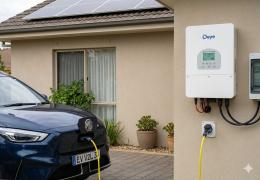
If you own an electric vehicle, it's like a mobile battery on wheels. Rather than charging during peak hours in the evening, schedule charging between 10 a.m. and 4 p.m.
Tip: Limit the charging power to 3-5 kW during the day (rather than 7-22 kW in the evening). You will charge more slowly, but entirely with your solar production. An EV consuming 15 kWh/100 km and travelling 40 km/day requires approximately 6 kWh per day: perfect for a 3-5 kWp installation.
✅ Smart solar charging • ✅ Surplus management • ✅ Mobile app
These appliances consume between 0.5 and 3 kWh per cycle. By programming them during the day using their "delayed start" function, you can recover a significant portion of your surplus.
Weekend tip: Plan your laundry and dishwashing for Saturday and Sunday between 11 a.m. and 3 p.m. You'll enjoy a double benefit: maximum solar production and being at home to manage the cycles.
Reversible heating and air conditioning systems are excellent candidates for self-consumption. The principle of pre-heating or pre-cooling consists of raising the temperature by a few degrees during daylight hours.
This technique exploitsthe thermal inertia of your home: the temperature changes slowly, allowing you to maintain comfort while consuming free solar energy.
Let's now look at 12 actions, ranked from the simplest to the most cost-effective. Some can be implemented immediately without investment, while others require minor equipment or configuration adjustments.
This is the most profitable and quickest action to implement. Your electric water heater consumes between 2 and 4 kWh per day. By programming it to heat exclusively during daylight hours, you immediately recover this volume.
How to do it:
Use the "delayed start" function on your dishwasher to start it automatically at 1 p.m. or 2 p.m. No investment required, just a change in habit.
The tumble dryer is one of the most energy-intensive appliances (2-3 kWh/cycle). Avoid using it in the evening; use it between 2pm and 3pm instead. Better still, dry your laundry outdoors when the weather permits.
Rather than charging at 7 or 11 kW in the evening (drawn from the grid), limit the power to 3-5 kW during the day. You can charge your EV entirely with your solar production. If your installation produces 20 kWh/day and your EV requires 10 kWh, you halve your grid injection.
An electric oven consumes between 1 and 2 kWh per cooking session. Take advantage of the weekend to cook large quantities between 12 noon and 2 pm: you can prepare your meals for the week while making the most of your solar production.
Use a connected socket (Zigbee, Z-Wave or WiFi compatible) to automatically activate a dehumidifier, auxiliary water heater, swimming pool pump or portable air conditioner as soon as surplus power is available.
Technical tip: If you have a Deye, Victron or WKS inverter with a built-in relay, configure it to activate a specific load as soon as the exported power exceeds a threshold (e.g. 500 W).
🔧 Compatibility: Deye, Victron and WKS inverters have programmable relays to control your loads intelligently.
→ See the advanced features of the Deye inverter
Standby mode accounts for an average of 300 to 500 kWh/year, or 10 to 15% of your total consumption. Always switch off unused devices: internet box at night, screens on standby, chargers plugged in but not in use, power strips without switches.
If you have a solar battery (Pylontech, BYD, Huawei), configure it so that it does not discharge completely during the day. Reserve 20 to 30% of capacity to cover the evening peak (6pm to 10pm). This will prevent you from drawing power from the grid at the most expensive times.
Example: 10 kWh battery → reserve 2-3 kWh for the evening. The battery powers your usage between 6pm and 10pm, then recharges the next day with the sun.
If you are in Wallonia with a capacity tariff or in France with a dynamic tariff (Tempo, EJP, optimised HPHC), programme your battery and EV to charge during off-peak hours and discharge during peak hours.
You turn your battery into an energy arbitrageur: purchase at 8 c€/kWh at night, resell internally at 25 c€/kWh in the evening.
📘 To go further: See our dedicated article on battery sizing and dynamic tariffs.
Create automations based on surplus. Example with a home automation system (Home Assistant, Jeedom, Domoticz):
These scenarios require a little configuration, but once in place, they work completely autonomously.
On some hybrid inverters, you can choose the charging priority:
In "home priority" mode, you maximise instantaneous self-consumption. In "battery priority" mode, you maximise storage for the evening. Adapt according to your profile.
If your battery charges and discharges several times an hour (micro-cycles), you will reduce its lifespan. Set wider trigger thresholds:
You will reduce the number of cycles and extend the life of your battery (up to +20% longer life).
To make these actions even more concrete, here are 3 typical profiles with their optimal strategies.
Profile: Family of 4, 5 kWp installation, current self-consumption rate 28%, absence during the day (work, school).
Priority actions:
Expected result: Increase in self-consumption from 28% to 49% in one month, i.e. +21 points. Annual savings: £350 to £500 depending on tariffs.
Profile: Retired couple, 6 kWp installation + 10 kWh battery, current self-consumption rate 65%, continuously occupied.
Expected result: Increase in self-consumption from 65% to 79%, 40% reduction in the number of battery cycles. Battery life extended by +3 years.
Profile: Family with 2 EVs, 8 kWp installation, current self-consumption rate 32%, teleworking 2 days/week.
Expected result: Increase in self-consumption from 32% to 62%. EVs absorb 80% of the surplus, with the water heater and heat pump absorbing the rest. Annual savings: £700 to £900.
Before concluding, here are the 6 classic mistakes that prevent progress. If you recognise any of them, correct them immediately!
Your inverter's "Auto" mode does not know your priorities. As a result, the battery charges first, then feeds in the surplus, when you could have powered your water heater or EV. Take manual control of the priorities.
If your battery is full at 1 p.m., all the surplus energy from the afternoon will be fed into the grid. It is better to slow down the battery charging and consume the surplus in real time (water heater, EV, household appliances).
Plugging in your EV when you get home at 6pm is a reflex, but it's the worst time in terms of pricing. Plug it in during the day (even if you're not there) or programme it to start charging at 12 noon via the charger app.
Installing 10 kWp of panels and a 15 kWh battery without optimising your usage is a waste of money. Optimise first, then size. You may find that 6 kWp + 5 kWh is more than enough.
The two are related but different. You can have 80% autonomy with 40% self-consumption if you oversize your installation.
Running the washing machine at 12 noon on a weekday when no one is there to empty it can lead to unpleasant odours. Running the tumble dryer at 2 pm in the middle of summer overheats the house. Adapt your actions to your lifestyle, not the other way around.
"Optimised self-consumption is not a constraint, it's a game of optimisation where every kWh recovered is a victory."
As you can see, increasing your self-consumption by 20 to 40% without changing your panels is entirely feasible. All you need to do is intelligently shift your consumption to times when solar energy is being produced.
Here is a 4-step checklist to get you started:
If you want to go further, check out our additional guides:
Yes, by shifting your usage to daylight hours (delayed start for appliances, batch cooking, limiting standby mode), you can gain 10 to 20 points without spending a penny. The additional 20 points require some equipment (Solar iBoost, controlled socket, smart EV charger) costing between £100 and £600 depending on the configuration.
Yes, but the gain is proportionally lower because solar production is reduced. In winter, focus on the "low-hanging fruit" actions: limiting standby mode, optimising the battery, preheating the house between 12 noon and 2 pm. The water heater remains cost-effective all year round.
No, a battery is not mandatory. Actions 1 to 7 (water heater, appliances, EV, standby mode) can be implemented without a battery. A battery becomes useful if you have already optimised your usage and there is still a significant surplus during the day.
Consult the technical manual for your inverter or contact us. The Deye, Victron and WKS inverters offered by Wattuneed all have relays that can be configured via a mobile app or web interface. We can guide you through the configuration process.
By limiting the depth of discharge (20-30% reserve) and avoiding micro-cycles, you can extend the life of your battery by 20 to 30%. A LiFePO4 lithium battery (Pylontech, BYD) will thus go from 6,000 cycles to 8,000 cycles, or +3 to +5 years of life.
Absolutely, this is even the optimal combination in 2026. You consume your own energy during the day (free solar power), charge your battery at night during off-peak hours (8-10 c€/kWh), and discharge it in the evening during peak hours (25-30 c€/kWh). The result: energy independence AND tariff arbitrage.
Wattuneed SPRLRue Henripré 12, 4821 Andrimont, BelgiumTel: +32 87 45 00 34 – info@wattuneed.comwww.wattuneed.com | Technical support
check_circle
This store asks you to accept cookies for performance, social media and advertising purposes. Social media and advertising cookies of third parties are used to offer you social media functionalities and personalized ads. Do you accept these cookies and the processing of personal data involved?