Since 2008
Based in Belgium and France
+ 60 000 clients
Our blog
A.S.S.
Shopping Cart
The solar battery industry is undergoing a major technological revolution: active thermal management, sodium-ion,...
Are you considering equipping your motorhome, boat, tiny house or home with a photovoltaic system? The first question...
Discover how to configure Deye Copilot step by step to maximise your energy savings. Comprehensive guide with...
Augmentez votre taux d'autoconsommation de 20 à 40% sans investir dans de nouveaux panneaux. Découvrez 12 actions...
Batterie physique ou virtuelle pour votre installation photovoltaïque ? Découvrez notre comparatif complet 2026 avec...
The Belgian and European photovoltaic energy storage market is undergoing a period of profound transformation. While the decade from 2010 to 2020 was marked by the democratisation of standard lithium-ion technology, 2026 heralds an era of technological specialisation in which each application finds its optimal chemistry. This development responds to the growing demands of Belgian installers and individuals faced with harsh climatic conditions, stricter safety standards and the search for maximum profitability from their photovoltaic installations.
💡 Belgian context: With winter temperatures regularly dropping below 0°C in Wallonia and peaks in energy demand in the evening, residential batteries must now combine thermal performance, fire safety and intelligent management to ensure an optimal return on investment.
Lithium-iron-phosphate (LFP) chemistry, favoured for its safety and longevity (>6,000 cycles), has one critical weakness: its sensitivity to cold. Below 0°C, electrochemical mechanisms rapidly deteriorate due to three distinct physical phenomena:
Faced with these physical limitations, the industry has developed self-heating batteries (SHBs) that are revolutionising thermal management. To understand this technology in concrete terms, let's analyse the architecture of the Leapton EL-A05 5.12 kWh battery, which is representative of the advanced systems available on the Belgian market in 2026.
The technical diagram of the Leapton EL-A05 reveals a sophisticated design with five integrated layers, each fulfilling a specific thermal or safety function:
🔬 Composition of the thermal system (from top to bottom):
This "thermal sandwich" design ensures uniform heat distribution across all cells in a matter of minutes, eliminating damaging thermal gradients that accelerate differential ageing. Unlike previous generations of external heating mats (slow, 30-60 minutes preheating time), the integrated silicone film acts directly on contact with the cells.
The manufacturer's specifications for the Leapton EL-A05 demonstrate the effectiveness of this architecture:
Belgian winter ROI calculation: Over a winter season (November-March, ~150 days below 5°C), a 5.12 kWh battery without heating loses an average of 1.5-2 kWh of usable capacity per day. With active heating, this energy remains accessible at a consumption rate of 300 Wh/day. The net balance is +1.2-1.7 kWh/day recovered, or 180-255 kWh over the season. At £0.30/kWh (average Belgian grid tariff), this represents £54-76 in annual savings, amortising the additional technological cost in 3-4 years.
Analysis of the leading products now reveals three distinct technical philosophies:
"Native integration of active thermal management transforms the battery from a simple passive chemical reservoir into an intelligent thermodynamic system capable of coping with Belgian climatic realities. For 5-6 kWh residential installations, the Leapton EL-A05 offers the best performance/price/robustness ratio in its class, while the Powerwall 3 dominates the premium segment with its predictive AI." — Wattuneed 2026 Technical Analysis
5.12 kWh LiFePO4 battery with integrated heating, aerosol extinguishing module and Smart BMS. IP65 certification for indoor/outdoor installation. Ideal for unheated garages and Ardennes regions. 10-year manufacturer's warranty, >6000 cycles.
The increasing energy density of storage systems (now >200 Wh/L for residential packs) requires a complete overhaul of fire safety protocols. Traditional water sprinklers, standard in commercial and residential buildings, have three critical weaknesses when it comes to lithium-ion battery fires:
Modern residential and commercial battery systems adopt a defence-in-depth strategy based on three sequential levels of intervention:
When a cell begins to fail (localised overheating, internal micro-short circuit), it releases characteristic gases (vaporised electrolytes, hydrogen, carbon monoxide, CO₂) hours or even days before the temperature becomes critical or smoke is visible.
🚨 Off-Gas Detection Technology:
If thermal runaway occurs despite early detection, advanced systems deploy a direct injection of clean extinguishing agents into the heart of the modules. The Leapton EL-A05, for example, natively integrates a chemical aerosol extinguishing module visible on its technical diagram (upper valve):
How the aerosol module works (Leapton EL-A05): In the event of critical thermal detection (>80°C BMS threshold) or the release of precursor gases, the module automatically triggers a chemical reaction that produces an aerosol of fine particles. This cloud acts through a dual mechanism: physical smothering of the flame AND interruption of the chemical reaction chain (binding to OH• free radicals). The agent is non-conductive and leaves no corrosive residue, preserving the electronics unaffected.
Manufacturers now incorporate passive thermal barriers between modules/racks to contain the spread even in the event of a cell runaway:
"The American NFPA 855 standard and European UL 9540A tests now require proof of thermal propagation control for all dense residential or commercial installations. In Belgium, the native integration of extinguishing systems such as the Leapton EL-A05 aerosol module is becoming a decisive factor in obtaining preferential insurance rates." — Wattuneed Safety & Compliance
The BMS (Battery Management System) is the brain of the storage system. Its evolution marks the transition from a "passive monitoring" approach to an "active optimisation" logic. This technological change has a direct impact on the lifespan of batteries (from 10 years to 15-20 years) and their actual usable capacity.
In a battery pack (cells in series), the total usable capacity is dictated by the weakest cell. If one cell reaches 100% charge while the others are at 95%, charging must stop to protect that cell. Keeping all cells at the same level (State of Charge - SoC) is therefore critical to extracting the maximum capacity from the system.
⚠️ Principle: When one cell reaches full charge before the others, the BMS connects a resistor to its terminals to "burn" the excess energy in the form of heat, allowing the weaker cells to continue charging.
Major disadvantages:
✅ Principle: Instead of dissipating energy, the BMS uses DC-DC converters, inductors or capacitors to transfer energy from the most charged cell to the least charged cell.
Decisive advantages:
Leapton EL-A05 implementation: The integrated "Smart BMS" not only manages standard protection (overload, overheating, over-discharge), but also coordinates the heating system and extinguishing module. It supports a charge/discharge rate of 1C at 25°C (100A for 100Ah), allowing the nominal 5.12 kW to be released instantly – a performance that requires precise and responsive balancing of the 16 cells in series.
Real-world impact: On a 10 kWh residential battery with a 5% imbalance between cells, passive balancing can take 12-24 hours to correct and waste 250-500 Wh. Active balancing corrects the same imbalance in 30-60 minutes while recovering 95% of this energy (i.e. 475 Wh reusable).
The latest generation of BMSs incorporate cloud-connected AI algorithms that create a "digital twin" of each installed battery. This approach transforms reactive maintenance into a predictive strategy:
Choose systems with active BMS and cloud monitoring to maximise ROI and lifespan. The additional cost (8-12%) pays for itself in 18-24 months through capacity optimisation and predictive maintenance.
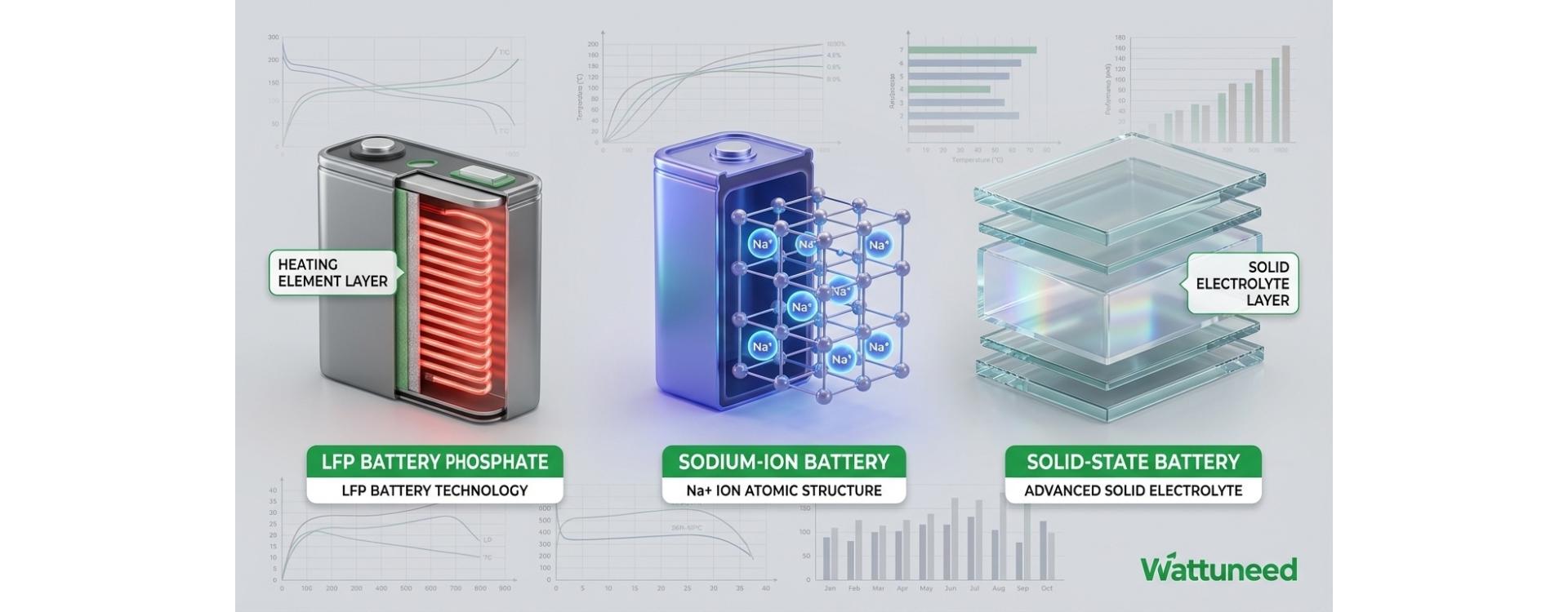
Sodium-ion (Na-ion) technology represents the biggest disruption in the storage market since the commercialisation of LFP. It simultaneously addresses three major challenges:
This is the major competitive advantage of Na-ion. Unlike lithium, whose ionic mobility collapses below 0°C, sodium ions retain high conductivity even at -40°C. This completely eliminates the need for active heating for cold climate applications:
Outlook: If Na-ion technology matures with life cycles >6000, it could advantageously replace heated LFP batteries such as the Leapton EL-A05 in applications where cost takes precedence over energy density. In the meantime, heated LFP remains the optimal choice for Belgian residential applications in 2026-2028.
Sodium's superior ionic mobility allows for 5C charging (full charge in 12 minutes) with less heating than Li-ion, simplifying thermal management and reducing cooling costs. For residential storage, this translates into full recharge capacity during a short solar window in winter.
A unique feature of Na-ion: it can be discharged to 0 volts without irreversible damage (unlike Li-ion, which degrades below a threshold voltage). This allows batteries to be transported in a completely inert state, eliminating the risk of fire during international logistics and reducing insurance costs.
The year 2026 marks the transition of Na-ion from the laboratory to the mass market:
The first Sodium-Ion modules for Belgian residential installations are expected in 2027 via CATL and BYD's European distributors. Target: economy segment (8-12 kWh) for lead/AGM replacement and new budget-constrained installations.
Considered the "Holy Grail" of electrification, solid-state batteries replace flammable liquid electrolytes with solid materials (polymer, ceramic oxide or lithium sulphide). This revolutionary architecture promises:
Industrial reality in 2026: The technology is entering an advanced pilot phase but faces production challenges:
Commercialisation timeline:
For very long-term grid and industrial storage (>10 hours of discharge), flow batteries offer a radically different alternative. Energy is stored in external liquid reservoirs (liquid electrolytes pumped through an electrochemical cell):
Iron Innovation (All-Iron Flow): Companies such as ESS Inc. market "all-iron" flow batteries using non-toxic, abundant and 100% recyclable materials. The most environmentally friendly profile on the market, reserved for stationary industrial applications (solar farms, island microgrids).
The Belgian and European energy storage market is entering an era of technical specialisation where there is no longer a universal solution. Each application now has its own optimal chemistry and architecture:
To guide the choice of a storage system adapted to the Belgian context (cold temperate climate, stable grid, capacity tariffs), use this technical checklist:
Our experts will assist you in sizing and selecting the optimal battery technology for your residential or commercial installation. Free technical audit, financial simulation and dedicated after-sales support.
With active thermal management and active balancing BMS, an LFP battery can easily reach 15-20 years or 8,000-10,000 cycles (compared to 10-12 years for passive systems). Maintaining the optimum temperature (15-25°C) drastically reduces calendar and cycle ageing. The Leapton EL-A05, for example, guarantees >6,000 cycles with 80% residual capacity after 10 years, thanks to its integrated heating system that protects the cells from winter thermal stress.
Yes, thanks to its IP65 protection rating (dustproof and splashproof) and its active heating system, which is functional down to -20°C. It can be installed on a protected exterior wall, in an uninsulated garage or in an unheated utility room. However, for maximum service life, indoor installation (garage, technical cellar) is still preferable in order to limit extreme thermal cycles.
No, it is more of a complement than a replacement. Na-ion will target the economy segment (8-12 kWh) and extremely cold climates where its native performance at -40°C completely eliminates the need for heating. LFP with active heating will remain dominant in the 5-15 kWh residential segment thanks to its industrial maturity, >6000 cycles and established ecosystem. By 2030, Na-ion is expected to have a 30-40% market share in the European entry-level residential market, but LFP will remain the majority until 2032-2035.
The integrated chemical aerosol extinguishing module is automatically triggered in the event of critical thermal detection (>80°C) or the release of runaway precursor gases. It produces an aerosol of fine potassium particles that acts through a dual mechanism: physical smothering of the flame AND chemical interruption of the combustion reaction (binding to free radicals). The agent is non-conductive and leaves no corrosive residue, protecting the system's electronics. This technology brings the battery into line with NFPA 855 and UL 9540A standards.
The additional cost of an active balancing BMS represents 8-12% of the total cost of the storage system (i.e. approximately £400-600 for a 10 kWh battery). This additional cost is recouped in 18-24 months thanks to the increase in actual usable capacity (+5-8%), extended service life (+30-50%) and reduced energy losses (>90% balancing efficiency vs. 0% for passive balancing). The Leapton EL-A05 integrates this technology into its Smart BMS, enabling it to support a 1C charge/discharge rate (100A at 25°C).
No, consumption is marginal. For a Leapton EL-A05 (5.12 kWh) at -15°C, preheating consumption is approximately 250-400 Wh (5-8% of capacity) to maintain the optimum temperature for 24 hours and enable charging/discharging. Without this system, the same battery would lose 40-50% of its usable capacity (i.e. 2-2.5 kWh inaccessible), making the benefit/cost ratio of 6:1 to 10:1 highly favourable. Over a full Belgian winter season, the net saving is 180-255 kWh.
True solid-state batteries (100% solid electrolyte) will not be available for the residential market until 2032-2035. Manufacturers' priority is the premium automotive sector, where margins justify the current cost (>2× LFP). Hybrid "semi-solid" versions could appear in the premium residential niche around 2029-2030, but their advantage over optimised LFP (such as Leapton with integrated heating + safety) will be marginal for stationary storage, where energy density is not critical, unlike in mobility.
Wattuneed SPRLRue Henripré 12, 4821 Andrimont, BelgiumTel: +32 87 45 00 34 – info@wattuneed.comwww.wattuneed.com | Technical support
check_circle
This store asks you to accept cookies for performance, social media and advertising purposes. Social media and advertising cookies of third parties are used to offer you social media functionalities and personalized ads. Do you accept these cookies and the processing of personal data involved?