Since 2008
Based in Belgium and France
+ 60 000 clients
Our blog
A.S.S.
Shopping Cart
Detailed comparison between the integrated Sofar ESI ecosystem (inverter + BTS battery) and the maximum flexibility...
Découvrez le système triphasé 15 kVA Wattuneed : 29 panneaux AIKO ABC 460W, 3 onduleurs Victron MultiPlus-II, 30 kWh...
The solar battery industry is undergoing a major technological revolution: active thermal management, sodium-ion,...
Are you considering equipping your motorhome, boat, tiny house or home with a photovoltaic system? The first question...
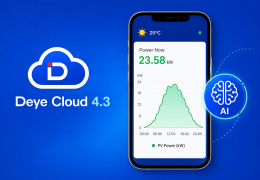
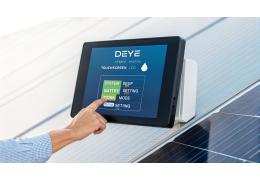
Discover how to configure Deye Copilot step by step to maximise your energy savings. Comprehensive guide with...
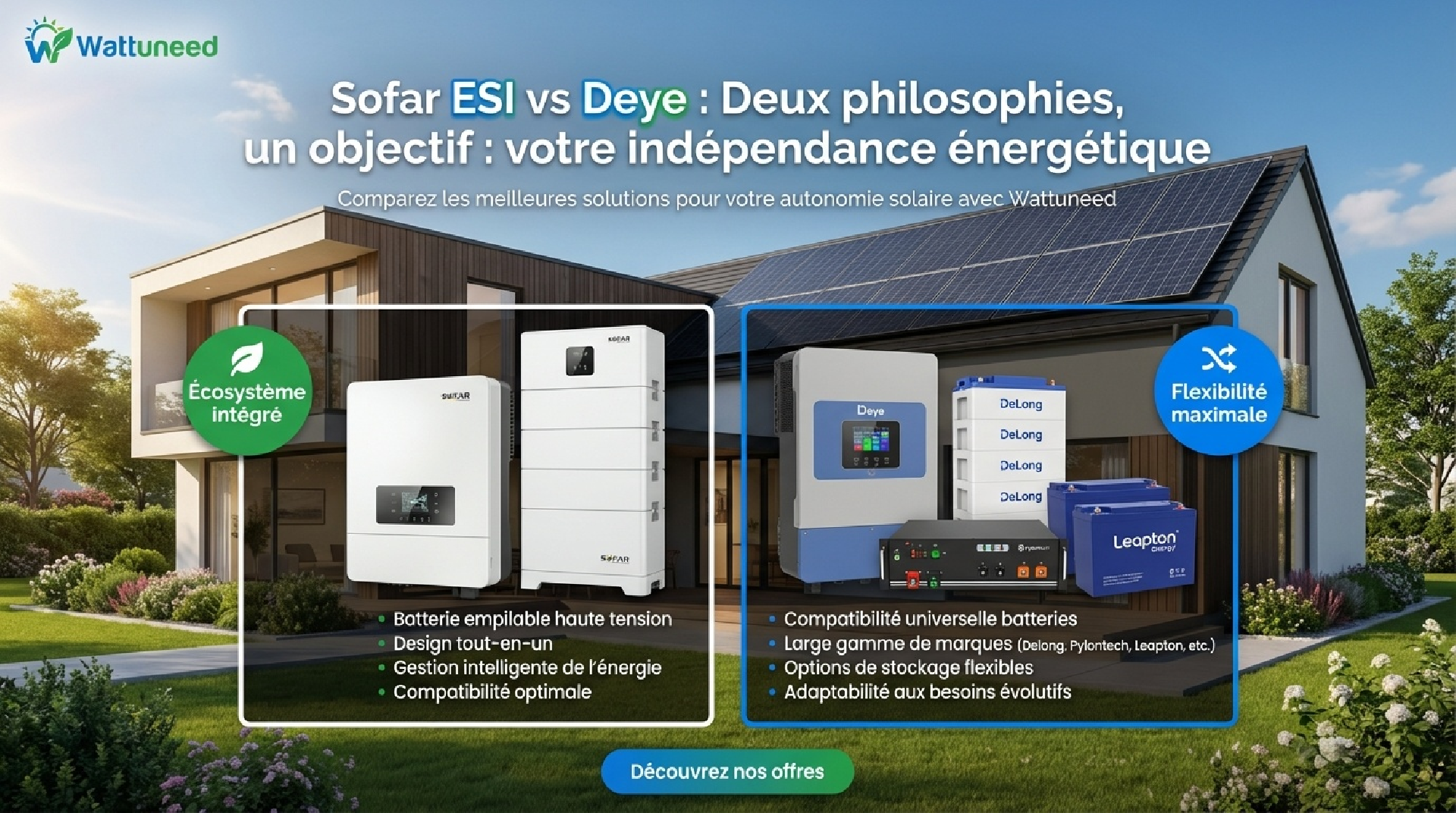
Installing solar panels with storage batteries has become the norm for avoiding electricity price increases and achieving energy independence. But when it comes to choosing the core of your installation, two major philosophies clash on the market: the closed and reassuring ecosystem versus the open and ultra-customisable system.
On the one hand, we offer the "All-in-One" solution with Sofar ESI hybrid inverters and their ESI (BTS) batteries. On the other hand, there are Deye inverters, true Swiss Army knives of energy, combined with reputable third-party batteries such as Delong, Pylontech or Leapton.
"The choice between Sofar ESI and Deye is not just a question of price: it is a strategic decision between the simplicity of an integrated ecosystem and the freedom of a modular architecture."
Free calculators and sizing tools for your installation
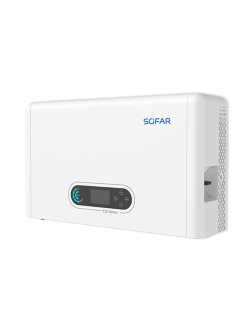
The Sofar ESI range (which combines the hybrid inverter with BTS stackable battery modules) is the very definition of an integrated system. It is the perfect solution for those who want a highly aesthetic and hassle-free system.
This is the major strength of this solution. The inverter and battery are designed by the same brand. In the event of a communication problem or a need for technical assistance, there is no buck-passing between the inverter manufacturer and the battery manufacturer. Everything is managed centrally by Sofar and our after-sales service.
This approach completely eliminates BMS (Battery Management System) compatibility issues and guarantees perfect integration from the very first start-up. Firmware updates are synchronised between the inverter and batteries, ensuring total system consistency.
The system is designed to blend harmoniously into the home. BTS 5K batteries stack easily like a tower with their management unit (BDU) at the top. There is no complex visible cabling; installation is plug and play and visually impeccable.
Each BTS 5K module (5.12 kWh) connects with a simple plug-in connection, with no visible external wiring. The system accepts up to 6 modules stacked vertically, offering a maximum capacity of 30.72 kWh with a minimal footprint.
💡 Recommended configuration: Sofar ESI 5 kVA inverter
Ideal for residential installations from 3 to 6 kWp with scalable storage
The inverter manages flows completely autonomously thanks to pre-programmed modes. The application is intuitive, it's "Set and Forget". The main modes available include:
✅ Step-by-step configuration • ✅ Advanced optimisation • ✅ Real-life use cases
A position justified by the absolute peace of mind offered by a proprietary system with a unified warranty.
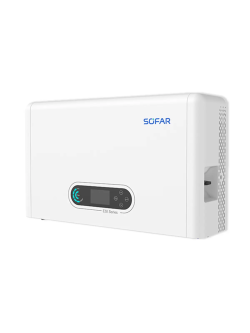
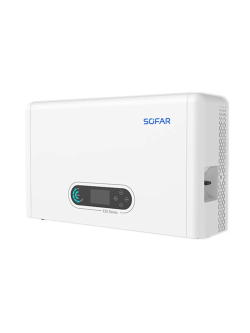
ESI 3 kVA UPS + BTS 5K battery: complete solution
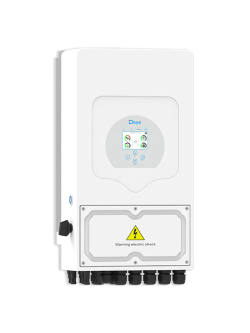
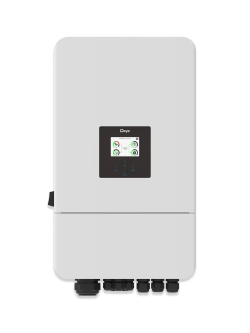
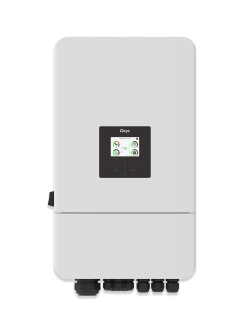
If Sofar is the equivalent of the "Apple ecosystem" of solar energy, Deye is the powerful, custom-built PC. Deye hybrid inverters (48V low voltage) are the most open, intelligent and comprehensive on the Belgian and French photovoltaic market.
With Deye, you are not locked into one brand. The inverter is compatible with almost all 48V batteries on the market thanks to its universal communication protocol (CAN 2.0, RS485). You can:
"The multi-brand compatibility of Deye inverters offers a major economic advantage: you can choose the best offer available without compromising on technical performance."
Delong Top Energy 5.12 kWh: unbeatable value for money
This is the revolutionary argument of the moment! Deye integrates the first AI-driven EMS (Energy Management System). The system analyses:
The result: the system decides on its own to charge the battery at night when electricity is free (two-tier pricing), to discharge during peak hours and slash your bill. AI can generate additional savings of 15 to 30% compared to a conventional self-consumption mode.
🤖 Discover Deye Copilot: Complete configuration and optimisation guide
Dynamic pricing, weather forecasts, intelligent autopilot
The Deye inverter has a multi-talented "GEN" port, which sets it apart from the competition:
This versatility makes the Deye inverter a true "energy control tower" capable of simultaneously managing solar production, battery storage, domestic consumption, grid injection and controllable loads.
✅ Battery BMS settings • ✅ Zero Export mode • ✅ AC Coupling • ✅ Smart Load
Being able to choose your battery brand offers an undeniable financial advantage. Here are the most popular configurations:
An extremely competitive entry cost for a true energy control tower with integrated AI.
Deye 5 kW inverter + Delong 5.12 kWh battery
To help you make the best decision, here is a detailed comparison of the two solutions based on eight essential criteria:
"In both cases, you are investing in state-of-the-art equipment certified for the Belgian and French markets. The difference comes down to your priorities: peace of mind vs. maximum flexibility."
One of the great advantages of Deye's architecture is the freedom to choose your batteries. Here is a comparison of the three most popular brands at Wattuneed:
💡 Our recommendation: Delong Top Energy 5.12 kWh battery
Best value for money on the market with BYD Grade A cells and 6,000 cycles guaranteed
Context: Annual consumption of 4,500 kWh, planned 6 kWp installation, looking for simplicity.
Recommended solution: Sofar ESI 5 kVA + 2x BTS 5K (10.24 kWh)
Why? The family prioritises peace of mind and aesthetics. The stackable design of the BTS batteries fits perfectly in the garage. The 5 pre-programmed modes allow for automatic management without intervention.
Total budget: ~ €3,900 (inverter + 2 batteries)
Context: Annual consumption of 7,000 kWh, off-peak/peak rates, existing 9 kWp installation with micro-inverters.
Recommended solution: Deye 6 kW + Delong Top Energy 15.36 kWh + Deye Copilot
Why? Deye Copilot AI automatically charges the batteries during off-peak hours and discharges them during peak hours. The GEN port in AC Coupling mode recovers the output from the existing micro-inverters. Estimated annual savings: 40-50% on the electricity bill.
Total budget: ~ £3,600 (inverter + XL battery + Copilot subscription)
Context: Diverse customer portfolio, need to offer solutions tailored to every budget.
Recommended solution: Complete Deye range
Why? Multi-brand compatibility allows adaptation to each customer's budget. The 12 advanced functions cover all use cases (AC Coupling, Smart Load, backup generator). Comprehensive technical training available on Wattuneed support.
✅ Brand comparison • ✅ Sizing • ✅ Connection diagrams • ✅ Purchasing advice
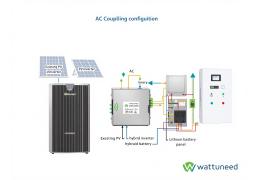
Do you already have solar panels with a string inverter or micro-inverters? Deye and Sofar ESI hybrid inverters both supportAC Coupling, a technology that allows you to add batteries to an existing installation without replacing everything.
AC Coupling connects your hybrid inverter in parallel to your domestic AC grid. Your existing installation continues to operate normally, while the hybrid inverter:
Deye advantage: The dedicated GEN port greatly simplifies AC coupling connection and offers maximum compatibility with Enphase, APsystems, Hoymiles and other micro-inverters.
📖 Complete AC Coupling Guide: 6 proven configurations for Deye, Sofar and Fronius
Wiring diagrams, inverter settings, BMS configuration
Estimated installation time: 3-4 hours for a qualified installer.
Estimated installation time: 4-5 hours for a qualified installer (BMS configuration included).
⚠️ Important: The installation of a hybrid inverter with batteries must be carried out by a qualified electrician in accordance with Belgian (RGIE) or French (NF C 15-100) standards. Wattuneed offers a network of certified partner installers.
Whatever your choice, Wattuneed supports you with:
Sofar ESI: Yes, you can start with 1 BTS 5K module and add up to 5 additional modules (total 30.72 kWh). The addition is done by simple stacking without complex reconfiguration.
Deye: Yes, and with even greater flexibility. You can start with a Delong 5.12 kWh battery and add other modules (up to 16 batteries in parallel depending on the model). You can even mix brands (e.g. Delong + Pylontech) if they use the same communication protocol.
The LiFePO4 (Lithium Iron Phosphate) batteries used in both solutions are guaranteed for 6,000 cycles at 90% depth of discharge (DOD). In real use with daily discharge:
After 6,000 cycles, the residual capacity is generally 80%; the battery continues to function but with reduced capacity.
Yes, especially if you have:
Annual savings observed with Deye Copilot: 15-30% more than with a conventional self-consumption mode.
Not recommended. Although technically feasible for an experienced DIY enthusiast, installing a hybrid inverter with batteries requires:
Furthermore, non-compliant installation may void manufacturer warranties and create safety risks.
Yes, both solutions offer a backup function:
Sofar ESI: Backup mode with automatic transfer in < 10 ms. Loads connected to the backup output continue to be powered.
Deye: UPS (Uninterruptible Power Supply) mode with transfer in < 4 ms. Priority outputs can be configured (refrigerator, internet box, etc.).
Important: To benefit from the backup, you must:
Rule of thumb: Battery capacity = Night-time consumption × 1.2
Concrete examples:
The coefficient 1.2 compensates for conversion losses (inverter efficiency ~95-97%).
Precisely size your installation with our free tools
Sofar ESI: No, ESI inverters are designed for grid-tied mode with backup. They cannot operate autonomously without a connection to the electricity grid.
Deye: Yes, Deye inverters support full off-grid mode. By connecting a generator to the GEN port, you create a fully autonomous system that is ideal for:
The generator starts automatically when the batteries reach a critical threshold (e.g. 20% SOC).
The choice between Sofar ESI and Deye is not a question of "better" or "worse", but of installation philosophy:
Both solutions will allow you to:
"Solar energy with storage is no longer a luxury, it is a profitable investment over 10-15 years with a guaranteed positive ROI. In 2025, not installing it will be like leaving money on the table."
Find these two comprehensive solutions on Wattuneed.com with our expert support!
Note: The prices shown are indicative and based on the current Wattuneed catalogue. They may vary slightly depending on current promotions. Please visit our website for up-to-date prices.
Wattuneed SPRLRue Henripré 12, 4821 Andrimont, BelgiumTel: +32 87 45 00 34 – info@wattuneed.comwww.wattuneed.com | Technical support
check_circle
This store asks you to accept cookies for performance, social media and advertising purposes. Social media and advertising cookies of third parties are used to offer you social media functionalities and personalized ads. Do you accept these cookies and the processing of personal data involved?