Since 2008
Based in Belgium and France
+ 60 000 clients
Our blog
A.S.S.
Shopping Cart
Découvrez comment installer, configurer et utiliser WatchPower pour surveiller votre onduleur solaire en temps réel....
Practical guide to reconnect your SMA Sunny Boy inverter to the WiFi network after a change of modem, router or...
Find out how Aiko is revolutionising photovoltaics with its silver-free ABC cells, laser engraving and 0BB...
Ajouter des batteries LiFePO4 neuves à un parc existant exige un équilibrage préalable rigoureux. Découvrez pourquoi...
Find out how the Walloon incentive tariff 2026 and dynamic contracts radically transform the electricity bill of...
At a time when energy prices are rising steadily and the energy transition is gathering pace, many private individuals and professionals are turning to photovoltaics to reduce their electricity bills while adopting a more environmentally-friendly approach. But with so many solutions available, one question often comes up: should you opt for a standard self-consumption inverter, or invest in a hybrid inverter with batteries?
This article guides you through the advantages and disadvantages of each technology, taking into account the specificities of the French and Belgian markets, as well as the different user profiles.
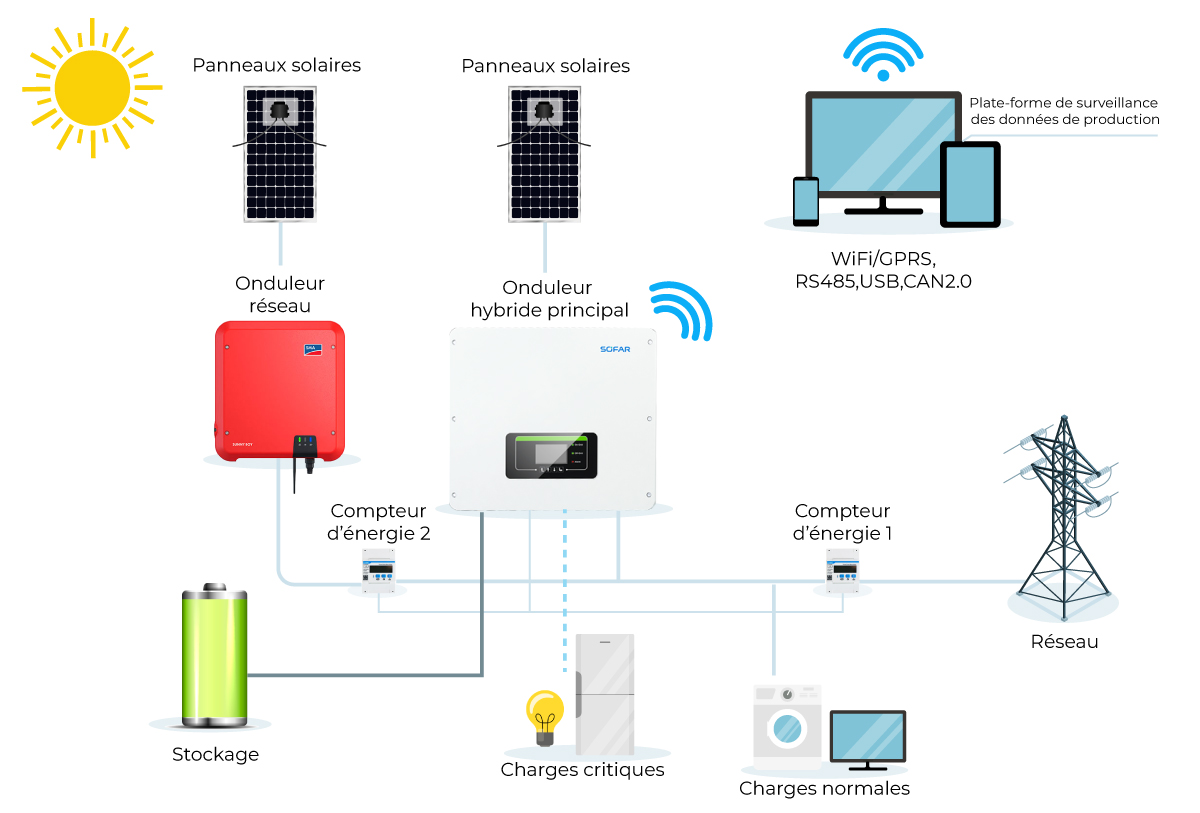
The standard self-consumption inverter (also known as the on-grid inverter) is the most common solution for grid-connected photovoltaic installations. Its main role is to convert the direct current produced by your solar panels into alternating current compatible with your electrical installation and the grid.
Operating principle :
Advantages :
Limitations :
Leading brands: Sofar Solar, SolaX, SMA, Fronius, SolarEdge, Deye, Solenso, Enphase, Huawei and Multisolar are among the best-known manufacturers of grid-connected inverters.
Discover our complete range of grid inverters on wattuneed.com and find the model to suit your needs!
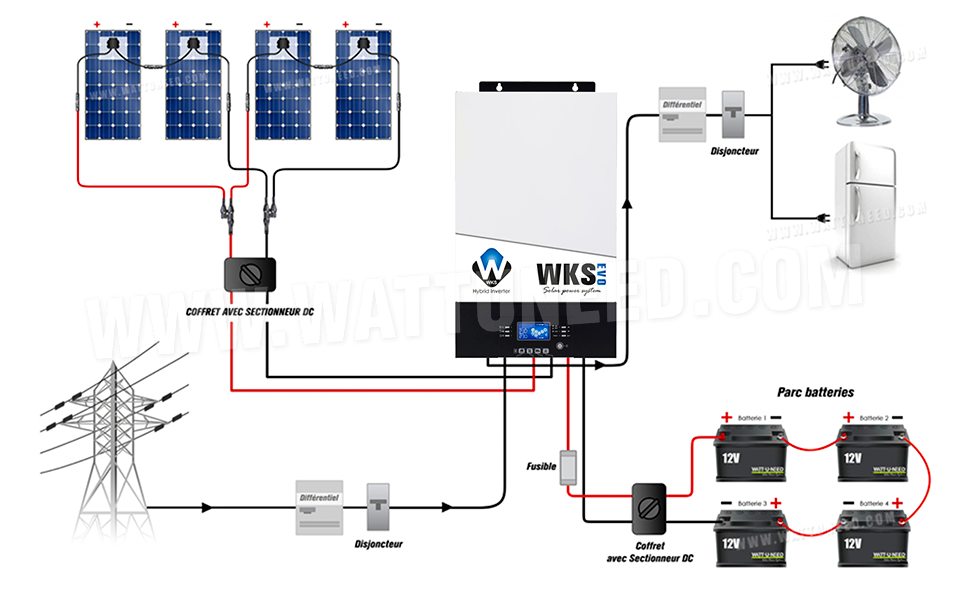
The hybrid UPS combines the functionality of a standard UPS with the ability to manage a battery storage system. This more advanced solution offers greater flexibility in energy management.
Benefits :
Leading brands: Sofar Solar, Deye, Multisolar, Huawei, SolaX, WKS and Sermatec are among the manufacturers offering high-performance hybrid inverter solutions.
Explore our selection of high-performance hybrid inverters on wattuneed.com for optimized energy management!
For households whose electricity consumption is mainly concentrated in the evening and at night (when occupants return from work), a hybrid inverter with batteries offers significant advantages:
Concrete example: The Martin familyThe Martin family lives in a detached house near Paris. The two adults work outside and the children are at school during the day. Their electricity consumption is therefore minimal precisely during the hours of maximum solar production.
With a standard inverter, this family consumes only 30-40% of its direct solar production. With a hybrid inverter and batteries (for example, a 6 kWp installation with a Sofar Solar or Deye hybrid inverter and 10 kWh storage capacity), their self-consumption rate can exceed 80%, maximizing the profitability of their installation in the face of the new extremely low feed-in tariffs.
Conversely, shops, offices and industries that consume mainly during the day can opt for a standard self-consumption inverter:
For these structures, the natural rate of self-consumption is already high, since their activity coincides with the hours of sunshine, making storage less necessary in the first instance.
Special case of businesses closed at weekends: For businesses that are closed at weekends, or have a large roof area that allows for significant production, the hybrid inverter becomes relevant to avoid selling the surplus at unattractive tariffs, particularly in France with the new feed-in tariff at just 4 c€/kWh.
A recent phenomenon that has upset the energy equation, particularly visible in Belgium but also present in France, is the increased fluctuation of electricity prices on the grid, sometimes reaching negative values.
In Belgium, negative prices have become a frequent and amplified phenomenon: in 2024, prices were negative for 408 hours, almost double the previous year (252 hours in 2023). These negative prices, sometimes reaching -462 euros per megawatt-hour, occur mainly during hours of high solar production (10am-5pm).
In France, the situation is also evolving. Since March 2025, the feed-in tariff for surplus photovoltaic electricity has fallen considerably, from 12.69 euro cents per kWh to just 4 cents for installations below 9 kWp. This tripling of the feed-in tariff considerably alters the economic equation for solar installations.
For larger installations (9-36 kWp), the feed-in tariff remains more attractive (7.61 c€/kWh), but is still lower than in previous years.
This new reality in the electricity market makes thehybrid inverter more attractive, even for certain commercial or industrial applications:
With feed-in tariffs as low as 4 c€/kWh in France, direct or deferred self-consumption (via storage) is clearly the preferred strategy for maximizing the profitability of your photovoltaic installation.
Need personalized advice on choosing between hybrid and standard inverters? Contact our experts at wattuneed.com or call us on +32 87 45 00 34 for a study tailored to your consumption profile!
C&I (Commercial & Industrial) storage refers to high-capacity battery systems specifically designed for commercial and industrial applications. These systems can reach several megawatt-hours in capacity, and offer advanced functionalities tailored to the needs of large-scale energy consumers.
For industrial sites, the integration of a hybrid UPS coupled with C&I batteries offers considerable strategic advantages:
Smoothing of
Securing
Example: C&I installation for a production companyAn industrial production company in Belgium has a 2,000 m² roof equipped with solar panels. Its consumption is relatively constant on working days, but zero at weekends. The company faces variable electricity costs and costly consumption peaks.
For this company, a complete C&I system with high-power hybrid inverters and high-capacity batteries (100-500 kWh) represents the optimum solution. A 300 kWp installation with three-phase hybrid inverters and a 300 kWh modular storage system would reduce energy bills by up to 30-40%, with a payback period of 5 to 8 years depending on consumption patterns and grid services used.
Do you run a business or industry? Discover our professional energy storage solutions on wattuneed.com or call our experts on +32 87 45 00 34 to optimize your energy costs!
47
With the feed-in tariff for surplus electricity having fallen to 4 cents/kWh in France, a hybrid inverter becomes more attractive if your consumption is mainly in the evening. Storing the energy produced during the day for consumption in the evening will generally be more advantageous than selling it back at such a low price.
With a 6 kWp residential installation equipped with a hybrid inverter and batteries, you can achieve a self-consumption rate of over 80%, compared with only 30-40% with a standard inverter without storage. Even with a higher initial investment cost, the payback over 20 years (the typical lifespan of an installation) is becoming increasingly obvious.
In Belgium, where electricity prices are extremely volatile, sometimes reaching negative values in the middle of the day (408 hours in 2024), a hybrid system makes it possible to store the energy produced during these low-value periods for later use, or to avoid having to "pay" to inject its surplus into the grid.
Grid costs in Belgium are also rising significantly (+10% between 2024 and 2025 for electricity), reinforcing the case for storage to reduce dependence on the grid.
For an industry with sensitive processes and high consumption, a hybrid system with C&I batteries can offer triple value: economic optimization, remunerated grid services, and security of supply.
In particular, C&I systems enable peak shaving, participation in grid services (frequency regulation), large-scale tariff arbitration, and storage of surplus production during periods of low or negative market prices.
Ready to take the plunge? Take a look at our solar configurator or contact us on +32 87 45 00 34 to find the right system for your needs!
The choice between a hybrid inverter and a standard self-consumption inverter is more than just a technical issue. It's part of a global reflection on our relationship with energy and our adaptation to changes in the power grid.
For individuals whose consumption is mainly during the evening and night, the hybrid inverter with batteries offers a relevant solution for maximizing self-consumption and gaining energy independence, particularly in a context of falling feed-in tariffs, as in France (from 12.69 c€/kWh to 4 c€/kWh).
For businesses and small industries whose activities coincide with sunshine hours, the standard inverter often remains the most economically viable solution in the short term, but the evolution of energy markets in Belgium (408 hours of negative prices in 2024) and gradually in France could change this equation.
As for large industrial consumers, C&I storage systems combined with sophisticated hybrid inverters enable them not only to optimize their energy costs, but also to transform their power consumption into a strategic asset, via frequency regulation and other network services.
In all cases, a precise analysis of your needs and a long-term projection are essential to make the most appropriate choice for your specific situation.
Do you still have questions about choosing your inverter? Don't hesitate to contact our experts at Wattuneed on +32 87 45 00 34 or by email at info@wattuneed.com, who will guide you towards the optimum solution for your photovoltaic installation!
Wattuneed
Rue Henripré 124821 AndrimontBelgium+32 87 45 00 34info@wattuneed.com
Q: Can I switch from a standard inverter to a hybrid inverter at a later date?
A: Switching from a standard inverter to a hybrid system generally requires replacing the inverter. It's best to opt for a battery-ready inverter from the outset, if you plan to add batteries at a later date.
Q: How long do the batteries associated with hybrid UPS systems last?
A: Modern (lithium) batteries generally last between 8 and 10 years, or between 3,000 and 6,000 charge/discharge cycles, depending on the technology and operating conditions.
Q: Does a hybrid inverter work in the event of a grid failure?
A: Some models of hybrid inverters can operate in standby mode during grid outages, but not all. Check this feature before you buy, if it's important to you.
Q : How much more does a hybrid inverter cost than a standard inverter?
A: The extra cost depends on the model, but you should expect to pay around 30% to 50% more for the hybrid inverter alone (i.e. €1,500 versus €800 for the entry-level model), and much more if you include the cost of the batteries (€5,000 to €15,000 depending on storage capacity for a typical residential installation).
Q : Are hybrid inverters compatible with all battery types?
A : No, each hybrid inverter is generally designed to work with specific battery types. Check compatibility before making your choice.
check_circle
This store asks you to accept cookies for performance, social media and advertising purposes. Social media and advertising cookies of third parties are used to offer you social media functionalities and personalized ads. Do you accept these cookies and the processing of personal data involved?