Since 2008
Based in Belgium and France
+ 60 000 clients
Our blog
A.S.S.
Shopping Cart
Find out more about energy sharing and renewable energy communities in Belgium: the 2025 legal framework, economic...
Découvrez comment équiper votre tiny house en totale autonomie avec le kit photovoltaïque Victron : modulaire,...
Découvrez comment le peak shaving avec onduleur hybride et batteries lithium évite les coupures de compteur en...
Transformez votre balcon en mini-centrale solaire avec les kits plug and play Wattuneed. Installation simple, budget...
Votre batterie Delong avec BMS PACE affiche un SOC mais 0V en sortie ? Découvrez les causes de mise en sécurité,...
The year 2025 marks a historic turning point for photovoltaic self-consumption in Europe. In Belgium, since April 17, 2025, plug-and-play solar kits up to 800 VA have been officially legalized, paving the way for thousands of individuals wishing to produce their own electricity without complex installations. In France, the ENEDIS framework, with the Convention for Self-Consumption Without Injection (CACSI), structures access to these innovative solutions.
These mini home solar power plants plug directly into a standard electrical outlet and allow you to immediately reduce your electricity bill. But how do you choose the right kit? What are the exact regulations? Can you add a plug-and-play kit to an existing photovoltaic installation? This article provides all the technical and practical answers you need to successfully complete your project by 2025.
"Plug & play kits represent the democratization of solar energy: accessible, safe and profitable in less than 3 years."
Since April 17, 2025 , Belgium has allowed the installation of plug & play solar kits under certain conditions. This framework was formalized in Wallonia through the adaptation of Synergrid's C10/11 standard , validated by the CWaPE (Walloon Energy Commission), but the Synergrid approval process applies at the Belgian level.
Crucial point: Unlike conventional photovoltaic installations, plug & play kits <800 VA are not subject to the prosumer tariff in Wallonia (at the date of writing this article, subject to regulatory changes), which significantly improves their profitability.
💡 Recommended product: Wattuneed certified Plug & Play kits
Compliant with Belgian legislation 2025, with certified micro-inverter and manufacturer's warranty
In France, the ENEDIS regulatory framework distinguishes several types of installations. As soon as a solar kit is connected to the public grid, even via a simple domestic socket, a declaration is generally required.
Self-Consumption Agreement Without Injection (CACSI):
⚠️ Important note: In practice, some households plug small kits into outlets without formally notifying ENEDIS. However, this is not in accordance with the official regulations. To remain compliant and avoid any issues with your home insurance or the network operator, it is best to declare the installation via a CACSI, regardless of the power rating.
Installations up to 3 kVA: Above 800 VA, CACSI becomes mandatory and generally requires installation by a qualified professional with Consuel certification.
A plug & play solar kit consists of:
900Wp Plug & Play Kit with Astro-E 800W Micro-Inverter
A common source of confusion concerns the difference between:
The principle of peak shaving: Installing two 450 Wp panels (900 Wp total) on an 800 VA micro-inverter is perfectly normal and recommended . The micro-inverter will simply limit the output power to 800 W during peak production periods (generally a few hours per day in summer). This practice maximizes annual production by compensating for losses related to tilt, orientation, shading, and high temperatures.
⚠️ Always check the datasheet: Microinverter manufacturers often indicate a recommended DC oversizing (e.g., 120% or 135% of the nominal power). Always consult this value in the technical specifications before choosing your panels.
"Oversizing the peak power of the panels by 20 to 40% compared to the micro-inverter optimizes annual yield without technical risk."
All certified microinverters incorporate an anti-islanding function compliant with EN 62109 and VDE 0126 standards. This protection automatically detects a power outage (mains failure, tripped circuit breaker) and immediately stops the microinverter's power production in less than 0.2 seconds. This ensures:
The 800 VA plug & play kits available on 🔗 See the kits all include this standard protection.
A recurring question: can I add a plug & play kit to my existing solar installation? The answer depends on your current setup.
Status: ✅ COMPATIBLE WITHOUT RESTRICTIONS
This is the ideal situation for getting started with a plug-and-play kit. You simply plug the kit into a dedicated outlet on your electrical panel (or a reinforced wall outlet) and immediately benefit from self-consumption. Any surplus energy not consumed is fed into the grid (permitted without compensation in Belgium, but not recommended in France due to CACSI regulations).
PLAN : PV panels → 800VA micro-inverter → 230V outlet → Electrical panel → Home network ↓ Linky/digital meter
Status: ✅ COMPATIBLE WITH PRECAUTIONS
You can add a plug & play kit in parallel with your existing string inverter installation (SMA, Fronius, Huawei, SolarEdge...). The two systems operate independently :
⚠️ Important note: Check the total installed power to remain compliant with the limitations of your connection contract (generally 10 kVA max in Belgium for installations <10 kWp).
PLAN : Existing installation: Panels → String inverter → AC board → Meter Plug & play kit: Panels → 800VA micro-inverter → Socket → Electrical panel ↓ Priority consumption
💡 Related article: Adding a Plug & Play kit to an existing installation
Detailed guide with connection diagrams and technical advice
Status: ⚠️ COMPATIBLE WITH LIMITATIONS
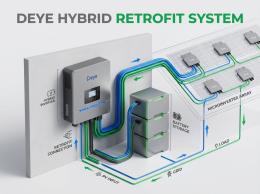
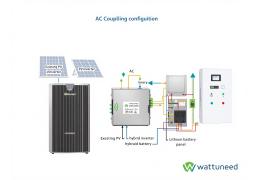
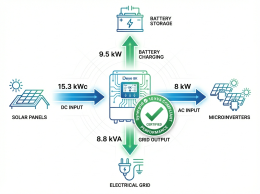
If you already have a system with a hybrid inverter (Growatt, Victron, Deye, Solis Hybrid...) and storage battery, adding a plug & play kit is technically possible but not optimal :
Wattuneed Recommendation: In this configuration, prioritize expanding your existing installation with additional panels connected to the hybrid inverter via dedicated optimizers or MPPT controllers. Contact our technical support for a customized sizing solution.
If your existing installation already uses microinverters (Enphase, APSystems, Astro-E, etc.), adding an 800 VA plug & play kit is perfectly compatible . Microinverters operate in a decentralized manner and automatically adapt to the grid load.
Tip: Simply respect the maximum connection power allowed by your DSO (generally 10 kVA in Belgium for a single-phase meter).
Status: ❌ NOT RECOMMENDED
If your current photovoltaic system already produces more than you consume (continuous injection into the grid), adding a plug & play kit will not provide any financial benefit . You will simply increase the amount of electricity you are feeding into the grid without compensation.
Alternative solution: First optimize your self-consumption by shifting your usage (programming washing machine, dishwasher, water heater) or invest in a storage battery to make use of your surplus.
Status: ⚡ COMPATIBLE BUT TRANSITION IN PROGRESS
The electromechanical (rotating disc) meters still used in Belgium allow for the "counter running backwards" during injection. However, this compensation is being progressively phased out.
Recommendation: Anticipate the switch to digital meters by sizing your plug & play kit to maximize instantaneous self-consumption rather than injection.
To ensure the compatibility and safety of your plug & play kit, follow these calculations:
1. Maximum open-circuit voltage (Voc):
The open circuit voltage (Voc) of the panels must not exceed the input limit of the micro-inverter, especially in negative temperatures.
⚠️ WARNING: 800 VA microinverters for plug & play kits generally accept two MPPT inputs in parallel , not in series. Each panel connects to an independent MPPT input. Always check the microinverter's datasheet for the maximum input voltage per MPPT and the permissible short-circuit current (Isc).
✅ 2 independent MPPT inputs • ✅ Built-in WiFi real-time monitoring • ✅ 96% efficiency • ✅ Manufacturer's warranty
2. Recommended oversizing:
The annual yield of your plug & play kit varies greatly depending on the orientation and tilt:
Wattuneed tip: For plug & play kits intended for self-consumption, favour East-West orientations which smooth production throughout the day and coincide better with your domestic consumption (breakfast, return from work).
Wattuneed offers several mounting solutions suitable for all locations:
To assess the profitability of an 800 VA plug & play kit, we use the following assumptions:
Example Belgium (Brussels):
Example France (Paris):
"With an average ROI of 3 to 4 years and a lifespan of 25 years, plug & play kits offer a higher financial return than most bank investments."
To maximize your savings, program your energy-intensive appliances during solar production hours (10am-4pm):
Incompressible consumption covered automatically: refrigerator, freezer, ventilation system, internet box, standby power, reduced natural lighting.
Even for a plug & play kit, compliance with electrical safety standards is imperative :
⚠️ Major risk: Plugging a plug & play kit into a standard household power strip is dangerous . The power strip is not designed for a continuous power flow of 800W for 8-10 hours/day; there is a risk of overheating and fire.
The micro-inverter is the heart of your plug & play kit. Choose certified brands:
Selection criteria:
Step 1: Preliminary check of the electrical panel
Step 2: Assembling the balcony structure
Step 3: Installation of photovoltaic panels
Step 4: Connecting the micro-inverter
Step 5: Commissioning
Step 6: Administrative Declaration
To confirm that your kit produces correctly:
2 x 450Wp solar panels + Astro-E 800W WiFi micro-inverter + balcony mounting kit + complete cabling
💡 Minimum configuration: 450 Wc Plug & Play Kit
Ideal for a narrow balcony or first self-consumption test (1 panel + 400W micro-inverter)
Additional accessories:
To support you in your project, Wattuneed provides you with a complete toolkit:
Answer: Yes, since April 17, 2025, certified plug & play kits can be installed by individuals without the need for a licensed electrician, provided that safety instructions are followed (Type A residual current device, dedicated 16A socket, 2.5 mm² cable cross-section). Notification to the grid operator remains mandatory within 30 days of commissioning.
Answer: The 800 VA (Volt-Ampere) refers to the maximum output power of the microinverter to the 230V household grid. The 800 Wp (Watt-peak) represents the nominal power of the photovoltaic panels under standard conditions. It is recommended to install between 800 and 1000 Wp of panels on an 800 VA microinverter to compensate for losses and maximize annual production.
Answer: No. All certified microinverters include islanding protection that automatically shuts down power production in the event of a grid outage (in less than 0.2 seconds). This safety feature is mandatory to protect technicians working on the grid. To have power during an outage, you need to invest in a system with a battery and a hybrid inverter in "off-grid" or "backup" mode.
Answer: No, absolutely not. Household power strips are not designed to handle a continuous current of 800W for 8-10 hours a day. This presents a major risk of overheating and fire. You must use a dedicated wall outlet protected by a 16A circuit breaker and a 30mA Type A residual current device (RCD).
Answer: The surplus is fed into the electricity grid . In Belgium, this injection is tolerated but not remunerated (except under a specific contract with a supplier). In France, with CACSI, injection is not theoretically permitted (self-consumption without injection); to sell the surplus, a different type of contract is required (OA Solaire, CRAE). To avoid injection, size your kit according to your base consumption (devices on standby, refrigerator, ventilation system) or add a storage battery.
Answer: It depends on your policy. Contact your insurer to declare the installation and check your coverage. Most Belgian and French insurers cover plug & play kits under 800 VA without an additional premium, provided they are certified (CE, Synergrid, NF) and correctly installed. Keep the invoices and certificates of conformity.
Answer: Yes, according to ENEDIS, as soon as a production system is connected to the public grid (even a plug-in kit), a declaration via CACSI (Self-Consumption Agreement Without Injection) is recommended to remain compliant with the official regulations. This also ensures your installation meets the requirements of your home insurance policy.
Answer: Yes, it's even recommended. Oversizing by 20 to 40% (for example, 900-1000 Wp of panels on an 800 VA microinverter) helps compensate for losses and optimize annual production. Always check the microinverter's datasheet to find the maximum DC oversizing ratio recommended by the manufacturer (usually 120-135%).
Plug & play 800 VA solar kits represent an accessible revolution in photovoltaic self-consumption. With Belgian legislation in April 2025 and the French ENEDIS framework via CACSI, thousands of individuals can now produce their own electricity without heavy investment or complex installation.
The advantages are numerous:
To ensure the success of your project, remember these key points:
"Plug & play solar energy is no longer reserved for experts: by 2025, everyone can become a producer of green electricity from their balcony."
Wattuneed supports you through every step of your project: from choosing the right kit for your needs to production monitoring and personalized technical support. Discover our complete range of 2025-certified plug & play kits and join the community of solar self-consumers!
Wattuneed SPRLBelgian specialist in photovoltaic and renewable energy solutions📧 Technical Support | 🛠️ Toolbox | 📚 Photovoltaic BlogYour trusted partner for solar self-consumption since 2015
check_circle
This store asks you to accept cookies for performance, social media and advertising purposes. Social media and advertising cookies of third parties are used to offer you social media functionalities and personalized ads. Do you accept these cookies and the processing of personal data involved?