Since 2008
Based in Belgium and France
+ 60 000 clients
Our blog
A.S.S.
Shopping Cart
Complete PPE2 2026 guide for photovoltaic installations > 100 kWp: eligibility criteria, ECS carbon footprint,...
Detailed comparison between the integrated Sofar ESI ecosystem (inverter + BTS battery) and the maximum flexibility...
Découvrez le système triphasé 15 kVA Wattuneed : 29 panneaux AIKO ABC 460W, 3 onduleurs Victron MultiPlus-II, 30 kWh...
The solar battery industry is undergoing a major technological revolution: active thermal management, sodium-ion,...
Are you considering equipping your motorhome, boat, tiny house or home with a photovoltaic system? The first question...
The year 2026 marks a major structural transition for the French photovoltaic market. The definitive shift from the historic open tariff window mechanism (S21) to the new tender systems (AOS and PPE2) completely redefines the financial and technical engineering of commercial, industrial and agricultural solar projects.
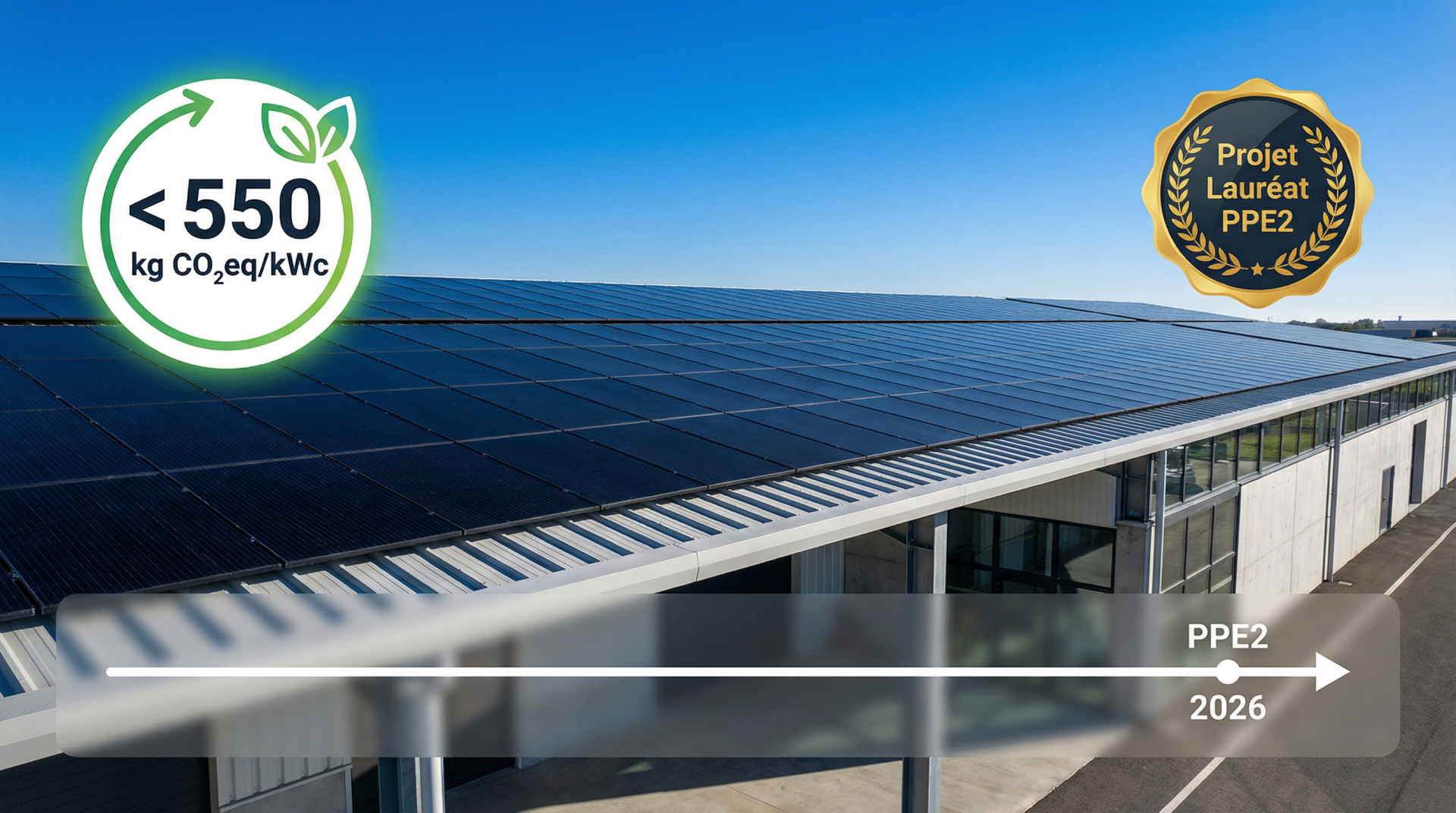
For project developers, design offices and professional installers, understanding the PPE2 eligibility criteria is becoming a strategic imperative. At the heart of this transformation is the Simplified Carbon Assessment (ECS), which now determines the economic viability of any project exceeding 100 kWp.
Wattuneed offers ECS-certified panels and expert technical support
For photovoltaic installations for self-consumption with surplus sales or total sales of less than 100 kWp, the S21 mechanism (tariff decree of 6 October 2021) remains applicable. This mechanism offers several advantages:
However, S21 tariffs have gradually decreased by 18-22% between 2021 and 2026, making profitability more difficult for medium-sized projects (70-100 kWp) without rigorous optimisation.
📊 Recommended tool: Wattuneed sizing calculator
Simulate the profitability of your project according to the applicable tariff mechanism
For any installation greater than or equal to 100 kWp (large commercial roofs, car park shade structures, agricultural roofs), participation in PPE2 tenders becomes mandatory in order to benefit from public support. This system requires:
"In 2026, 87% of projects rejected in PPE2 tenders are rejected due to non-compliance of the panels' carbon footprint. A high-performance panel without an ECS certificate disqualifies the entire application, regardless of the technical quality of the rest of the project." — Source: CRE 2025 Report on PV Tenders
Simplified Carbon Assessment (ECS) is a standardised method developed by ADEME and imposed by the Energy Regulatory Commission (CRE) to quantify the carbon footprint of photovoltaic panels throughout their life cycle:
This approach is in line with the objectives of France's National Low-Carbon Strategy (SNBC), which aims to reduce emissions from the energy sector by 40% by 2030. The threshold of 550 kg CO₂eq/kWp imposed by PPE2 reflects this ambition.
Please note: Some Asian manufacturers mention "carbon footprints" in their technical data sheets without third-party certification. These statements are not acceptable under PPE2. Only ECS certificates issued by Certisolis or PEP equivalents are accepted by the CRE.
✅ IEC 61215 certification (product quality) ≠ ECS certification (carbon footprint)❌ A panel certified by TÜV for its performance is NOT automatically eligible for PPE2
The AIKO Neostar range represents the state of the art in energy and environmental performance. These panels use revolutionary 0BB (Zero BusBar) technology with ABC (All Back Contact) cells and copper metallisation, eliminating traditional silver ribbons.
AIKO Neostar 3S+ 470Wp – 0BB technology and N-Type ABC cells
The AIKO Neostar panel also benefits from a drastic reduction in micro-cracks thanks to 0BB technology, improving long-term reliability. To learn more about this innovation, check out our dedicated article: Aiko Solar: Why 0BB technology changes everything.
For projects seeking excellent value for money while meeting PPE2 criteria, the Luxen LUXNERI range is a strategic alternative. These N-Type bifacial panels combine high efficiency with a controlled carbon footprint.
💡 Recommended product: Luxen LUXNERI N5 500Wp N-Type Bifacial
Bifacial technology for up to 25% increase in production in shaded areas
Wattuneed offers complete pallets to simplify the supply of PPE2 projects:
For a 250 kWp project, allow for 14-15 pallets, i.e. an optimised supply in 2-3 deliveries to comply with PPE2 schedules.
Putting together a complete PPE2 file requires close coordination between the project owner, design office and installer. The following documents are essential:
For a 300 kWp installation on an industrial roof, here is an indicative reverse schedule:
"The average time between the launch of a PPE2 project and its commissioning is 14 months. 60% of delays are due to incomplete applications at the time of submission, in particular the absence of an ECS certificate. Anticipate this step as early as the study phase." — Feedback from Wattuneed design offices
Unlike the S21 open window, PPE2 operates on a competitive basis. The CRE ranks applications according to two main criteria:
The winning projects are those offering the best compromise between price competitiveness and environmental impact.
The price offered must cover all project costs while remaining attractive to the CRE. Here is the typical structure for a 250 kWp installation:
With CAPEX optimised at £623/kWp via Wattuneed, a project developer can offer a PPE2 price of £85-95/MWh while maintaining an IRR of 6-8%, whereas CAPEX at £850/kWp would impose a price of £110-120/MWh (uncompetitive).
Free sizing and profitability calculator
Wattuneed offers comprehensive support to secure your PPE2 applications:
Contact our sales team for a personalised quote and access to ECS certificates
Tel: +32 87 45 00 34Email: info@wattuneed.comSupport: support.wattuneed.com
"We won three PPE2 tenders in 2025 thanks to the AIKO Neostar panels supplied by Wattuneed. The carbon footprint of 480 kg CO₂eq/kWp gave us a 5-point bonus in the CRE scoring, which was decisive in the face of competition. The technical support team was responsive and validated our sizing within 72 hours." — SOLENER design office, Toulouse (3 projects 150-300 kWp winners of PPE2 2025)
PPE2 becomes mandatory for all installations ≥ 100 kWp. Below this threshold, you can benefit from the S21 feed-in tariff (open window). Between 90 and 110 kWp, consider both options: S21 offers guaranteed but declining tariffs, while PPE2 can offer better prices if your application is competitive.
No, this is a deal-breaker. The CRE automatically rejects any application for which the panels do not have an ECS Certisolis certificate or PEP equivalent. Technical performance (efficiency, warranty) does not compensate for the lack of carbon certification. Choose panels such as AIKO Neostar or Luxen LUXNERI, which are already certified.
Allow 8 to 16 weeks depending on the organisation (Certisolis is faster than TÜV/Bureau Veritas). The cost varies from £1,500 to £3,000 depending on the number of references to be certified. Tip: Choose panels that are already certified (Wattuneed range) from the outset to avoid this delay and cost.
According to CRE data, the median price is €92/MWh for 100-500 kWp rooftop installations. Projects above €110/MWh are unlikely to be selected, unless they offer exceptional environmental benefits (carbon footprint < 350 kg CO₂eq/kWp).
Yes, but the carbon footprint will be the weighted average of all the panels installed. If you mix AIKO panels (480 kg) with others at 540 kg, make sure that the average remains below 550 kg. In practice, homogeneity simplifies management and optimises scoring.
Wattuneed provides ECS certificates for the AIKO Neostar and Luxen LUXNERI ranges, which are PPE2-eligible. For other references, please contact our technical support team (support.wattuneed.com) to check availability. Certificates are sent within 48 hours of order confirmation.
In 2026, the success of a commercial photovoltaic project in France will no longer be based solely on technical performance. The carbon footprint of solar panels has become the decisive criterion for accessing PPE2 public support mechanisms.
Project developers, design offices and installers must now integrate ECS from the design phase onwards, in the same way as electrical dimensioning or structural strength. A high-performance panel that is not ECS-certified compromises the entire project, regardless of its technical quality.
The keys to PPE2 success:
If you have any questions about the eligibility of your panels or support for your PPE2 project, the Wattuneed team is at your disposal.
📚 DISCOVER ALL OUR PHOTOVOLTAIC GUIDES
Wattuneed SPRLRue Henripré 12, 4821 Andrimont, BelgiumTel: +32 87 45 00 34 – info@wattuneed.comwww.wattuneed.com | Technical support
check_circle
This store asks you to accept cookies for performance, social media and advertising purposes. Social media and advertising cookies of third parties are used to offer you social media functionalities and personalized ads. Do you accept these cookies and the processing of personal data involved?