Since 2008
Based in Belgium and France
+ 60 000 clients
Our blog
A.S.S.
Shopping Cart
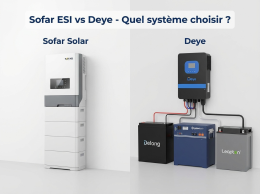
Detailed comparison between the integrated Sofar ESI ecosystem (inverter + BTS battery) and the maximum flexibility...
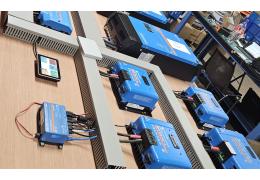
Découvrez le système triphasé 15 kVA Wattuneed : 29 panneaux AIKO ABC 460W, 3 onduleurs Victron MultiPlus-II, 30 kWh...
The solar battery industry is undergoing a major technological revolution: active thermal management, sodium-ion,...
Are you considering equipping your motorhome, boat, tiny house or home with a photovoltaic system? The first question...
Discover how to configure Deye Copilot step by step to maximise your energy savings. Comprehensive guide with...
The world of photovoltaics is undergoing a veritable technological revolution. Recent innovations now make it possible to achieve exceptional yields while reducing environmental impact and improving architectural integration. As the energy transition accelerates in Europe, it is essential to understand the new technologies available in order to make an informed choice.
"Technological advances in the field of photovoltaics now allow us to offer solutions with an efficiency of over 22%, which was unthinkable just a few years ago."
In this article, we will explore in detail the most promising innovations in the field of photovoltaic solar panels and how they can transform your approach to renewable energy.
Before exploring specific innovations, let's understand why it is crucial to stay informed about the latest advances:
In 2025, the European photovoltaic module market continues its impressive growth, valued at over €63 billion with an annual increase of 7%. This momentum can be explained by the emergence of revolutionary technologies, which we will now explore.
TOPCon (Tunnel Oxide Passivated Contact) technology represents one of the major advances in the photovoltaic industry in recent years. A direct successor to PERC technology, TOPCon offers significant improvements in terms of efficiency and durability.
TOPCon uses a thin layer of oxide and a doped polycrystalline silicon film that act as a "contact passivation". This structure allows for:
This technology achieves efficiencies of over 22% in industrial production, compared to 18-20% for traditional PERC panels.
If you are considering investing in a photovoltaic installation, TOPCon panels offer several major advantages:
Discover our Shinson N3-TOPCon 450 Wp Bifacial solar panel, a perfect example of this cutting-edge technology, combining exceptional performance with an elegant ultra-black design.
Another major innovation transforming the photovoltaic landscape is bifacial technology, which captures sunlight from both sides of the panel.
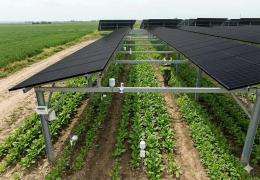
Unlike traditional panels, which only capture solar energy on their front side, bifacial panels have photovoltaic cells that are active on both sides. The rear side captures light reflected from the ground or surrounding surfaces (a phenomenon known as "albedo").
This ingenious design increases electricity production by 5% to 30%, depending on the installation environment and the available reflective surface.
Bifacial panels are particularly effective in certain configurations:
In 2025, we are seeing growing adoption of this technology, particularly when combined with TOPCon to maximise overall efficiency.
Our Leapton N-Type 450Wp TOPCon bifacial panel represents the perfect combination of these two advanced technologies, offering optimal performance in all installation conditions.
The distinction between P-type and N-type photovoltaic cells is a fundamental development in the manufacture of modern solar panels.
Traditionally, solar panels mainly used P-type silicon (boron-doped). N-Type technology uses phosphorus-doped silicon, which offers several advantages:
N-type cells are the basis for the most advanced technologies such as TOPCon, offering unrivalled efficiency on the current market.
Investing in N-type solar panels offers many long-term advantages:
Our JNL OptimaX 440Wp N-Type Bifacial panel perfectly illustrates this technological advance, combining N-type cells and bifacial design for maximised production.
Constant advances in manufacturing processes have led to the emergence of half-cell panels, a structural innovation that significantly improves performance.
In half-cell panels, each traditional photovoltaic cell is divided into two equal parts. This configuration has several technical advantages:
This technology increases the overall efficiency of the panels by approximately 2-3% compared to traditional designs.
The photovoltaic industry is also moving towards larger cell formats, including:
These larger formats, combined with half-cell technology, maximise power per panel while optimising manufacturing and installation costs.
Our range of high-efficiency panels at Wattuneed incorporates these technological advances to guarantee you optimal production with excellent value for money.
Although silicon technologies currently dominate the market, a revolution is brewing with the emergence of perovskite cells, considered to be the future of the photovoltaic sector.
Perovskite solar cells use a crystalline material that is different from traditional silicon. These materials have exceptional photovoltaic properties:
In 2025, this technology began to enter the commercial market, mainly in the form of tandem cells (silicon/perovskite combination) achieving efficiencies of over 24%.
While laboratory performance is impressive, several challenges remain to be overcome for widespread adoption:
Projections indicate that by 2027-2028, perovskite panels could represent a significant share of the market, with performance exceeding current technologies at potentially lower costs.
"Innovation in the field of photovoltaics never stops. Our team is closely monitoring developments in perovskite technologies so that we can offer you the most advanced solutions as soon as they reach commercial maturity."
Beyond pure performance, architectural integration is becoming a major criterion for many customers concerned about the aesthetics of their installation.
Ultra Black panels represent a significant advance in the visual integration of photovoltaic installations:
This refined aesthetic is generally accompanied by high-performance technologies such as TOPCon or N-type cells, combining beauty and efficiency.
Our Shinson N3-TOPCon 450 Wp Bifacial Ultra Black panel perfectly illustrates this winning combination of refined aesthetics and cutting-edge technology.
The integration of photovoltaics directly into building elements (BIPV - Building Integrated Photovoltaics) is a strong trend in 2025:
These solutions allow energy production to be integrated into the building design from the outset, transforming every surface into a potential source of electricity.
Advances in photovoltaics are not limited to solar panels, but also extend to the entire ecosystem, including energy storage and management.
Storage solutions are evolving rapidly to support modern photovoltaic installations:
Our self-consumption kits with lithium storage incorporate the most efficient batteries on the market to maximise your energy autonomy.
Artificial intelligence and the Internet of Things (IoT) are transforming the way we manage our solar energy production and consumption:
These systems significantly increase the rate of self-consumption, maximising the profitability of your photovoltaic installation.
The photovoltaic market in Europe, particularly in France and Belgium, is experiencing remarkable growth in 2025.
Here are the main trends observed in the Franco-Belgian market in 2025:
In Belgium, the adoption of photovoltaics is also accelerating, with falling average prices and attractive regional incentives.
Economic analysis of photovoltaic installations in 2025 reveals several encouraging trends:
The combination of lower costs and increased performance makes photovoltaic investment particularly attractive in 2025.
At Wattuneed, we help you size your installation to maximise its profitability while offering you the most efficient technologies on the market.
Given the diversity of technologies available, it is crucial to make an informed choice that meets your specific needs.
To determine the ideal photovoltaic solution, several factors must be taken into account:
Our Wattuneed solar simulator allows you to quickly assess the potential of your installation and determine the optimal configuration.
Here are our personalised recommendations based on different user profiles:
Contact our Wattuneed experts for a personalised assessment of your photovoltaic project and find out which technology best suits your specific needs.
TOPCon and N-Type photovoltaic panels have an estimated lifespan of 30-35 years, compared to 25 years for previous generations. Most manufacturers guarantee at least 87% of the initial power output after 30 years of use, with an annual degradation rate of less than 0.4%.
Bifacial panels are particularly effective on flat roofs or structures (pergolas, shade structures) where the rear side can capture reflected light. On a traditional sloped roof, their efficiency gain is more limited, generally in the range of 5-8% depending on installation conditions and surrounding reflectivity.
In 2025, the price difference between a standard panel and a latest-generation panel (TOPCon or N-Type) has narrowed considerably, to between 10% and 15%. Considering the efficiency gains (5-7%) and extended lifespan, the investment in these advanced technologies is generally recouped over the total operating life.
It is technically possible to combine different technologies in a single installation, but this is not generally recommended. Differences in electrical characteristics (voltage, current) can create imbalances and reduce the overall efficiency of the system. It is preferable to use homogeneous panels, ideally of the same model, to optimise the performance of the installation.
The first commercial versions of tandem panels (silicon-perovskite) are expected to be more widely available by 2027-2028. The current challenges mainly concern long-term durability and the industrialisation of manufacturing processes. Hybrid solutions, combining traditional silicon cells and thin layers of perovskite, are expected to constitute the first generation of products available to the general public.
The rapid evolution of photovoltaic technologies opens up remarkable prospects for the production of energy.
● Wattuneed solar fence for bifacial panels: robustness, durability and maximum energy production. The ideal solution for homes and businesses wishing to reduce their bills and become energy self-sufficient.
check_circle
This store asks you to accept cookies for performance, social media and advertising purposes. Social media and advertising cookies of third parties are used to offer you social media functionalities and personalized ads. Do you accept these cookies and the processing of personal data involved?