Since 2008
Based in Belgium and France
+ 60 000 clients
Our blog
A.S.S.
Shopping Cart
Découvrez comment installer, configurer et utiliser WatchPower pour surveiller votre onduleur solaire en temps réel....
Practical guide to reconnect your SMA Sunny Boy inverter to the WiFi network after a change of modem, router or...
Find out how Aiko is revolutionising photovoltaics with its silver-free ABC cells, laser engraving and 0BB...
Ajouter des batteries LiFePO4 neuves à un parc existant exige un équilibrage préalable rigoureux. Découvrez pourquoi...
Find out how the Walloon incentive tariff 2026 and dynamic contracts radically transform the electricity bill of...
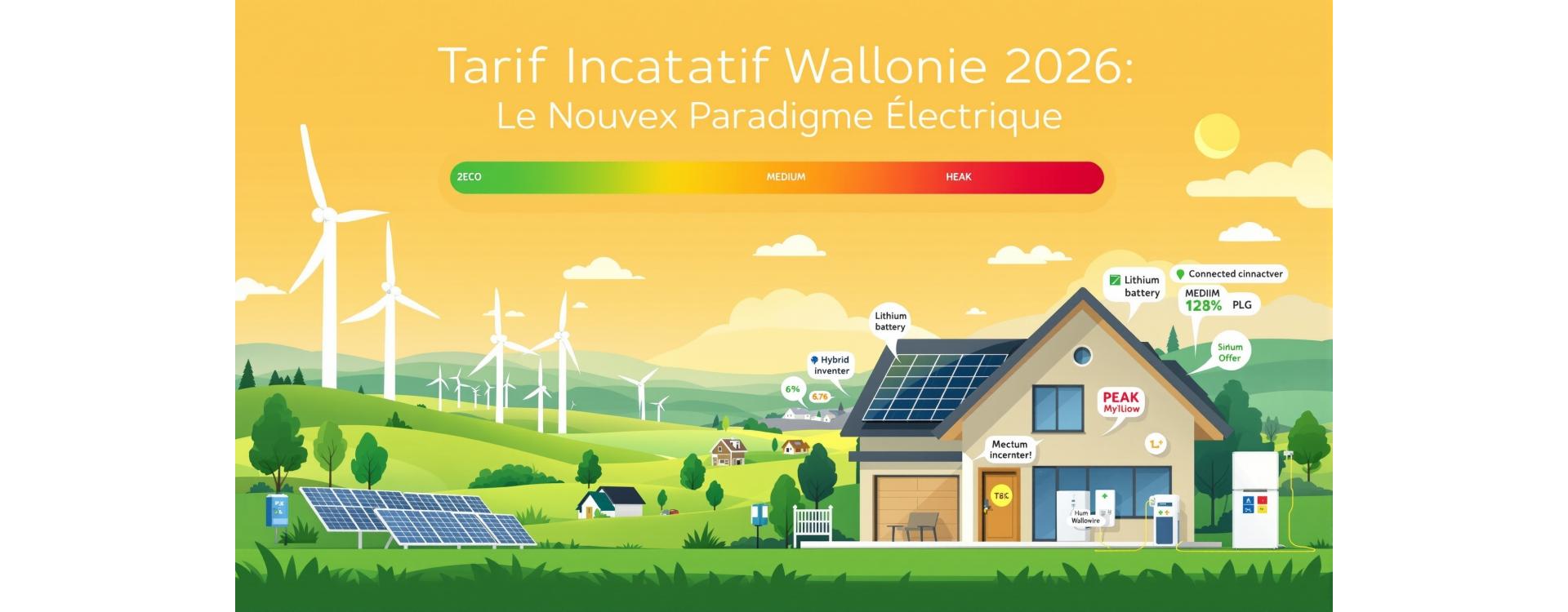
The Walloon Tariff Revolution 2026: Understanding the Real IssuesFrom 1 January 2026, Wallonia will embark on a structural transformation of its electricity market that goes far beyond a simple tariff adjustment. This transformation, orchestrated by the Walloon Energy Commission (CWaPE) and implemented by the network operators ORES and RESA, marks the end of a historical model based on passive consumption inherited from the nuclear era.The new paradigm is based on behavioural flexibility. Faced with the massive integration of intermittent renewable energies and the rapid electrification of uses (mobility and heating), pricing becomes a steering tool to synchronise consumption with network availability."The incentive tariff is not a comfort option; it is the rational response to mass electrification. For Walloon households, the cost of inaction will run into thousands of euros a year from 2026."The Realistic Consumption Profile: Overcoming Statistical IllusionsMost tariff analyses are based on an erroneous example: a household consuming 4,500 kWh/year with a heat pump and an electric vehicle. This reference is invalid and distorts the economic projections.Deconstruction of the Electrified Profile 2026For a Walloon family of 4 equipped with a heat pump and an electric vehicle, here are the real consumption figures based on thermodynamics and vehicle physics:Poste de ConsommationEstimation BasseEstimation RéalisteEstimation HauteUsages Domestiques(Électroménager, éclairage, cuisson)2 500 kWh3 500 kWh4 500 kWhPompe à Chaleur(Chauffage + ECS, SCOP réel 3,0-3,5)3 000 kWh5 000 kWh7 500 kWhVéhicule Électrique(15 000 km/an, pertes de charge incluses)2 800 kWh3 400 kWh4 500 kWhTOTAL ANNUEL8 300 kWh11 900 kWh16 500 kWhKey conclusion: We are working on the basis of 12,000 kWh/year to reflect the reality of a modern low-carbon household. It is on this volume that the Impact tariff and dynamic contracts make their full economic sense.💡 Recommended solution: Lithium solar batteries for optimised storage Maximise your savings with a storage solution adapted to the new Walloon tariff paradigmArchitecture of the New Tariff Framework 2026The end of the historical bi-hourly modelThe traditional system offered a preferential tariff from 22:00 to 07:00 and throughout the weekend. This model will disappear completely. From January 2026, the week/weekend distinction will be abolished. Time slots will be identical 7 days a week.The New Bi-hourly Standard (Default)For users without a smart meter or taking no active steps:Peak hours (High Tariff): 07:00 - 11:00 and 17:00 - 22:00Off-peak (Low Tariff): 22:00 - 07:00 (Night) and 11:00 - 17:00 (Day)The introduction of the 11 a.m. to 5 p.m. off-peak period is a direct response to the "Duck Curve" created by solar energy: we need to encourage consumption when the sun is shining to avoid surpluses.The "Impact" Tariff: The Three-Zone RevolutionThe Impact Tariff is the centrepiece of the reform. Accessible only to holders of communicating meters configured in SMR3 mode, it divides the day into three price zones, creating a powerful economic signal.Zone TarifairePlages Horaires (7j/7)Niveau de PrixObjectif SystèmeHeures ÉCO 🟢01h00 – 07h0011h00 – 17h00Très Faible(~6 c€/kWh)Inciter au report massif des charges (VE, ECS, électroménager)Heures MEDIUM 🟠07h00 – 11h0022h00 – 01h00Intermédiaire(~10 c€/kWh)Gérer les transitions. ATTENTION : 22h-01h n'est plus "bon marché"Heures PIC 🔴17h00 – 22h00Punitif(~30 c€/kWh)Décourager formellement toute consommation additionnelle lors de la pointe critiqueCritical point: Moving the start of night-time ECO hours to 01:00 (instead of 22:00) is a major break. Many users used to the old tariff are likely to start their appliances too early, paying a "Medium" tariff when waiting until 01:00 would offer them the "Eco" tariff.🔧 RECOMMENDED SOLUTIONVictron MultiPlus-II hybrid inverter for intelligent control of energy flows. ⚡ DISCOVER VICTRON INVERTERS The Dynamic Supply Contract: Luminus Dynamic DecodedWhile the Impact Tariff manages transmission costs (network), the supply contract manages the commodity price (the electron itself). It is the combination of these two elements that defines the total bill.Hourly Price Formation MechanismThe Luminus Dynamic contract reflects the hourly price on the Day-Ahead market (EPEX Spot Belgium), set each day at around 1pm for the next 24 hours. The pricing formula is as followsTotal price (c€/kWh) = (Coefficient × hourly Belpex) + Supplier margin + TaxesParamètreValeur Novembre 2025ExplicationCoefficient Multiplicateur0,1018Intègre les pertes réseau et le profilageMarge Fixe Additif2,1316 c€/kWhRémunération Luminus (service client, certificats verts)Redevance Annuelle75,00 €/anNettement plus élevée que les contrats "Basic" (25-30 €)Strict technical requirementsAccess to this offer in Wallonia is conditional on :Digital Communicating Meter: EssentialActivation of the SMR3 Regime: The meter must transmit indexes every 15 minutesActual monthly billing: Very high bills in winter, very low in summer (cash management required).If the meter is digital but not communicating (or if the customer has refused data communication), the dynamic tariff is impossible.💡 Practical tool: Wattuneed sizers and calculators Access our free tools to calculate your consumption profile and size your installationConvergence strategy: Optimising Impact + Dynamic TariffsThe Hourly Decision MatrixCross-analysis of the timetables reveals windows of opportunity (Sweet Spots) and areas of absolute financial danger.Créneau HoraireTarif Impact (Réseau)Prix Dynamique (Fourniture)Verdict StratégiqueAction Recommandée01h00 – 06h00ÉCO (Min)Faible (Nuit basse)OPTIMALRecharge VE principale. Programmation ECS06h00 – 07h00ÉCO (Min)Moyen (Rampe matin)BONFin de cycle de charge07h00 – 11h00MEDIUM (Moyen)Élevé (Pic matinal)MAUVAISÉviter les gros consommateurs11h00 – 16h00ÉCO (Min)Très Faible / NégatifEXCELLENTLavage/Séchage. Charge VE (télétravail/week-end)16h00 – 17h00ÉCO (Min)Moyen (Déclin solaire)MOYENFin des cycles17h00 – 22h00PIC (Max)Très Élevé (Pointe soirée)⚠️ CRITIQUESTOP TOTAL. Passage sur batterie domestique22h00 – 01h00MEDIUM (Moyen)MoyenMÉDIOCREAttendre 01h00 pour lancer les appareilsCritical analysis: Convergence is perfect at night (01:00-06:00) and in the afternoon (11:00-16:00). The major trap is between 10pm and 1am. Many users risk launching their devices too early.Economic simulation: Comparison of 3 scenariosLet's quantify the financial impact for a typical household (12,000 kWh/year) according to three behavioural strategies.ScénarioConfigurationComportementCoût Annuel EstiméGain vs Scénario AA - "Legacy"Bi-horaire par défaut+ Contrat FixeAucune adaptation. VE branché à 18h00. PAC en continu4 200 €/anRéférence (0 €)B - "Semi-Actif"Tarif Impact+ Contrat Variable MensuelÉvite le tarif Pic réseau. VE programmé la nuit (parfois dès 22h)3 200 €/an+ 1 000 €C - "Expert Optimisé"Tarif Impact+ Luminus Dynamic+ AutomatisationVE chargé à 02h00 ou dimanche après-midi. PAC surchauffe l'après-midi. Zéro conso en zone PIC2 400 €/an+ 1 800 € (43%)Conclusion: The expert scenario results in a 43% reduction in bills, or €1,800 in annual savings. This performance fully justifies the investment in automation and energy storage. BEST-SELLER Pylontech US5000 Lithium battery - 4.8 kWh✅ More than 6000 cycles - ✅ Modular design - ✅ Compatible with all inverters 📋 See technical details Analysis of Technical Risks and ConstraintsThe phenomenon of "Dunkelflaute" (Winter shortage)The German term Dunkelflaute (literally "darkness and dead calm") refers to winter periods when there is no sunshine and no wind over a large part of Europe. These episodes can last from a few days to two weeks.Impact for dynamic tariff consumers:Renewable supply collapses. Only controllable power plants (gas, nuclear) are running.Spot prices soar, sometimes reaching 50, 100 or even 500 c€/kWh.Double whammy: This is precisely the time when demand for heating (heat pumps) is at its highest because of the cold weather."Over a full year, the gains made in the summer and on windy nights generally offset this one-off extra cost. However, the January bill can be shocking for a household's cash flow."The Prosumer's Dilemma and Negative PricesFor owners of photovoltaic panels, the dynamic is changing. In Wallonia, the compensation system ("meter that turns upside down") is gradually disappearing. With a dynamic contract, the energy injected is sold at the real hourly price.The paradox: On sunny days, there is overproduction. Spot prices often become negative.Consequence: If the price is -5 c€/kWh, the prosumer pays 5 centimes for each kWh he injects into the grid.Mandatory strategy: Increase self-consumption at such times (water heaters, EVs), or install a load-shedding system that switches off the inverter if the price becomes too negative.Do you already have a photovoltaic installation? 🔗 See our guides Technological dependency (HEMS and Automation)Scenario C "Optimised Expert" (the most profitable) relies entirely on technology. It requires:A HEMS (Home Energy Management System) capable of reading the Spot price and controlling appliances.A compatible and controllable recharging point (OCPP)A reliable internet connectionIf the connection fails or the API crashes, the car may charge at the worst possible moment. The mental burden of monitoring prices manually is unsustainable in the long term, so automation is a prerequisite.🔌 ESSENTIAL INFRASTRUCTURESmart charging station for automatic control according to tariffs. ⚡ DISCOVER OUR SMART CHARGING STATIONS Wattuneed storage and optimisation solutionsOptimal system architecture for the Impact TariffTo transform regulatory constraints into financial opportunities, a coherent system architecture is essential:Lithium solar battery (5 to 10 kWh): Stores grid electricity during ECO hours, discharges during PIC hours.Intelligent hybrid inverter: Automatic flow management between grid, battery and solar panelsMonitoring system: Interface for tracking and optimising consumption in real timeControllable charging station: programmed EV charging only during ECO hoursTypical sizing for 12,000 kWh/yearComposantSpécification RecommandéeFonction PrincipaleBatterie Lithium10 kWh (ex: Pylontech US5000 x2)Autonomie pour 17h-22h (heures PIC)Onduleur Hybride5 kVA (ex: Victron MultiPlus-II 48/5000)Commutation automatique réseau/batterieBorne de Recharge11 kW pilotable (ex: Easee Home)Charge VE programmée 01h-06hMonitoringVictron VRM ou équivalentSuivi temps réel + historiqueReturn on investment : Financial analysisFor a complete installation (10 kWh battery + hybrid inverter) :Initial investment: €8,000 to €10,000 (including installation)Annual savings: €1,200 to €1,800 (depending on optimisation)Payback period: 5 to 8 yearsGuaranteed lifetime: 15 to 20 years (6,000+ cycles)Net return over 15 years: €10,000 to €17,000 savings after investment amortisation.💡 Recommended complete kit: Self-consumption solar kits with storage Turnkey solutions optimised for the Impact wallon 2026 tariffRecommendations by User ProfileThe Electrified Household (heat pump + EV) without PhotovoltaicsAbsolute priority:Switch to the Impact Tariff from January 2026Take out a Luminus Dynamic or equivalent contractInstall an intelligent recharging point programmed for 01h-06hInvest in a 5-10 kWh storage system to cover PIC hoursExpected ROI: €1,500 to €1,800 in annual savings.Prosumer with existing photovoltaic installationOptimisation strategy:Add a modular lithium battery (retrofit on existing installation)Configureforced self-consumption in hours with negative pricesSchedule large consumers (water heaters, household appliances) in the 11am-5pm period (solar)Avoid grid injection between 11am and 4pm on sunny daysBenefit: Elimination of negative injection costs + maximisation of self-consumption.The Complete New Project (Construction/Renovation)Integrated system architecture :Sized photovoltaic system (6-10 kWp)High-capacity lithium battery (15 kWh)Three-phase hybrid inverterControllable heat pump with programmed overheatingIntelligent 22 kW recharging pointCentralised HEMSObjective: Maximum energy autonomy with minimum grid bill (< €1,000/year for 12,000 kWh).🎯 NEED PERSONALISED SIZING?Our experts analyse your consumption profile and design your optimal solution ⚡ CONTACT OUR EXPERTS FAQ : Incentive Tariff and Dynamic Contracts Wallonia 2026What is the difference between the Impact Tariff and the Dynamic Tariff?The Impact Tariff is the distribution (network) component with three fixed price levels according to predefined time slots (ECO/MEDIUM/PIC). The Dynamic Tariff (like Luminus Dynamic) is the supply (energy) component, which varies in real time according to the Belpex market. To maximise savings, you need to combine the two.Is my current meter compatible?You need a digital communicating meter configured in SMR3 mode. This mode records and transmits meter readings every 15 minutes. If your meter is old (electromechanical with a disc), contact your network operator (ORES/RESA) to plan a replacement.Is the 12,000 kWh/year profile realistic for my household?For a family of 4 with a heat pump (heating a standard 150 m² house) and an electric vehicle (15,000 km/year), this profile is perfectly realistic. The commonly quoted examples of 4,500 kWh correspond to certified passive houses or very marginal use of the vehicle, which does not represent the average Walloon housing stock.What happens if I do nothing in 2026?You will automatically be switched to the new default bi-hourly tariff (with off-peak hours 11am-5pm and 10pm-7am, 7 days a week). If you don't adapt your behaviour or stock up on energy, your bill is likely to rise significantly, especially if you consume a lot between 5pm and 10pm. The cost of inaction can run into thousands of euros a year.What are the risks of dynamic contracts in winter?During periods of Dunkelflaute (darkness and lack of wind), Spot prices can explode (50-500 c€/kWh) precisely when heating demand is at its highest. This is the "double penalty". Over a full year, the gains made in summer and windy nights generally offset this one-off extra cost, but the bill in January can be very high.Is automation really necessary?For the "Optimised Expert" scenario (43% savings), yes, automation is essential. The mental burden of manually monitoring hourly prices and programming appliances on a daily basis is unbearable. A HEMS (Home Energy Management System) coupled with an intelligent terminal and a controlled battery will pay for itself in 5 to 8 years.Conclusion: Act Now to Control Your 2026 BillThe 2026 Walloon incentive tariff and dynamic supply contracts are not simple administrative adjustments. They represent a structural transformation of the electricity market that redefines the consumer's relationship with energy.For electrified Walloon households (heat pump + electric vehicle), with a realistic consumption of 12,000 kWh/year, the financial stakes are considerable:Without adaptation: annual bill of ~€4,200 (Legacy scenario)With partial optimisation: ~€3,200 (saving of €1,000)With full optimisation: ~€2,400 (saving of €1,800, i.e. 43% savings)Profitability in 2026 will no longer come from negotiating the price per kWh down to the last cent, but from households' ability to flex their consumption. Technology (home automation, smart terminals, energy storage) will become the main source of savings, ahead of the choice of supplier."The transition to Impact Tariff and dynamic pricing is not a comfort option, it's a rational response to mass electrification. For Walloon households, the cost of inaction will run into thousands of euros a year from 2026."The three keys to success :Anticipation: Prepare your installation now (SMR3 meter, Impact tariff subscription)Technology: Invest in high-quality equipment (lithium battery, hybrid inverter, smart charging point)Support: Call on experts to size and optimise your systemAt Wattuneed, we're supporting Wallonia in this energy transition by offering comprehensive, tailor-made solutions adapted to the new Walloon 2026 tariff context.🚀 PREPARE YOUR 2026 INSTALLATION NOWFree energy audit + personalised sizing + installation support ⚡ REQUEST A FREE AUDIT Wattuneed SPRLRue Henriprè 124, 4821 Andrimont, Belgium☎ +32 87 45 00 34 | ✉ info@wattuneed.comBlog | Support | Toolbox
check_circle
This store asks you to accept cookies for performance, social media and advertising purposes. Social media and advertising cookies of third parties are used to offer you social media functionalities and personalized ads. Do you accept these cookies and the processing of personal data involved?