Since 2008
Based in Belgium and France
+ 60 000 clients
Our blog
A.S.S.
Shopping Cart
Découvrez comment installer, configurer et utiliser WatchPower pour surveiller votre onduleur solaire en temps réel....
Practical guide to reconnect your SMA Sunny Boy inverter to the WiFi network after a change of modem, router or...
Find out how Aiko is revolutionising photovoltaics with its silver-free ABC cells, laser engraving and 0BB...
Ajouter des batteries LiFePO4 neuves à un parc existant exige un équilibrage préalable rigoureux. Découvrez pourquoi...
Find out how the Walloon incentive tariff 2026 and dynamic contracts radically transform the electricity bill of...
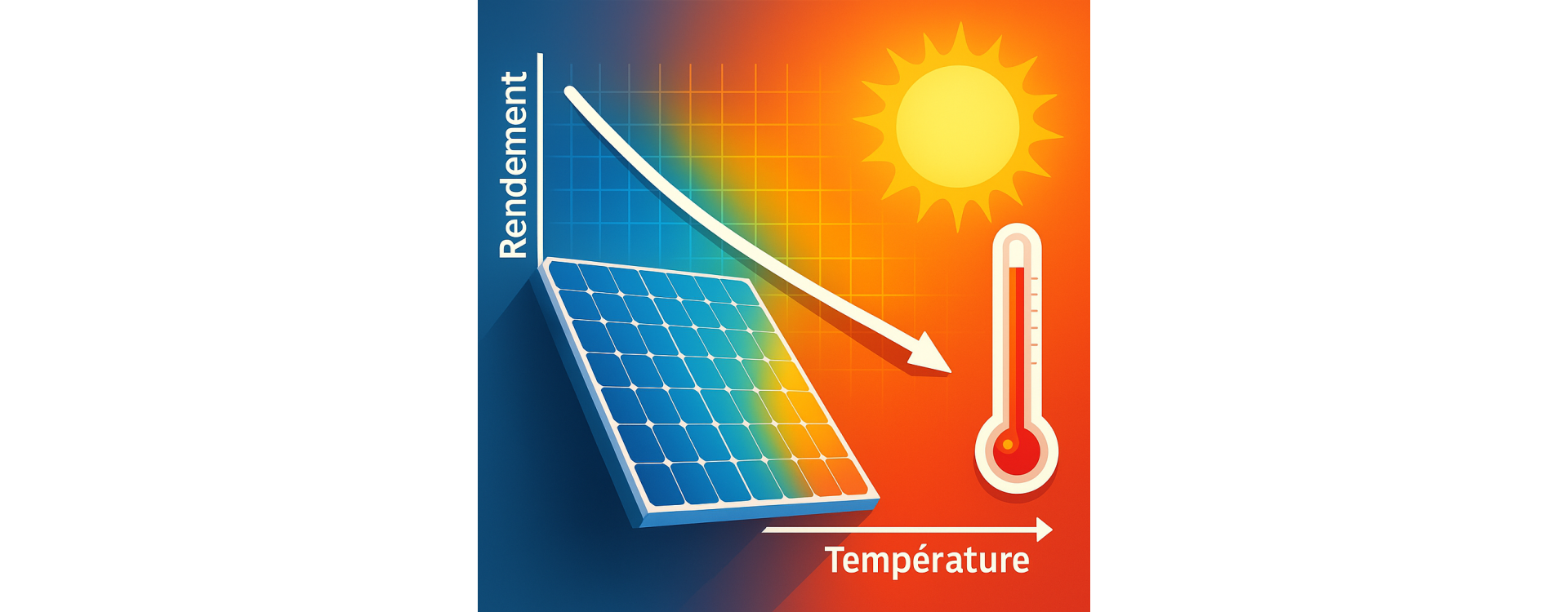
Contrary to popular belief, photovoltaic panels don't particularly like heat. While sunshine is essential to produce electricity, high temperatures can paradoxically significantly reduce the performance of your installation. With more and more regions experiencing heatwaves, it's essential to understand this phenomenon in order to optimize the energy production of your solar system.
In this article, we'll take a closer look at the impact of temperature on the performance of photovoltaic panels, explain the STC (Standard Test Conditions) used as a reference in the industry, and suggest concrete solutions for limiting these losses and maximizing your electricity production, even during the hottest periods.
"Solar panels are like athletes: they need sun to perform, but too high a temperature is detrimental to their performance."
When you buy a solar panel, its power is always indicated in Watt-peak (Wp), such as the Shinson N3-TOPCon 450 Wp Bifacial panels available on our site. This power represents the panel's maximum production capacity under standard test conditions (STC), which are :
These ideal conditions serve as a benchmark for comparing the different panel models on the market. However, they rarely correspond to the reality in the field, particularly where temperature is concerned.
To get a more realistic idea of panel performance under normal conditions of use, manufacturers sometimes also indicate the NOCT (Nominal Operating Cell Temperature) value, which represents the temperature the cell would reach under the following conditions:
For most photovoltaic panels, the NOCT is generally between 45°C and 48°C, which means that even with a moderate ambient temperature of 20°C, the cell temperature is already well above the STC reference temperature of 25°C.
To quantify the impact of temperature on solar panel performance, manufacturers specify an essential parameter: the power temperature coefficient. This coefficient, generally expressed as a percentage per degree Celsius (%/°C), indicates the power loss for each degree above 25°C.
For example, if a solar panel has a temperature coefficient of -0.35%/°C (a typical value for many panels), this means that for every degree above 25°C, the panel will lose 0.35% of its rated power.
The formula for calculating power loss is as follows:
Power loss = (Cell temperature - 25°C) × Temperature coefficient
Let's take a concrete example with a 450 Wp panel (like the Shinson N3-TOPCon) having a temperature coefficient of -0.30%/°C :
This represents a significant loss of over 47 Wp for a single panel. For a complete installation with 10 panels, this represents a loss of almost 500 Wp!
-
-6
423
-9
-12
396
It's important to note that during hot summer months, cell temperatures can easily exceed 70°C, resulting in even greater losses.
Temperature does not uniformly affect all the electrical parameters of a solar panel. Here's how it affects the main parameters:
Open-circuit voltage (Voc) and voltage at maximum power point (Vmp) are the most sensitive to temperature. They decrease significantly as temperature rises, with typical temperature coefficients of -0.30% to -0.40%/°C.
For example, a panel with a Voc of 40.20V at 25°C (like the Shinson N3-TOPCon) could see its voltage drop to around 36.18V at 60°C, a drop of 10%.
Short-circuit current (Isc) and current at point of maximum power (Imp) are less affected by temperature. They increase slightly with temperature, with positive coefficients typically of the order of +0.04% to +0.07%/°C.
However, this slight increase in current does not compensate for the significant drop in voltage, which explains the overall power loss.
Voltage drop has important implications for photovoltaic system design, particularly for inverter sizing. If the voltage drops too low in summer, the inverter may no longer be able to operate in its optimum range, or even shut down completely if the voltage falls below its minimum operating threshold.
This is why it's crucial to take these temperature variations into account when designing a solar installation, especially in regions prone to high summer temperatures.
Not all solar panel technologies are equal when it comes to temperature. Some are more resistant than others to the negative effects of heat.
Heterojunction
N-type solar panels such as the Shinson N3-TOPCon and Leapton N-Type TOPCon panels available on our site therefore offer a significant advantage over older technologies in terms of temperature resistance.
Bifacial panels like the Shinson N3-TOPCon 450 Wp Bifacial offer an additional advantage. By capturing light from both sides, they can partially compensate for temperature-related losses by increasing overall output through reflected light. What's more, their design often allows for better heat dissipation, thus reducing the operating temperature of the cells.
"Opting for bifacial panels with N-Type TOPCon technology means choosing an installation that performs better all year round, including during periods of high heat."
Now that we understand why and how temperature affects solar panel performance, let's see what solutions can be implemented to limit these losses.
For large-scale installations or in particularly hot climates, more advanced solutions may be considered:
Important note: Manual watering of panels is generally not recommended, as thermal shock can damage glass and cells, and tap water can leave traces of limescale that will reduce panel efficiency.
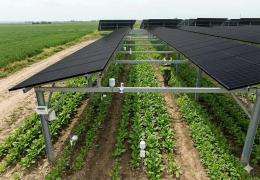
An ecological and effective solution for reducing panel temperatures is to install a green roof under or around the solar panels. The plants absorb some of the sun's energy and evaporate water, naturally cooling the environment around the panels.
This solution offers a number of advantages:
If you are interested in this solution, contact our experts who will be able to advise you on the possibilities of integrating it with your solar installation.
It's important to put these losses into perspective. Although hot summer days lead to a drop in yield, it's also during this period that sunshine is at its peak, which partly offsets temperature-related losses.
On the other hand, the summer months are generally the most productive for a photovoltaic installation, despite the negative effect of temperature. The annual electricity production of a well-designed installation will therefore always be satisfactory, even if it doesn't reach the theoretical values calculated under STC conditions.
Finally, it should be remembered that manufacturers already take these factors into account in their long-term production calculations, and that performance guarantees generally include these seasonal variations.
The impact of temperature on photovoltaic panels is an inescapable physical phenomenon that can temporarily reduce the performance of your solar installation, particularly during hot periods. However, thanks to recent technological advances such as the N-type TOPCon and bifacial panels available from Wattuneed, and to an adapted design of your installation, these losses can be significantly limited.
By choosing quality equipment and following good installation practices, you can optimize the performance of your photovoltaic system all year round and maximize your return on investment.
To benefit from personalized support for your solar project and select the panels best suited to your geographical location and energy needs, don't hesitate to contact our experts. They'll help you design a high-performance, long-lasting installation that minimizes the impact of high temperatures on your electricity production.
Solar panels work best at a cell temperature of 25°C, which corresponds to STC conditions. However, in real-life conditions, they generally operate at much higher temperatures, which reduces their efficiency.
No, manual watering of panels is generally not recommended, as thermal shock can damage cells and glass. What's more, tap water can leave traces of limescale, reducing the panels' efficiency. Professional cooling systems are available for large-scale installations.
Panels using heterojunction technology (HJT) are generally the least sensitive to heat, with temperature coefficients of around -0.25% to -0.30%/°C. N-type TOPCon panels like those offered by Wattuneed also offer excellent temperature resistance, with coefficients around -0.30% to -0.35%/°C.
A simplified formula for estimating panel temperature is: T(cell) = T(ambient) + (NOCT-20)/800 × Sunshine. For example, with an ambient temperature of 30°C, sunshine of 1000 W/m² and an NOCT of 45°C, the cell temperature would be around 61.25°C.
Bifacial panels can actually perform better in hot weather for two reasons: they allow better heat dissipation thanks to their design, and their ability to capture reflected light can partially compensate for temperature-related losses.
WattuneedRue Henripré 124821 AndrimontBelgium+32 87 45 00 34info@wattuneed.com
check_circle
This store asks you to accept cookies for performance, social media and advertising purposes. Social media and advertising cookies of third parties are used to offer you social media functionalities and personalized ads. Do you accept these cookies and the processing of personal data involved?