Since 2008
Based in Belgium and France
+ 60 000 clients
Our blog
A.S.S.
Shopping Cart
Découvrez comment installer, configurer et utiliser WatchPower pour surveiller votre onduleur solaire en temps réel....
Practical guide to reconnect your SMA Sunny Boy inverter to the WiFi network after a change of modem, router or...
Find out how Aiko is revolutionising photovoltaics with its silver-free ABC cells, laser engraving and 0BB...
Ajouter des batteries LiFePO4 neuves à un parc existant exige un équilibrage préalable rigoureux. Découvrez pourquoi...
Find out how the Walloon incentive tariff 2026 and dynamic contracts radically transform the electricity bill of...
This article ONLY concerns three-phase 3x220V networks WITHOUT NEUTRAL.If your installation has a distributed neutral wire (4-wire network), this procedure DOES NOT APPLY.A wiring error can destroy your equipment and completely distort the measurements.
In Belgium, some installations (particularly older or industrial ones) use a 3x220V three-phase network without a neutral connection . Here are the characteristics:
⚠️ Not to be confused with:• Single-phase network : 1 phase + neutral (230V phase-neutral)• Three-phase 4-wire network : 3 phases + neutral (400V between phases, 230V phase-neutral)
Connecting a single-phase inverter to a standard network with a neutral wire is simple:
But on a network without a neutral , there are only 3 phases. To connect a single-phase inverter, you must use 2 phases :
Crucial point: The terminal marked "N" on the inverter is connected to a phase (not a neutral). This is technically incorrect, but that's how the system works.
On a 3x220V network without a neutral, the inverter could theoretically be connected between any two phases (L1-L2, L2-L3, or L1-L3). However, for the energy meter (Chint DTSU666) and the inverters to communicate, they must share the same voltage reference .
The solution: impose a convention .
L2 is ALWAYS the common reference phase(even though it's technically a phase, not a neutral)
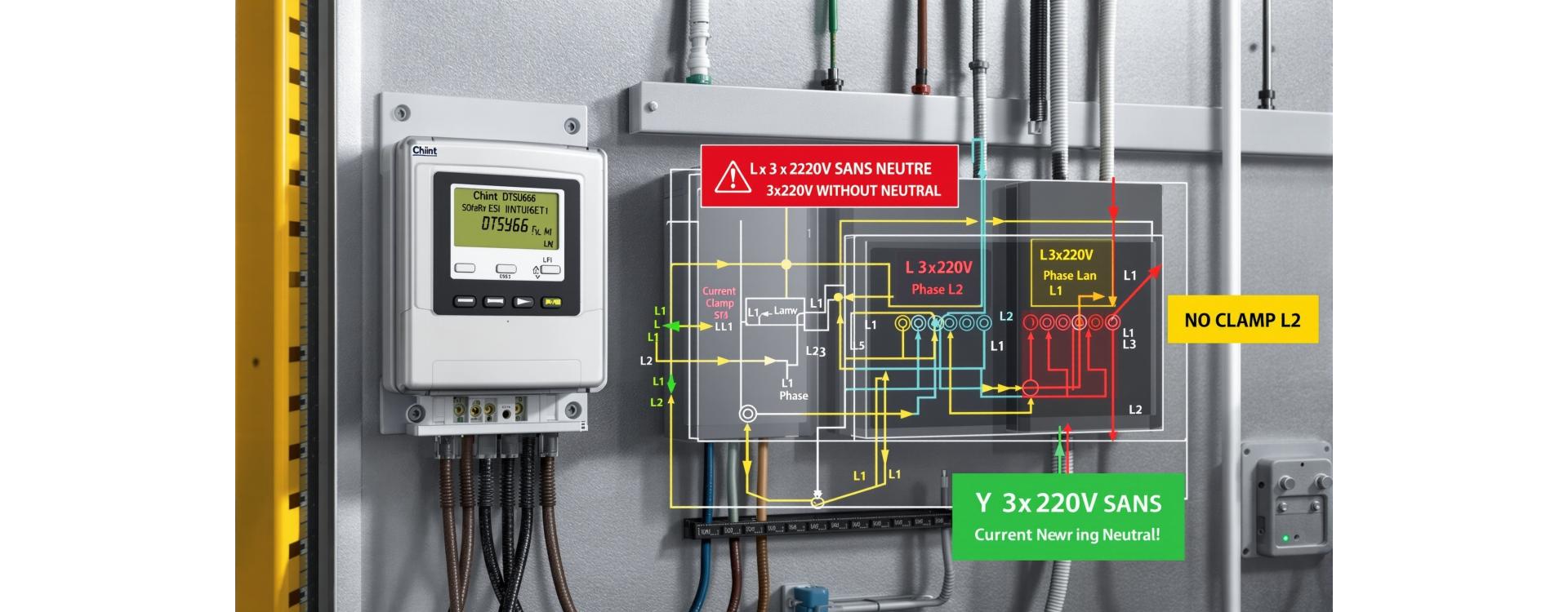
• All inverters have their "N" terminal connected to L2• The Chint meter uses L2 as a voltage reference• The meter clamps measure on L1 and L3 (never on L2)
The Chint DTSU666 meter can operate in several modes. For a 3x220V network without a neutral wire , the Aron mode (Net ID 33) is used:
The meter performs two independent measurements:
The counter calculates:
Crucial point: All voltages are measured relative to L2 . This is why L2 must be the common reference for the entire system.
💡 Chint DTSU666 Counter Configuration
Check the "Net ID" setting in the configuration menu. For a 3x220V network without a neutral wire, it should display 33 (Aron 3-wire mode). Contact our technical support if you have any questions.
This is the only wiring permitted to guarantee the proper functioning of the system:
If you only have one single-phase inverter (e.g., Sofar ESI 3kW):
┌─ L1 ────→ Clamp 1 (Chint) ────→ Terminal "L" (Inverter)
├─ L2 ────→ (Reference) ────────→ Terminal "N" (Inverter)
└─ L3 ────→ Clamp 3 (Chint) ────→ (Domestic Charges)
If you have two single-phase inverters (e.g., 2× Sofar ESI 3kW = 6kW total):
Crucial points:
┌─ L1 ────→ Clamp 1 ────→ Terminal "L" (Inverter 1)
│ Terminal "N" (Inverter 1) ──┐
├─ L2 ────→ (Common Reference) ←────────────────┴─ Terminal "N" (Inverter 2)
│
└─ L3 ────→ Clamp 3 ────→ Terminal "L" (Inverter 2)
💡 Recommended product: Sofar ESI single-phase inverters
Compatible with 3x220V mains power, intelligent injection management, integrated Modbus communication
A single-phase inverter (like the Sofar ESI) calculates its injected power according to the formula:
P inverter = I L × U LN × cos(φ)
It measures:
For an inverter wired according to the convention (L→L1, N→L2):
The Chint counter (Element 1) calculates:
P element1 = I L1 × U L1-L2 × cos(φ)
Both devices measure exactly the same thing :
➡️ Result: The inverter displays 1000W, the meter reads 1000W. The system is working perfectly.
Imagine you wire Inverter 1 backwards :
"My inverter shows 2500W of production, but my home meter is running backwards and my Chint meter says I'm consuming 2000W from the grid." — Classic symptom of reversed wiring.
If your system exhibits these symptoms, immediately disconnect the inverter and contact a qualified installer or our technical support . Do not attempt to correct the problem yourself unless you are 100% certain.
Before switching on your installation, check each point individually :
✅ Online calculators • ✅ Wiring guides • ✅ Compatibility charts
Once the wiring is complete and verified, follow this testing procedure:
If all tests are positive, your installation is correctly wired and operational.
You can now safely enjoy your solar self-consumption
Because your electrical system doesn't have one. A 3x220V system without a neutral wire only distributes three phases. There is no neutral wire available in your electrical panel. If you had a neutral wire, you would have a different system (single-phase or three-phase with four wires).
No, that's dangerous. Between L1 and L3, the voltage is 380V (line voltage = √3 × 220V). A single-phase inverter is designed for 220-230V. You would instantly destroy the inverter. You must always connect between two adjacent phases (L1-L2 or L2-L3), and adhere to the convention L2 = reference.
Not possible with 2 clamps. The Aron setup (2 clamps) can only measure a maximum of 2 inverters (one on L1, one on L3). If you have 3 single-phase inverters, you must:
The error "Err 01" usually indicates a configuration problem :
No, this is not compatible with the Aron configuration. In Aron mode, phase L2 is the common reference. All inverters must have their "N" terminal connected to L2. If you connect an inverter between L1 and L3 (bypassing L2), the voltage measurements will be incorrect.
It depends on the power and the distance. For a 3 kW single-phase inverter:
Consult our cable cross-section calculator for accurate sizing.
💡 Need cables and accessories?
Discover our complete range of photovoltaic cabling : solar cables, MC4 connectors, protective sheaths.
All inverters have their "N" terminal connected to L2 , even though it is technically a phase. This is the universal convention of the system.
The Chint counter in Aron mode (Net ID 33) has its clamps on L1 and L3 . Never a clamp on L2 (it serves as a voltage reference).
If you have 2 inverters: Inverter 1 (L→L1, N→L2) and Inverter 2 (L→L3, N→L2). Both share the same reference L2.
Golden rule: In a 3x220V network without neutral with Chint DTSU666 meter (Aron mode), the "N" terminal of the single-phase inverter must ALWAYS be connected to phase L2 (common reference), never to L1 or L3.
If you follow these 3 rules, your installation will work perfectly: the inverters will produce, the meter will measure correctly, and you will fully enjoy your solar self-consumption in complete safety.
Our technical team will guide you through the wiring and configuration of your three-phase installation.
Now that you've mastered 3x220V network wiring without a neutral, check out our other guides:
✅ Inverters • ✅ Energy Meters • ✅ Cabling • ✅ Protection • ✅ Monitoring
Wattuneed SPRL | VAT BE0644.865.670Photovoltaic specialist in Belgium since 2015www.wattuneed.com | support.wattuneed.com | Toolbox
check_circle
This store asks you to accept cookies for performance, social media and advertising purposes. Social media and advertising cookies of third parties are used to offer you social media functionalities and personalized ads. Do you accept these cookies and the processing of personal data involved?