Voltage
Charging power
Load current
Brand
MPPT controller
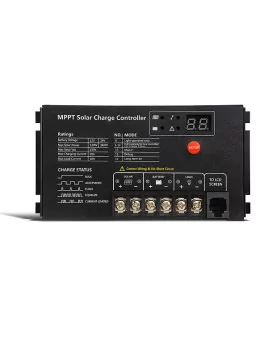
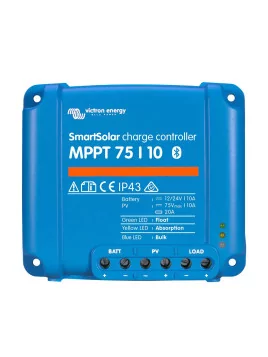
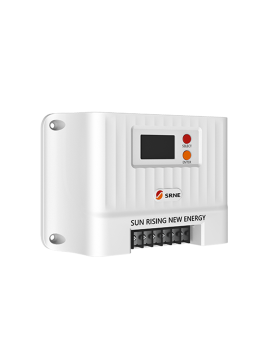
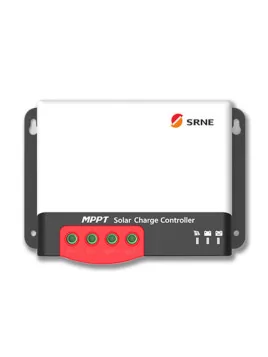
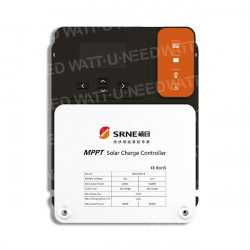
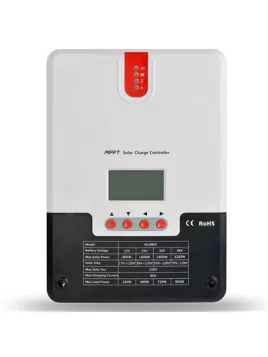
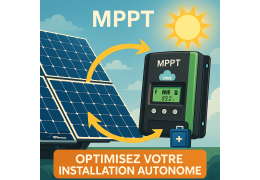
MPPT charge controllers (Maximum Power Point Tracking) continuously extract maximum power from your solar panels by adapting their input voltage to real conditions — clouds, temperature, angle of incidence. Result: 10 to 30% more energy compared to a PWM controller, especially in non-ideal conditions. They accept high PV voltages (up to 100–450V depending on the model), enabling overpanelling and series strings with optimised wiring. Available from Victron Energy (SmartSolar, BlueSolar) and SRNE. For complete sizing (Voc, current, overpanelling), see our MPPT technical sizing guide 2025.
Choose in 30 seconds
- Battery voltage: check 12V, 24V or 48V for your battery bank. Most modern MPPT controllers auto-detect battery voltage at first commissioning.
- Charge current (A): quick formula: PV power (W) ÷ battery voltage (V) + 20% margin. Example: 1,200W ÷ 48V = 25A → choose a 30A MPPT minimum. Common ranges: 10A, 15A, 20A, 30A, 40A, 60A, 100A.
- Max Voc input voltage (CRITICAL): the open-circuit voltage of your series-connected panels must NEVER exceed the controller's max input voltage — even briefly, even in cold weather (Voc rises as temperature drops). See our MPPT guide for cold-temperature calculations.
- Overpanelling: you can install 10 to 20% more PV power than the controller's nominal rating — panels rarely reach peak power in real conditions. This improves off-peak production without risk.
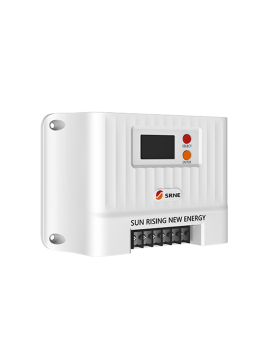
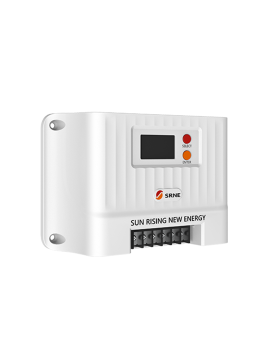
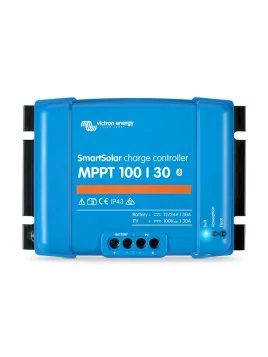
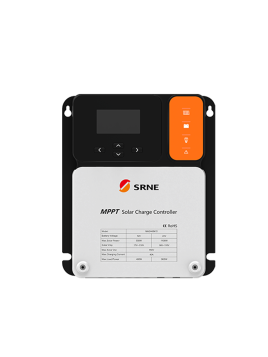
- Monitoring: Victron SmartSolar = native Bluetooth + VictronConnect app + Cerbo GX compatible. SRNE MPPT = integrated LCD display + great value for standard installations without advanced supervision.













Related posts

FAQ - MPPT solar charge controller
MPPT solar charge controllers: complete guide to sizing and choosing
The MPPT charge controller is today's benchmark technology for solar regulation in autonomous systems. Its principle: an integrated DC/DC converter continuously adapts PV input voltage to maintain panels at their Maximum Power Point, regardless of battery voltage. Unlike PWM, which "clamps" panels to battery voltage, MPPT fully exploits their potential in all conditions.
Concrete advantages of MPPT over PWM
- 10 to 30% more energy: gain is especially significant in non-ideal conditions — morning, evening, partial cloud cover, low temperatures.
- Compatibility with modern panels: current residential panels have Vmp of 30 to 40V. MPPT exploits them fully on 12V, 24V or 48V batteries. PWM would waste 40 to 60% of the energy.
- Overpanelling: connect 10 to 20% more PV power than the controller's nominal rating. Panels rarely reach peak power — overpanelling improves off-peak production without risk.
- High-voltage strings: connect panels in series to increase voltage and reduce cable losses — especially useful for long distances.
- High efficiency: 93 to 98% vs 70 to 85% for PWM.
The 3 essential parameters for sizing your MPPT
1. Battery voltage (12V, 24V or 48V)
Most modern MPPT controllers auto-detect battery voltage at start-up. General rule: the more powerful the installation, the higher the battery voltage should be (48V for installations >1 kWp).
2. Maximum charge current (A)
Formula: max current (A) = total PV power (W) ÷ battery voltage (V)
- 600W on 12V battery → 600/12 = 50A → choose a 60A MPPT
- 800W on 24V battery → 800/24 = 33A → choose a 40A MPPT
- 2,000W on 48V battery → 2000/48 = 41.7A → choose a 50A MPPT
3. Maximum PV input voltage (Voc)
The most critical safety parameter. Series-connected panel Voc must NEVER exceed the controller's max input voltage. Two key points:
- Voc is measured at open circuit — the highest voltage your panels can produce.
- Voc rises as temperature drops. In cold weather (-10°C), Voc can exceed nominal value by 10 to 20%.
Exceeding max Voc — even briefly — permanently destroys the controller with no warranty recourse. See our MPPT sizing guide 2025 for thermal correction formulas.
Brands available at Wattuneed
Victron Energy SmartSolar MPPT
- Native Bluetooth: configuration and monitoring via VictronConnect app (iOS and Android), no extra accessory needed.
- Ecosystem integration: compatible with Cerbo GX, Venus GX, Battery Monitor, Multiplus.
- Adaptive MPPT algorithm: especially effective in variable conditions (partial shading, cloud cover).
- 5-year warranty.
SRNE MPPT
- Integrated LCD display for direct parameter reading
- Compatibility with all battery technologies (AGM, GEL, LiFePO4, OPzS/OPzV)
- Long-term robustness on remote sites
- Controlled cost for budget-conscious projects