Since 2008
Based in Belgium and France
+ 60 000 clients
Our blog
A.S.S.
Shopping Cart
Découvrez comment le peak shaving avec onduleur hybride et batteries lithium évite les coupures de compteur en...
Transformez votre balcon en mini-centrale solaire avec les kits plug and play Wattuneed. Installation simple, budget...
Votre batterie Delong avec BMS PACE affiche un SOC mais 0V en sortie ? Découvrez les causes de mise en sécurité,...
Guide complet pour connecter votre onduleur Solax à Internet via WiFi et configurer l'application SolaX Cloud pour...
Découvrez pas à pas comment obtenir un devis solaire sur mesure avec Wattuneed, que vous soyez débutant ou expert,...
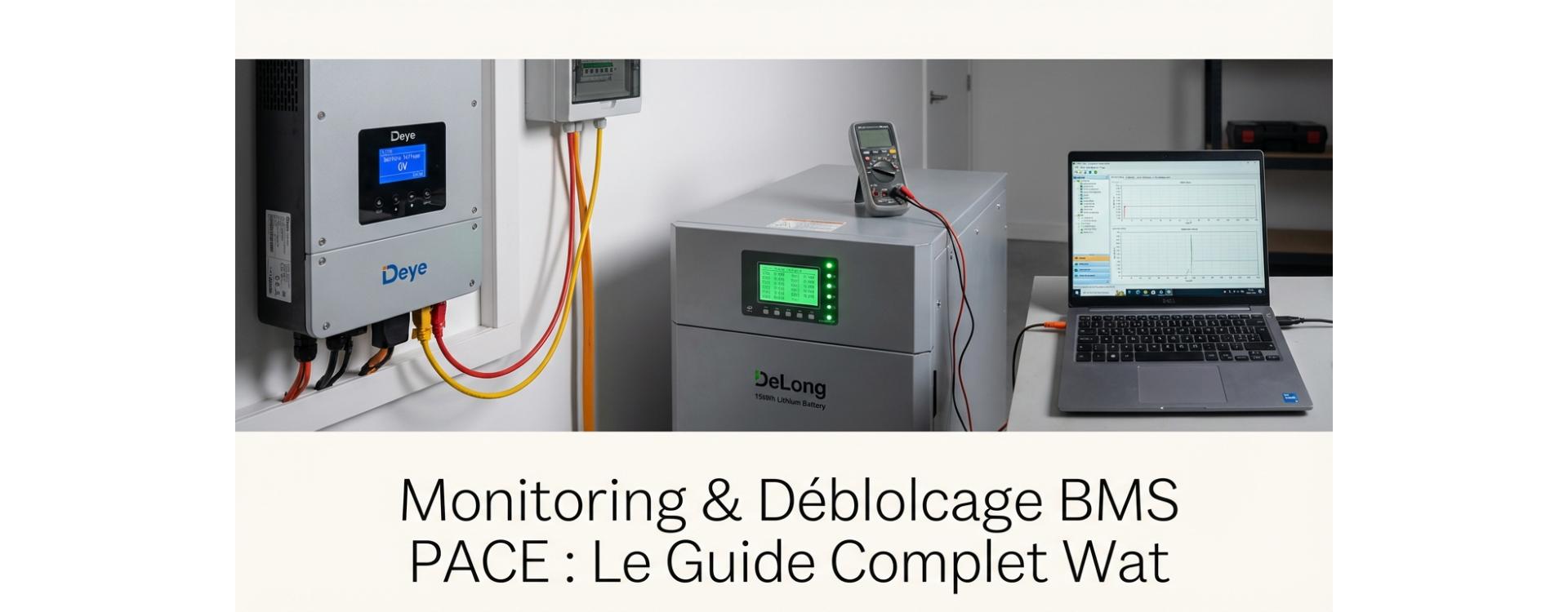
Lithium batteries from the Delong Top Energy range equipped with a PACE BMS (Protection And Control Electronics) are high-performance, reliable storage solutions. However, like any sophisticated protection system, the BMS can sometimes trip and block the battery, leaving the user with a confusing situation: the battery communicates with the inverter, displays a SOC (State of Charge) of 50% or more, but delivers no output voltage (0V).
In this technical article, we will detail the causes of this blockage, explain how to correctly interpret the monitoring data from a Deye installation, and above all, guide you step by step through the procedures for unblocking the PACE BMS.
The PACE BMS (used by Delong, Seplos, and other manufacturers) is an advanced battery management system that performs three critical functions:
Key point: The BMS uses MOSFETs (power transistors) as "electronic switches" between the cells and the output terminals. When a protection is activated, these MOSFETs open instantly, physically breaking the circuit. This is why you measure 0V at the terminals while the battery contains 52V inside.
💡 Product concerned: Delong Top Energy 15kWh Lithium Battery 51.2V 314Ah
High-capacity battery equipped with BMS PACE with LCD screen and CAN/RS485 communication.
Let's take a concrete example of a Deye 6kVA single-phase installation + Delong 15kWh Battery where the battery refuses to wake up. Here are the data read in the Deye monitoring interface:
Analysis of this data reveals a BMS software lock characterised by:
Conclusion: The BMS went into protection following a short-circuit detection (probably during an attempt to connect to the inverter's loaded DC bus) and did not automatically reset this protection.
Trip : The BMS detects a sudden current draw greater than 300-400A for a few microseconds.
Typical scenario: Closing of the battery circuit breaker while the Deye inverter's DC bus (50V, empty capacitors) creates an electric arc. The BMS interprets this arc as a short circuit and opens the MOSFETs in less than 50µs.
💡 Tip: Deye inverters have 1000-2000µF filter capacitors that behave like an instantaneous short circuit when empty. This is the #1 cause of BMS blockages when adding a battery to an already powered system.
Trigger: One or more cells drop below 2.0V (critical threshold for LiFePO4).
Why it's misleading: Even if the overall SOC shows 50%, an unbalanced cell may be at 1.8V while the others are at 3.3V. The BMS switches off everything to protect this weak cell.
Trip: Internal temperature > 60°C (warning) or > 80°C (definitive shutdown).
False positives: If an NTC sensor is disconnected, the BMS can read -40°C or +120°C and block the battery for safety reasons.
Symptom: The battery refuses to charge OR discharge (only one direction blocked).
Cause: One of the power transistors (charging or discharging) is burnt out following a transient overvoltage (lightning, reverse polarity, etc.).
Effect: If the BMS loses contact with the inverter for more than 60 seconds, some models go into safety standby (Discharge Limit = 0A).
Before doing anything, consult the LCD screen of the Delong battery (use the MENU, ENTER, DOWN, ESC buttons to navigate):
In 80% of cases, the blockage is resolved by a simple "Hard Reset".
According to the official Delong Stackable Series manual, the ON/OFF button (silver below the screen) has a built-in "Reset" function:
⚠️ Important: If the red "ALM" LED lights up again immediately after the reset, this means that a hardware protection is really active (cell undervoltage, faulty temperature sensor, or damaged MOSFET). Proceed to step 3 (PC diagnostics).
Once the battery has woken up (52V at the terminals), you must prevent it from reverting to a safe state when reconnecting to the system. Here is the pre-charging procedure:
Case A: You have several batteries in parallel
Case B: You only have one battery
🔌 Pre-charge resistor: Deye inverters have an internal pre-charge circuit (resistance of a few ohms that limits the inrush current for 2-3 seconds). However, if you connect/disconnect the battery quickly, this system does not have time to activate. Hence the importance of switching off the UPS before doing anything.
If the Reset button does not work, the BMS is in "Hard Lock". You must use the PC configuration software.
Hardware required :
Procedure:
Modifying the BMS parameters via software may invalidate the manufacturer's warranty. NEVER modify the protection thresholds (voltage, current, temperature) without the agreement of technical support.
A well-monitored installation prevents 90% of BMS blockages. Here are the parameters to monitor in the Deye interface (via LCD screen, Wi-Fi Stick, or cloud platform):
Use the Wattuneed sizing tools to calculate the maximum discharge current of your installation and check that your BMS is not undersized.
Delong batteries with BMS PACE communicate via the Pylontech CAN 2.0 protocol (also known as "PYLON Protocol"). This protocol is natively supported by Deye UPS since firmware version 4000+.
📖Full guide: See our dedicated article Commissioning Guide Deye Batterie Pylontech UPS which details the configuration of the communication protocol (applicable to Pylontech compatible batteries such as Delong).
Once configured, the Deye UPS displays the following information if the communication is working:
If the UPS displays "Battery Factory: Unknown" or "BMS Voltage: 0V" while the battery is on → wiring problem or incorrectly configured protocol.
Answer : This is the classic symptom of a BMS in protection. Follow the "Hard Reset" procedure (ON/OFF button for 5 seconds). If this doesn't work, check the battery LCD screen to see if an alarm is displayed (red LED). An undervoltage cell (< 2.5V) prevents the BMS from activating the discharge MOSFETs.
Answer: The Deye's "Activate Battery" function sends a small charge pulse (a few amps for 10-20 seconds) to "wake up" a lithium battery in deep sleep (cells at 2.0-2.5V). But if the BMS is in 'Hard Lock' protection (Discharge Limit = 0A), this function fails because the MOSFETs remain open. The BMS must first be unlocked using the physical Reset button.
Answer: No, and this is a fundamental safety feature. If you configure the inverter in "Lead-Acid" mode instead of "Lithium", it will ignore the BMS commands and apply its own charge/discharge thresholds. Result: risk of cell destruction by overcharging/deep discharging. Never use a lithium battery in "Lead-Acid" mode.
Answer: The "Hard Reset" (physical button) is a safe software operation, you can do it as many times as necessary. However, if you have to reset the BMS several times a week, there is an underlying problem (weak cell, faulty temperature sensor, unstable wiring). Contact Wattuneed technical support for a detailed diagnosis.
Answer:
If these two values differ by more than 1V, the MOSFETs are open (active protection).
Answer: "MOSFAIL" means that the BMS has detected a power transistor failure (burnt-out charge or discharge MOSFET). This cannot be repaired by software. The BMS board must be replaced (under warranty if manufacturer's fault) or the complete battery, depending on age and cause. Contact Wattuneed support immediately with your serial number.
💡 Did you know?
Delong LiFePO4 batteries are designed for over 6000 cycles at 80% depth of discharge. Proper maintenance (regular balancing + controlled temperature) can extend this lifespan to 10-15 years of daily use.
To ensure perfect compatibility and avoid BMS communication problems, Wattuneed offers pre-configured and tested packs:
🔋 SEE PACK DEYE 6KVA + DELONG 5KWH
This pack includes:
💡 For three-phase installations: Deye 10 kVA three-phase inverter pack and Delong 15kWh lithium battery.
Complete solution for energy-hungry homes or small businesses (30-40 kWh/day).
To speed up the processing of your request, please have ready :
check_circle
This store asks you to accept cookies for performance, social media and advertising purposes. Social media and advertising cookies of third parties are used to offer you social media functionalities and personalized ads. Do you accept these cookies and the processing of personal data involved?