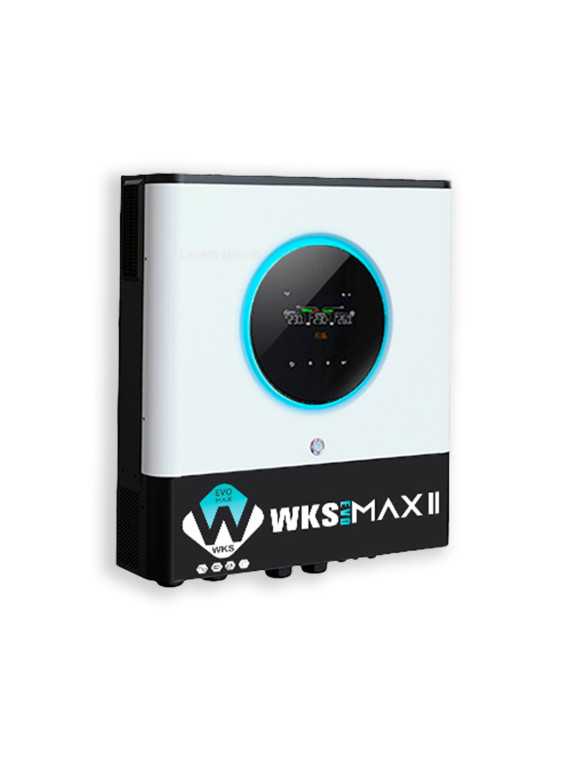
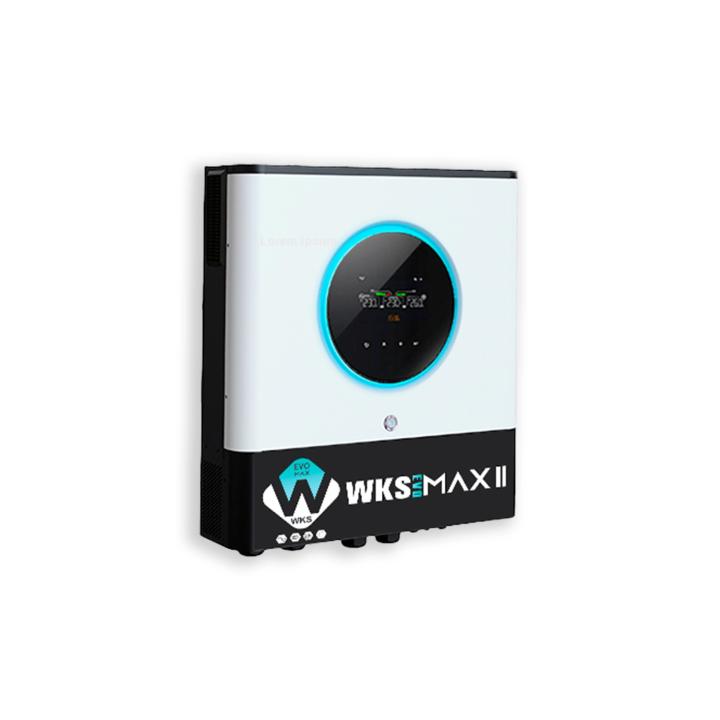
WKS Evo MAX II 10kVA: Your smart power station
Discover the WKS Evo MAX II 10kVA hybrid inverter, the ideal solution for generating and storing your own solar energy. Thanks to its exceptional performance and flexibility, it offers you a degree of energy independence and allows you to significantly reduce your electricity bill.
Why choose the WKS Evo MAX II?
Key benefits:
Ideal for:
Ready to become energy self-sufficient?
Contact us to discuss your project and receive personalised advice.
Currently restocking: estimated arrival 8 June 2026
- Status indication with RGB lights
- Integrated Wi-Fi for mobile monitoring (Android/iOS app available)
- Supports USB On-the-Go function.
- Dedicated communication port for BMS (RS485, CAN-BUS or RS232).
- Replaceable fan for easy maintenance.
- Battery-independent design
- Configurable timer and priority of use for AC/PV outputs.
- Selectable high-power charging current
- Selectable input voltage range for household appliances and personal computers.
- Compatible with mains or generator input.
- Integrated dust kit
- Integrated DC output for DC fan, LED bulb, router, etc.
- Parallel operation with up to 6 units
- Two outputs available as configurable output or generator input.
The powerful WKS Evo MAX II is equipped with a 150 A MPPT solar charger, a newly upgraded 5" color LCD display and a touch button. It can also access and store data in the inverter for easy monitoring of inverter operating status.
- Circular scrolling: Rapid scrolling of the color of your choice in a continuous circular movement.
- Wheel: Illuminated with twinkling lights in the color of your choice.
- Chasing: Light up and down the circle in the color of your choice.
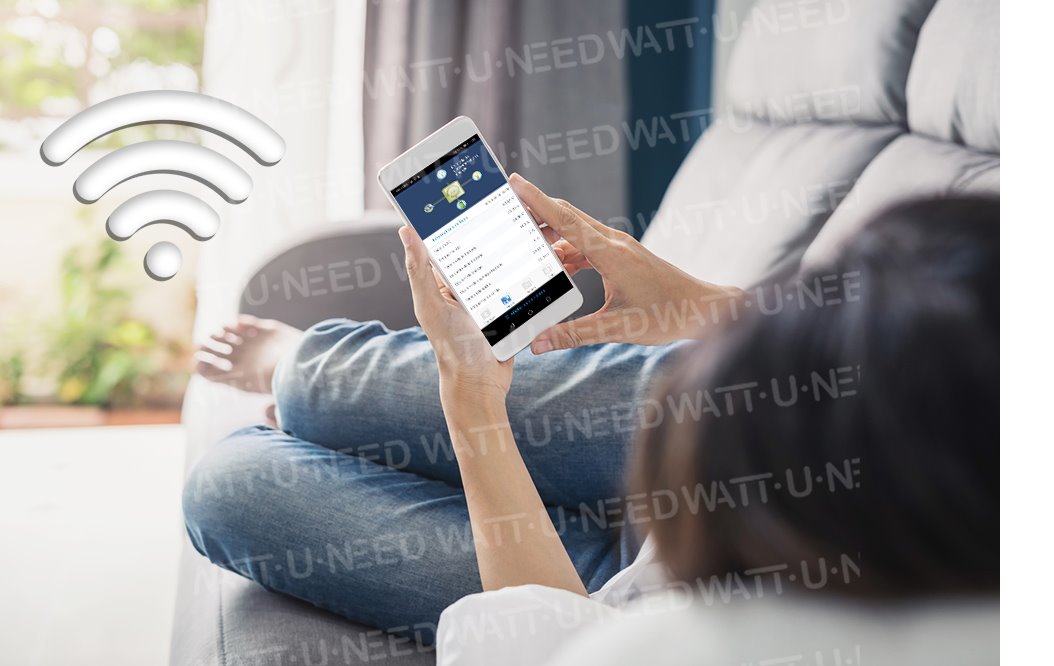 Wifi communication (WatchPower)
Set up your inverter and system, check your output and save your data from your smartphone!
The WKS Evo's Wifi app gives you easy access to all your system's information.
An example of the app's available pages is shown in the product images.
Enjoy continuous, reliable power, whether the grid is available or not. The energy produced by WKS inverters is directed and used intelligently for optimum performance. All priorities can be defined by the user: use of batteries, solar or AC source (grid or generator). In self-consumption, the energy produced by your panels fluctuates and does not correspond to consumption. The WKS inverter stores part of the solar output in the batteries for later use during the evening or night. On isolated sites, the WKS inverter can be connected to a generator to charge the batteries if they are empty and solar production is insufficient. This inverter is capable of working with several different energy sources, such as :
Microprocessor-based management directs energy according to production, consumption needs and battery state-of-charge. Real-time monitoring can be carried out locally or remotely. The WKS inverter does not feed power back into the grid.
1) Solar priority
2) Emergency
3) Solar and grid

The UPS can be used as a back-up without photovoltaic panels. In this mode, the UPS takes on the role of UPS, protecting your appliances from grid outages.
The UPS protects computers and audio-visual equipment, or any other sensitive load, by supplying a stable current. It guarantees uninterrupted power supply to consumers.
The electricity produced by these pure sinusoidal inverters is stable.
You can protect one or more rooms in your home via the distribution box.

In this configuration, the inverter uses the panels to power consumers and charge batteries when the sun is shining. The inverter draws power from the batteries to ensure energy distribution at night.
A generator can be added to the inverter's AC input to provide emergency power.
The inverter takes power from the grid only if the batteries are empty and solar production was not sufficient to cover consumption.
The inverter never feeds power back into the grid.
As with the "back-up" mode, you can connect only part of your domestic installation to the inverter. Consumers connected to the inverter will still be powered, even in the event of a mains power cut. What's more, they'll be supplied free of charge!
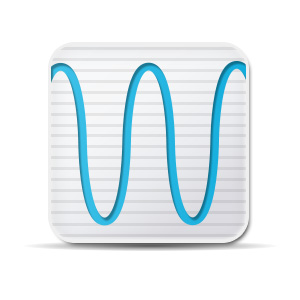
The WKS Evo MAX II is a pure sinusoidal voltage inverter that reproduces a power quality similar to that of the public grid. It can be used to power all types of appliance.
The WKS Evo MAX II integrates two MPPT charge controllers, each delivering a maximum charge current of 150A.

The WKS Evo MAX II also features MPPT (Maximum Power Point Tracking) technology, i.e. it constantly searches for the maximum power point, enabling maximum performance from photovoltaic panels. As well as providing a boost in power to an installation, it optimizes battery charging and extends their lifespan. It scans the panel voltage to find the maximum power output point, and is able to adapt the voltage supplied by the panel to match the voltage the battery can receive.

WatchPower 1.17SP1
WatchPower 1.17SP3
| MODEL | Axpert MAX II 10000 |
| Rated inverter power | 10000VA/10000W |
| PARALLEL CAPACITY | YES, |
| 6 units |
| INPUT |
| Voltage | 230 VAC |
| Selectable voltage range | 170-280 VAC (for computers) |
| Frequency range | 90-280 VAC (for household appliances) |
| AC voltage regulation (Mode Batt.) | 230 VAC ± 5%. |
| urge power | 20000VA |
| Efficiency (peak) | 93% |
| Transfer time |
|
15 ms (for personal computers),
|
|
20 ms (for household appliances)
|
| Pure sine wave |
| Vacuum power consumption | < |
| 0W |
| DC voltage | 12 VDC ± 5%, 100W |
| Dual outputs | Yes |
| BATTERY |
| Battery voltage | 48 VDC |
| Floating charge voltage | 54 VDC |
| Overload protection | 66 VDC |
| SOLAR CHARGER & |
| AC CHARGER |
| Type of solar charger |
| Maximum power of photovoltaic panel | 10000W (5000W x 2) |
| MPPT range at operating voltage | 90 ~ 450 VDC |
| Maximum voltage | |
| open circuit of photovoltaic panel | 500 VDC |
| Maximum solar load current | 150A |
| Maximum AC load current | 150A |
| Maximum load current | 150A |
| PHYSICS |
| Dimensions, | D X W X H (mm) | 158.4 x 503.6 x 530.8 |
| Net weight (kgs) | 20 |
| Communication interface | USB/RS232/RS485/Wifi/Dry contact |
| OPERATING ENVIRONMENT |
| Humidity | 5% to 95% relative humidity (non-condensing) |
| Operating temperature |
| 10℃ to 50℃ |
| Storage temperature |
| to 60℃ |
| STANDARD |
| Conformity Safety | CE |
| Product specifications are subject to change without notice |

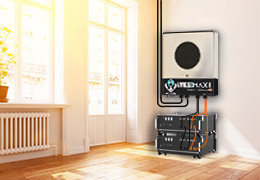 WKS Evo MAX II 10kVA: Energy autonomy at your fingertips
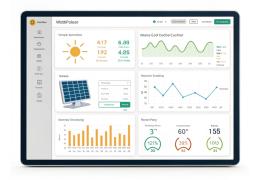 WatchPower: A Comprehensive Guide to Monitoring Your Solar Inverter
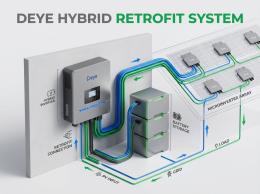 Solar Retrofit: Unlock the potential of your micro-inverters with a Deye inverter
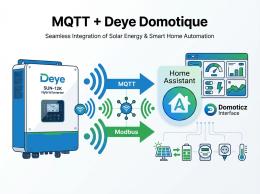 MQTT + Deye: 2 ways to integrate your inverter into your home automation system
WKS EVO MAX II Mono 10 kVA 48V Hybrid Inverter by WKS is available in our Hybrid inverters catalog.
Product weight: 25.0 kg. Reference: WKS-EVO-MAX-II.
check_circle
check_circle