Voltage
Technology
Brand
Price
Battery park
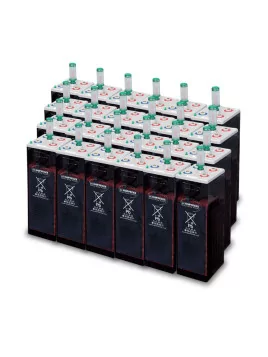
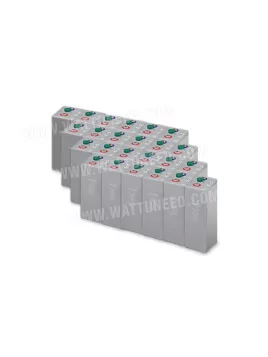
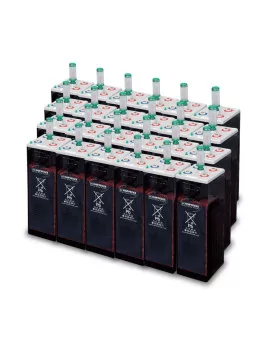
Our battery banks are pre-configured sets ready to deploy for off-grid installations in 12V, 24V or 48V. The benefit of a configured pack: compatible components, optimised wiring and tested performance — avoiding assembly errors and the efficiency losses that come from mismatched elements. Available in OPzS / OPzV technology (Hoppecke) for maximum professional autonomy, or in LiFePO4 lithium (Pylontech, BYD) for residential and semi-industrial installations. Use our sizing tool to calculate the capacity you need.
Choose in 30 seconds
- System voltage: choose 12V for small mobile systems, 24V for mid-range power, 48V for residential installations and high-consumption off-grid sites.
- Technology: OPzS/OPzV Hoppecke for maximum longevity (up to 8,000 cycles at 20% discharge) — professional sites, telecom, large off-grid. LiFePO4 lithium for compactness, modularity and residential or semi-industrial use.
- Autonomy: size in days of autonomy, not just kWh. Plan for 2 to 3 sunless days. Our sizing tool calculates optimal capacity based on your PV production and consumption.
- Wiring and assembly: check whether inter-cell wiring is included or optional. For 2V cell banks (OPzS/OPzV), plan sufficient space and appropriate cable cross-sections.
- Individual batteries: to build your own bank, see our OPzV/OPzS, lithium and AGM/GEL ranges.





Related posts




FAQ - Battery bank (pack)
Solar battery banks: complete guide to building your energy storage
A battery bank is an assembly of batteries configured to provide coherent, reliable energy storage capacity. Unlike buying individual batteries and assembling them yourself, a pre-configured bank guarantees component compatibility, optimised wiring and factory-tested performance. It is the preferred solution for professional installations, large-capacity off-grid sites and projects that cannot afford failures.
When to choose a battery bank over individual batteries?
- Large capacity (>20 kWh): beyond a certain volume, a configured bank is more reliable and cost-effective than DIY assembly.
- Professional installation: telecom, agriculture, industry — the bank is delivered with technical documentation and performance guarantees.
- Voltage or space constraints: 2V cell banks (OPzS/OPzV) allow you to build exactly the voltage needed (24V, 48V, 120V...) with optimal capacity.
- Turnkey project: if you want to avoid assembly and wiring, a ready-to-install bank is the solution.
The two main battery bank families
OPzS / OPzV banks — maximum longevity
Built from Hoppecke 2V tubular plate cells, these banks are the reference for installations requiring a 15 to 25-year lifespan with conservative discharge (20% daily). Sized for professional off-grid sites, telecom relays, agricultural installations and mountain refuges. See our OPzV and OPzS batteries for individual cells.
LiFePO4 lithium banks — compactness and modularity
Built from Pylontech, BYD or Dyness modules, these banks suit residential and semi-industrial installations prioritising compactness, easy installation and BMS communication with the hybrid inverter. See our LiFePO4 lithium batteries and inverter + battery packs.
How to size your battery bank
- Daily consumption (kWh/day): average 24h consumption including power peaks.
- Days of autonomy: 2 to 3 days for France and Belgium, 4 to 5 days for low-winter-sun regions.
- Admissible depth of discharge: 20% for OPzS/OPzV (8,000 cycles), 50% for AGM/GEL (500 cycles), 80% for lithium (5,000 cycles).
- System voltage: 12V, 24V or 48V depending on your converter/inverter.
Basic formula: Nominal capacity (kWh) = Daily consumption × Days of autonomy ÷ Admissible depth of discharge.
Use our battery sizing tool for automated calculation.
Wiring and assembly of a battery bank
The most common wiring errors:
- Insufficient cable cross-section: causes Joule losses and dangerous voltage drops under heavy load. Use our voltage drop calculator.
- Asymmetric parallel connections: batteries closest to the charger overcharge. Use cables of equal length and cross-section for all parallel connections.
- Mixing different technologies or ages: never mix different brands, models or battery ages in the same bank.