Voltage
Brand
Price
Lithium battery
Our lithium batteries (LiFePO4 technology) store the electricity from your solar panels for use in the evening, overnight or during a grid outage. With 4,000 to 6,000 charge cycles, 80–90% depth of discharge and high safety standards, they are today's benchmark for self-consumption with storage, off-grid sites and backup power. Available from Pylontech, BYD, Dyness and Wattuneed in 48V and high-voltage versions, modular and scalable. To compare technologies and cost per usable kWh, see our battery comparison guide.
Choose in 30 seconds
- Daily self-consumption: aim for 5 to 10 usable kWh to cover a standard overnight consumption. LiFePO4 technology recommended — best cost per kWh over lifetime.
- System voltage: 48V for most residential hybrid inverters. High voltage (100–400V) for premium inverters (Huawei, Sofar HYD-EP). Check compatibility before buying.
- Inverter compatibility: verify the BMS protocol (CAN bus or RS485) and the certified battery list for your hybrid inverter model.
- Modularity: Pylontech, BYD and Dyness ranges are stackable — start with 1 or 2 modules and add capacity later without changing the inverter.
- Off-grid site: size in days of autonomy (not just nights). Plan for 2 to 3 cloudy days depending on your region.
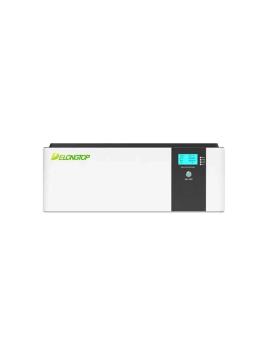
LiFePO4 lithium battery 5.12 kWh - Sofar Solar...
- On sale!
- -€127.60
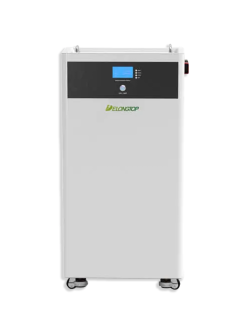
Marstek Venus-E-GEN-3.0 lithium battery - 51.2...
- On sale!
- -€227.99
FAQ - Solar batteries
Solar lithium batteries: complete guide to making the right choice
LiFePO4 (Lithium Iron Phosphate) technology has established itself as the benchmark for residential and semi-industrial solar energy storage. Exceptional longevity, high safety, deep discharge capability and modularity: it outperforms AGM and GEL technologies on almost every criterion.
Why choose a LiFePO4 lithium battery?
- Lifespan: 4,000 to 6,000 charge/discharge cycles — 10 to 15 years of daily use. An AGM battery lasts 500 to 1,200 cycles under the same conditions.
- Depth of discharge: 80 to 90% of nominal capacity is usable. AGM should not exceed 50% — at the same nominal capacity, a lithium battery gives you almost twice the usable energy.
- Safety: LiFePO4 is the most stable lithium chemistry. No thermal runaway risk, no dangerous gases during normal charging. Suitable for indoor installation.
- Charge/discharge efficiency: 95 to 98%, vs 80 to 85% for AGM. Less energy lost per cycle.
- Low self-discharge: less than 3% per month — ideal for seasonal installations (chalets, campervans).
How to size your lithium battery
1. What capacity (kWh)?
Estimate your overnight consumption — what you use between sunset and the next morning. For a standard home, this is typically 3 to 6 kWh/night. Add 20–30% margin to preserve cycle life. For off-grid sites, think in days of autonomy: 2 to 3 cloudy days depending on your region. Use our battery sizing tool for accurate calculations.
2. What voltage?
- 48V: standard for residential hybrid inverters up to ~6 kVA (Deye, Sofar ESI, WKS, SolaX...). Pylontech US3000/US5000 and BYD Battery-Box LV are the benchmarks in this segment.
- High voltage (HV): for premium inverters like Huawei SUN2000 (with LUNA2000) or Sofar HYD-EP. Lower currents, better efficiency at high power.
Compatibility with your hybrid inverter
This is the most important point to check before buying. Three parameters to verify:
- Battery voltage compatible with the inverter's input range
- BMS protocol: CAN bus or RS485 — without BMS communication, the inverter cannot intelligently manage the battery
- Maximum charge/discharge power consistent with the inverter
See validated combinations in our inverter + battery packs catalogue.
Brands available at Wattuneed
Pylontech
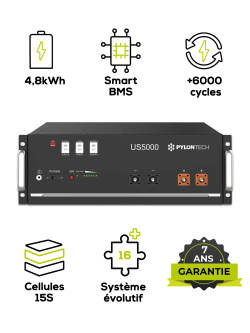
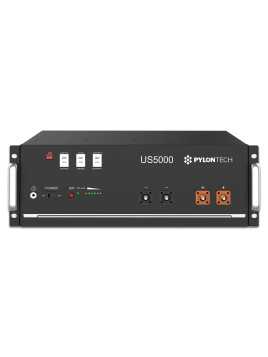
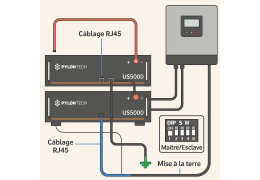
The global benchmark for residential LiFePO4 storage. US3000C (3.55 kWh) and US5000 (4.8 kWh) modules are stackable up to 8 units in parallel. Compatible with most hybrid inverters on the market.
BYD Battery-Box
BYD Premium LVL and HVS are the high-capacity ranges from one of the world's largest battery manufacturers. LV range for 48V installations, HV range for high-voltage inverters (SMA, Fronius, Huawei).
Dyness
Cost-effective alternative with good inverter compatibility. Dyness B4850 and Tower modules are a strong option for budget-conscious projects without sacrificing LiFePO4 technology.
Wattuneed
Our own lithium battery range, selected and tested for optimal compatibility with the inverters we offer. Controlled value for money and direct technical support.
Lithium vs AGM/GEL: the real comparison
To compare fairly, reason in cost per usable kWh over lifetime. A €1,000 AGM battery with 500 cycles at 50% DoD delivers 250 usable kWh over its life. A €1,500 lithium with 5,000 cycles at 80% DoD delivers 4,000 usable kWh. Lithium is 5 to 10 times cheaper per usable kWh. See our detailed technology comparison for all the figures.