Phase
Battery storage
Mains re-injection
Inverter power in VA
Basic storage (kWh)
Kit output voltage
Wind turbine
Price
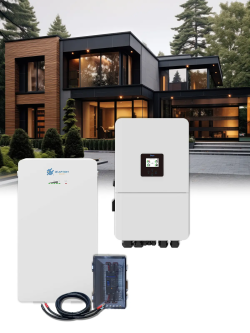
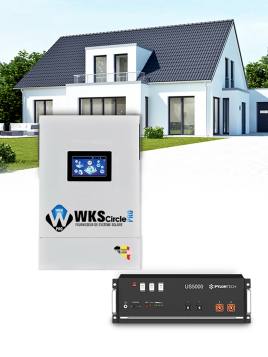
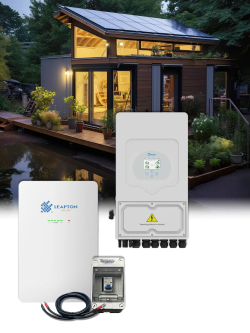
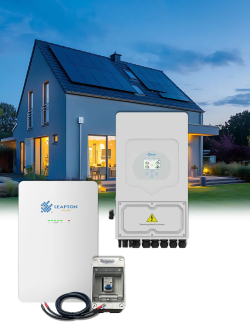
Inverter and battery packs
Optimise your solar self-consumption with our inverter and battery packs: a ready-to-install solution for storing excess production and using it in the evening or when needed. Choose your configuration (single/three-phase, kVA, kWh capacity) and stay in control with monitoring and control features.
An inverter and battery pack is ideal if you already have solar panels and want to add storage, or if you’re looking to replace your inverter with a battery-compatible hybrid model. It’s also the perfect solution for keeping your priority appliances running during a power cut, thanks to the backup function (EPS).
We offer packages comprising hybrid inverters from recognised brands (WKS, Sofar Solar) combined with LiFePO4 lithium batteries (Pylontech, Leapton, Sofar) — reliable, durable technologies with up to a 10-year battery warranty and over 6,000 charge cycles.
To quickly calculate your PV power requirements and confirm your choice, use the
Choose in 30 seconds
- Objective: store surplus energy for self-consumption, add a back-up, or retrofit an existing installation.
- Grid: check whether you have single-phase or three-phase power and the target power (kVA).
- Storage: choose the battery capacity (kWh) according to your usage (evening/night, priority appliances).
- I confirm: estimate PV production and power with the Solar Simulator.
See also


















Related posts


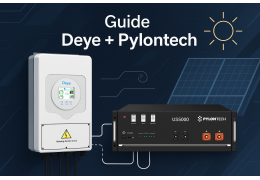

FAQ - Inverter & battery bundles
Inverter + battery pack: the simple way to add storage to your solar installation
An inverter + battery pack allows you to store the electricity produced by your solar panels for later use, in the evening, at night or during a power outage depending on the chosen configuration. It is the ideal solution if you want to increase your self-consumption rate, reduce the electricity you buy from the grid, or upgrade an existing installation toward a more autonomous system.
At Wattuneed, our packs combine hybrid inverters and compatible LiFePO4 lithium batteries to offer you coherent, reliable and ready-to-integrate combinations. The goal is simple: avoid compatibility issues between inverter, battery, voltage and BMS protocol, while making it easier to choose the right power and storage level.
In which cases should you choose an inverter + battery pack?
- You already have solar panels and want to store your surplus instead of feeding it back into the grid or losing it.
- You are replacing an existing inverter and want to move directly to a hybrid architecture compatible with batteries.
- You are looking for a back-up / EPS function to power certain priority circuits in the event of a blackout.
- You want an expandable solution with monitoring, control and possible storage extension.
Why choose a pack rather than a separate inverter and battery?
On paper, assembling a hybrid inverter and battery yourself may seem simple. In practice, you need to check battery voltage (48V or high voltage), BMS communication protocol (CAN, RS485), charge and discharge power, current limits, and backup operating conditions. A validated pack helps avoid these mistakes and gives you a combination already designed to work together.
If you want to compare the different inverter families before choosing, you can browse our hybrid inverters. To explore the storage side in more detail, you can also visit our lithium batteries category.
How to size your pack correctly
Proper sizing is based on two different figures that should not be confused:
- Inverter power (kVA): this must cover the simultaneous consumption peaks of your home or your priority circuits.
- Battery capacity (kWh): this determines how much energy you can store and use later.
In other words, the inverter answers the question “how much power can I draw at the same time?”, while the battery answers “how long can I run on stored energy?”. A well-chosen pack must therefore be coherent with your solar production, your evening usage, your consumption profile and your goal: optimized self-consumption, backup power or partial autonomy.
To estimate your production and better define your project, you can use our solar study. To refine the storage size, our battery calculator is also an excellent starting point.
48V or high voltage: which architecture should you choose?
48V systems remain the main reference for standard residential installations and moderate power levels. They are proven, widely compatible and well suited to domestic storage projects. High-voltage systems become especially interesting for more ambitious configurations, with higher power levels, a search for greater performance, or a specific manufacturer ecosystem.
The right choice therefore depends on your inverter, the target battery and the level of expandability you are looking for. If you are hesitating between several technologies, also consult our battery comparison.
Back-up / EPS: what you really need to understand
Not every battery pack necessarily powers the whole house during a blackout. Backup must be designed as a feature to be sized: which circuits do you want to keep running? Fridge, lighting, internet box, freezer, pump, a few priority sockets? The higher your needs, the more you need to adjust inverter power and storage capacity.
So the right approach is not simply to look for “the biggest pack”, but to choose a solution that matches your real usage. This is especially important in a retrofit project, where the existing installation can sometimes impose technical limits.
For which uses are these packs most relevant?
- Residential self-consumption: store the solar surplus produced during the day and use it in the evening.
- Homes with occasional outages: secure essential appliances thanks to a backup function.
- Photovoltaic retrofit projects: add storage to an installation already in service.
- Scalable projects: start with a coherent base and later expand storage according to your needs.
Stop the prosumer tax: the solution in Belgium!
● This video explains how to avoid the prosumer tax in Belgium with a solar battery. Discover how to optimise your self-consumption, reduce your electricity bills and gain energy independence.