By Julien Mawet· Solar PV Expert at Wattuneed•Updated April 2026
€3,493.44
Tax included
36XLP182*182-M-54-NB-450Wc
0768563822063
Discover the Leapton N-Type 450Wp TOPCon bifacial solar panel, a high-performance, sustainable solution for maximising energy production while optimising your yield. Ideal for your renewable energy projects, it helps you reduce your energy costs and do your bit for the environment.
High performance: TOPCon technology and double glass for optimum energy efficiency.
Increased durability: Low degradation and resistance to climatic conditions for superior longevity.
Why choose the N-Type TOPCon bifacial solar panel?
This solar panel is designed to maximise energy production thanks to its bifacial technology, which captures light from both sides. This optimises your energy yield and reduces your electricity bill. With an extended lifespan and performance guarantee, it's a reliable and profitable investment.
Ready to invest in solar energy?
Contact our experts for a personalised study and a free quote.
Leapton solar panel N-Type 450Wp TOPCon Bi-glass Bifacial Full Black
N-Type TOPCon Bi-glass cells - Bifacial technology - Premium Full Black design - Maximum efficiency.
⚡
450Wp
Power
🔬
N-Type TOPCon Bi-glass
Cell technology
📊
Maximum
Efficiency
🏆
Performance
30-year guarantee
Minimum unspecified value
🏆 GUARANTEES
Your investment 100% protected
25
Product warranty
Material & manufacturing defects
25-year guarantee
30
Performance
Unspecified value guaranteed power
30 years linear
📜
Certifications
European conformity
CE - TÜV - IEC
✨ Total peace of mind: your solar installation protected by Leapton, a recognised technology leader
🌱 Revolutionary photovoltaic innovation
The Leapton N-Type 450Wp TOPCon bifacial incorporates N-Type TOPCon technology with bifacial bi-glass, guaranteeing maximum yield in all light conditions. It's the optimal choice for maximising energy production thanks to solar capture on both sides of the panel.
🔬 Integrated technologies:
✓N-Type TOPCon Bi-glass cells
✓Bifacial technology (+5% to +25%)
✓Optimised PID
📐 Key specifications
450W
Power Pmax
1762 mm
Length
1134 mm
Width
25 kg
Weight
🏭
Premium manufacturer
Leapton Solar
World technology leader Innovation N-Type TOPCon
💡 WHAT MAKES THE DIFFERENCE
Why choose Leapton 450Wp TOPCon?
1. Advanced bifacial technology
Bifacial technology captures solar energy on both sides of the panel, offering an extra 5% to 25% yield depending on installation conditions. Ideal for maximising production per square metre.
2. Extreme resistance tested
The panel is tested against wind (2400 Pa) and snow (5400 Pa), guaranteeing safe, durable installation even in the harshest weather conditions.
3. Double glass for maximum durability
The double-glazed construction offers superior protection against the elements and mechanical stress, ensuring stable performance over 30 years with little degradation.
4. Exceptional warranty
This panel is covered by an outstanding double guarantee: 25 years product (defects and materials) and 30 years performance, offering total peace of mind and an excellent return on investment.
✅ Quality assurance and compliance (C.D.A)
Every Leapton TOPCon panel is certified to the highest industry standards.
🌍
International standards
IEC 61215 & 61730
European CE mark
TÜV Rheinland certification
🌱
Management systems
ISO 9001 (Quality)
ISO 14001 (Environment)
Safety IEC 61730
🛡️
Extreme resistance
Resistance RG4 (Anti-hail)
Snow load (5400 Pa)
Wind load (2400 Pa)
⭐ Technical benefits
Discover the innovations that make the difference
🛡️
N-Type TOPCon technology
High efficiency with 182*188 mm half-cells Optimised PID and low degradation
Low-light performance
Optimal
⚡
Exceptional efficiency
Optimised bifacial efficiency Maximum output per m²
Bifacial gain
+5% à +25%
🎨
Full Black bi-glass design
High-end aesthetics Perfect architectural integration and double glass for increased durability and resistance to weather and mechanical stress.
Construction
100% Black
🌡️
Performance in all conditions
Maximum efficiency even in low light and variable exposure. Extreme climatic resistance
Temperature range
-40°C to +85°C
🏠 Optimum applications
Recommended configurations to maximise efficiency
🏘️ Residential
Single-family homes and detached houses
Optimum output: South-facing, 30° tilt Installation: Integrated or surface-mounted
Commercial buildings
Offices, warehouses, shopping centres
Benefit: High efficiency per m² Solution: Flat or pitched roofs
🌾 Ground-mounted and solar parks
Agricultural installations and solar power plants
Performance : High energy density Installation : Fixed structures or tracking
🌿 Agri-voltaics
Systems combining agriculture and solar production
Advantage : Optimal bifacial collection Function : Cultivation + energy production
N-Type TOPCon technology offers higher efficiency than conventional panels, especially in low light. Dual-Glass (Bi-glass) means the cells are encapsulated between two glass layers, which enhances the panel's durability and mechanical resistance.
2. What is the benefit of "Bifacial" yield?+
A bifacial panel captures light on both sides. Depending on installation conditions (ground reflection, albedo), this can result in an additional production gain ranging from +5% to +25% compared to a monofacial panel.
3. What warranties are offered by Leapton Solar?+
This panel benefits from exceptional protection: a 25-year product warranty (against manufacturing defects) and a 30-year linear performance warranty, ensuring stable energy production over the very long term.
4. Does the Full Black design compromise efficiency?+
No. Thanks to TOPCon innovation, Leapton manages to combine a premium Full Black aesthetic with peak performance. It is the ideal solution for residential projects where architectural integration is a priority.
5. How does the panel react to extreme weather conditions?+
This panel is built for robustness. It has been tested to withstand snow loads of 5400 Pa and wind loads of 2400 Pa. It is also RG4 certified against hail, guaranteeing reliability from -40°C to +85°C.
6. What are the dimensions and weight of the panel?+
The panel measures 1762 mm in length and 1134 mm in width. Its weight is 25 kg, which is justified by its robust double-glass (bi-glass) construction.
7. Which inverters is this panel compatible with?+
Thanks to its standard MC4 connectors and IP68 junction box, it is compatible with the vast majority of residential inverters, micro-inverters, and power optimizers on the market.
8. What certifications accompany this product?+
The Leapton TOPCon panel is certified according to the strictest international standards: IEC 61215 & 61730, European CE marking, and TÜV Rheinland certification, ensuring full compliance with safety and quality requirements.
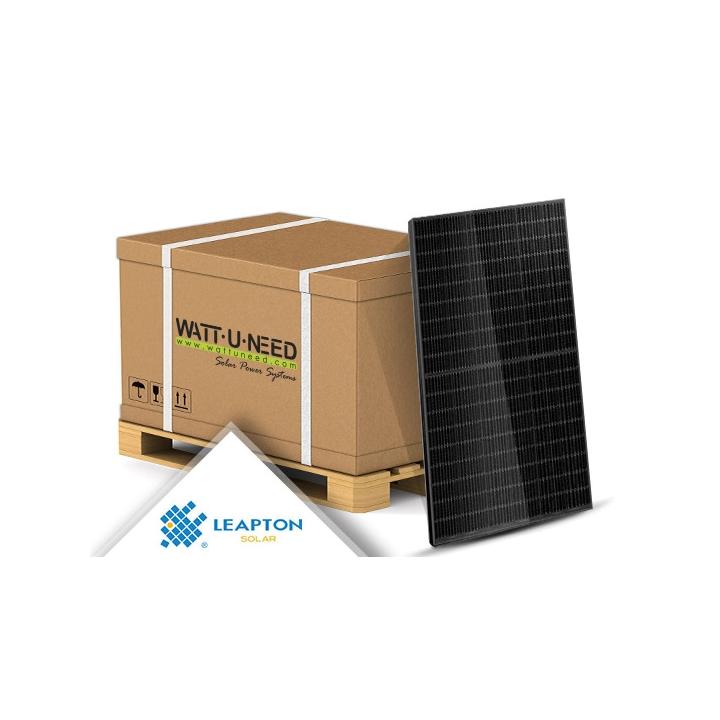
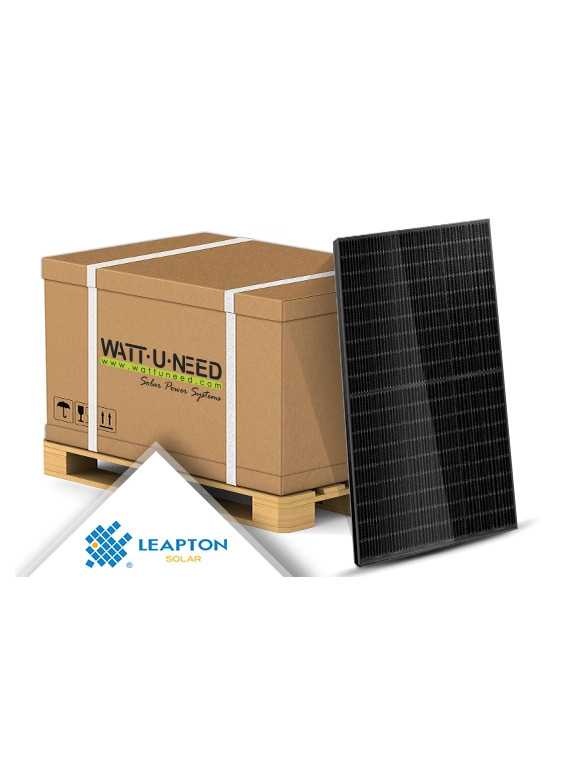
36X Leapton N-Type 450Wp TOPCon bifacial vane – Optimised Solar Panel Efficiency — Pallet of panels
36X Leapton N-Type 450Wp TOPCon bifacial vane – Optimised Solar Panel Efficiency by Leapton Solar is available in our Pallet of panels catalog.
Product weight: 930.0 kg. Reference: 36XLP182*182-M-54-NB-450Wc.

 XBC vs ABC Solar Panels: A Technological Revolution for Optimal Performance