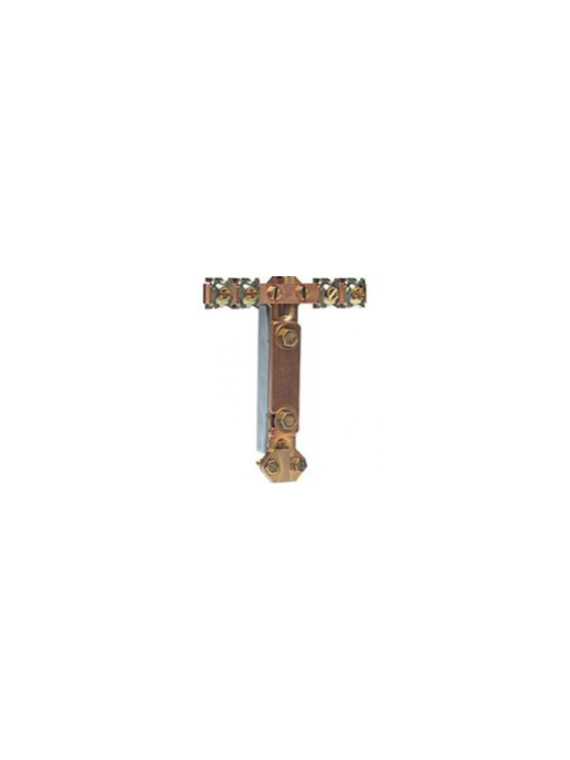
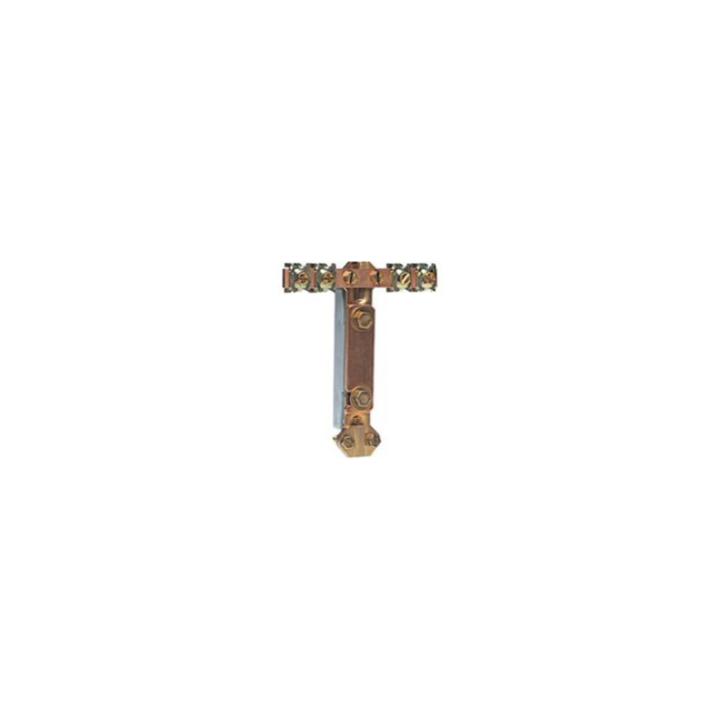
T 45x10mm Low Earth Switching Strip - Compulsory Device for Measuring Earth Resistance
The low earth terminal block (reference BIZ710427) is an essential component of any domestic, commercial or photovoltaic electrical installation. It is the removable link between the main protective conductor (earth cable coming from the electrical panel) and the earth rod (or ground loop).
Its main purpose is to enable the earth resistance to be measured without having to physically disconnect the cables. By opening the strip with a spanner or screwdriver, the electrician or inspection body can isolate the earth connection from the rest of the installation and take a precise measurement using a tellurometer (earth ohmmeter). This measurement is compulsory when a new installation is handed over and during regulatory periodic inspections.
Function and purpose of the earthing terminal block
The earthing system meets a number of regulatory and technical requirements:
- Earth resistance measurement: Used to check that the resistance of the earth connection complies (≤ 100 Ω for domestic installations, ≤ 30 Ω recommended for installations with lightning arresters). Without a bar, the cables would have to be disconnected manually, a time-consuming and risky operation.
- Checking the surge arrester's effectiveness: Type 1 and Type 2 surge arresters require a low earth resistance to discharge surges effectively. The strip allows this resistance to be checked regularly.
- Regulatory obligation: Standard NF C15-100 (France) and the RGIE (Belgium) require the presence of an accessible disconnecting strip for regulatory checks (acceptance, periodic inspection, sale, hire).
- Worker safety: Allows the earth to be isolated for specific work (addition of extra poles, earth connection repairs, etc.) without any electrical risk.
- Fault diagnosis: In the event of an unexplained differential trip, the strip can be used to test whether the fault is coming from the earth connection or the internal installation.
Measurement principle: The electrician opens the terminal block (physical separation of the circuit), then connects the tellurometer between the two separate parts. The device injects a test current and measures the resistance. A resistance ≤ 100 Ω validates compliance. If higher, additional earth rods must be added.
Technical characteristics and design
This low-lying isolating strip features a modern, safe design:
- High-strength plastic insulation: Unlike older terminal blocks with a visible metal plate, this terminal block incorporates a robust plastic insulation that :
- Avoids the risk of accidental contact with live metal parts (enhanced safety)
- Eliminates the risk of overheating due to the Joule effect on an incorrectly sized metal plate
- Resists mechanical shock and vibration
- Protects against moisture and corrosion (outdoor installations)
- Optimised T-shape: Dimensions 45 + 8 x 10 mm. The T-shape allows :
- Optimum clamping of cables from 4 to 10 mm in diameter (cross-sections 6 mm² to 35 mm²)
- Even distribution of clamping pressure (no points of excessive stress)
- Stable, robust wall mounting
- Generous copper cross-section: copper inner conductor with a suitable cross-section (≥ 35 mm²) to carry fault currents (several hundred amperes for a few milliseconds) without overheating.
- Mechanical disconnection system: Square-head or hexagonal clamping screw (depending on manufacture). Open/close with Allen key or screwdriver. Robust mechanism withstands hundreds of operations.
- No integrated mounting plate: streamlined design. Mounted directly on the wall or in a dedicated box using the mounting accessories supplied (screws, plugs). Benefit: more compact, flexible installation.
Detailed technical specifications
| Paramètre |
Valeur |
| IDENTIFICATION |
| Référence fabricant |
BIZ710427 |
| Type |
Barrette de coupure basse terre |
| Avec platine de fixation |
Non (fixation directe) |
| DIMENSIONS ET CONCEPTION |
| Format |
T (forme en T) |
| Dimensions principales (mm) |
45 + 8 x 10 |
| Poids approximatif (g) |
150 |
| CONDUCTEURS ET RACCORDEMENT |
| Diamètre câble accepté (mm) |
4 à 10 |
| Section cuivre recommandée (mm²) |
16 à 35 |
| Section cuivre barrette (mm²) |
≥ 35 |
| Type de borne |
Vis de serrage mécanique |
| Nombre de connexions |
2 (entrée/sortie) |
| MATÉRIAUX |
| Isolant |
Plastique haute résistance (ABS ou PA) |
| Conducteur interne |
Cuivre électrolytique |
| Vis de serrage |
Acier zingué ou laiton |
| CARACTÉRISTIQUES ÉLECTRIQUES |
| Courant nominal |
Non applicable (liaison terre) |
| Courant de défaut supporté (instantané) |
Plusieurs kA (court-circuit phase-terre) |
| Résistance de contact |
< 0,1 mΩ (serrage correct) |
| CONDITIONS D'EXPLOITATION |
| Température de fonctionnement (°C) |
-20 à +60 |
| Installation |
Intérieure ou extérieure (dans coffret IP54) |
| Hauteur d'installation recommandée |
30 cm du sol (norme NF C15-100) |
| NORMES ET CONFORMITÉ |
| Norme installation électrique |
NF C15-100 (FR) / RGIE (BE) |
| Norme photovoltaïque |
UTE C15-712-1 |
| Conformité |
CE |
Installation and Regulatory Positioning
The positioning of the earthing strip complies with strict rules:
Authorised locations in accordance with NF C15-100 and RGIE:
- In the technical housing duct (GTL): this is the preferred location for single-family homes. The terminal block is fixed to the wall of the GTL, between the electrical panel and the floor. Recommended height: 30 cm from the floor.
- Near the earthing rod (outside): In single-family homes, the terminal strip can be installed outside in a watertight box (minimum IP54), fixed to the wall near the point where the earthing cable enters the building.
- In a technical room: cellar, garage, laundry room. The terminal strip must be accessible without dismantling equipment or moving furniture.
- PROHIBITED: In a habitable dwelling (bedroom, living room), in a locked cupboard, under an inaccessible trapdoor, in an inaccessible crawl space.
Installation procedure:
- Switch off the mains supply: Switch circuit breaker to OFF position. Check absence of voltage with VAT.
- Prepare the cables:
- Cable from the electrical panel (main earth terminal block): minimum cross-section 16 mm² (25 mm² recommended).
- Cable to earth rod (or underground loop): same cross-section.
- Strip conductors over 15 mm
- Fix the strip to the wall: Drill 2 to 4 holes (depending on model). Insert wall plugs to suit the surface (concrete, brick, plasterboard). Screw the strip in place. Recommended height: 30 cm from the floor.
- Connect the cables:
- Insert the switchboard cable into a terminal
- Insert the earth spike cable into the other terminal.
- Tighten the clamping screws firmly (tightening torque: 2-3 N.m, do not exceed to avoid crushing the copper).
- Check tightening: pull slightly on the cables. They must not move.
- Label the bar: Affix a label "EARTH BAR - DO NOT REMOVE".
- Carry out the earth measurement: Open the terminal block and measure the earth resistance using a tellurometer. Must be ≤ 100 Ω. Close the terminal block.
- Final check: Reset the connection circuit breaker. Check that there is no differential tripping.
Professional tip: Protect the terminal strip with a transparent plastic cover (available separately) to prevent accidental tampering (children, pets) while allowing visual inspection.
For a detailed installation guide with photos, consult our technical support centre.
Measuring Earth Resistance - Procedure
Measuring earth resistance is a compulsory regulatory operation. Here is the procedure:
Equipment required:
- Digital or analogue tellurometer (earth ohmmeter)
- 2 auxiliary rods (supplied with the tellurometer)
- Measuring cables (supplied with the tellurometer)
- Allen key or flathead screwdriver (to open the bar)
Measurement procedure (62% method):
- Open the cut-off strip: Insert the Allen key or screwdriver into the cut-off screw. Unscrew until the two parts are completely separated. Check the separation with a multimeter (infinite resistance between the two terminals).
- Plant the auxiliary posts:
- Voltage rod (H): approximately 25 metres from the earth rod to be tested.
- Current rod (S): approximately 40 metres from the earth rod to be tested (62% method: rod H is 62% of the distance between the main rod and rod S).
- Connect the tellurometer:
- Terminal E (earth): on the terminal strip on the earth spike side
- H terminal (voltage): on auxiliary post H
- Terminal S (current): on auxiliary pole S
- Take the measurement: Start the measurement on the tellurometer. The device injects a test current and displays the resistance in Ohms (Ω). Wait for the value to stabilise (a few seconds).
- Interpret the result:
- ≤ 30 Ω: Excellent (recommended for installations with lightning arresters)
- 30-50 Ω: Good (acceptable for domestic installations)
- 50-100 Ω: Acceptable (regulatory upper limit)
- > 100 Ω: Non-compliant. Add additional ground stakes in parallel or improve soil quality (bentonite, salt)
- Close the clamp again: Screw the clamping screw back in until the two metal parts are in firm contact. Tighten firmly (torque 2-3 N.m).
- Record the measurement: Note the value in the electrical installation logbook. Mandatory for statutory inspections.
Frequency of measurements: Compulsory measurement on initial acceptance (new installations), then every 5 years for domestic installations (Belgian RGIE). Recommended every 2-3 years for photovoltaic installations with lightning arresters.
Importance for photovoltaic installations
The earthing strip is particularly critical for solar installations:
- Earthing the panel frames: The metal structures supporting the solar panels must be earthed. The strip can be used to check that this connection is effective (low resistance).
- DC lightning arrester protection: DC lightning arresters (on the panel side) discharge overvoltages to earth. A high earth resistance (> 30 Ω) considerably reduces the surge arrester's effectiveness, putting the inverter and batteries at risk.
- AC surge protection: AC surge protectors (mains side) also require effective earthing to discharge lightning currents. Recommended resistance: ≤ 10 Ω for Type 1 surge protectors, ≤ 30 Ω for Type 2 surge protectors.
- Compliance with UTE C15-712-1: The French photovoltaic standard requires earthing to be measured on receipt and periodically checked. The barrette is mandatory for these measurements.
- Fire prevention: Poor earthing can cause arcing in metal structures (leakage currents, insulation faults). The terminal block enables these faults to be detected before they get out of hand.
- Personal safety: The solar panels remain live even when the circuit-breaker is switched off (DC voltage on the panel side). The earth protects against indirect contact (live metal frames following an insulation fault).
Recommended resistance values depending on installation:
| Type d'installation |
Résistance terre max (Ω) |
Recommandation |
| Domestique standard sans parafoudre |
100 |
Conforme réglementaire |
| Domestique avec parafoudre Type 2 |
30 |
Recommandé fortement |
| Photovoltaïque résidentiel avec parafoudre Type 2 |
30 |
Obligatoire UTE C15-712-1 |
| Photovoltaïque avec parafoudre Type 1 |
10 |
Obligatoire NF C15-100 |
| Installation professionnelle/industrielle |
10-30 |
Selon puissance |
To correctly size your earthing system, consult our earthing calculator.
Standards and regulatory compliance
The earthing system is governed by several standards:
- NF C15-100 (France): Low-voltage electrical installation standard. Imposes :
- Presence of an accessible earthing strip
- Installation height: minimum 30 cm from the ground
- Earth resistance measurement at reception (≤ 100 Ω)
- Section of main protective conductor: 16 mm² minimum (25 mm² if length > 25 m)
- RGIE (Belgium): General Regulations on Electrical Installations. Imposes :
- Compulsory disconnecting strip for all installations
- Earth measurement on acceptance and every 5 years (periodic inspection)
- Resistance ≤ 30 Ω for domestic installations (recommendation)
- Certificate of compliance issued by an approved body (Vinçotte, BCCA, AIB, etc.)
- UTE C15-712-1 (Photovoltaic): Specific standard for photovoltaic installations. Imposes :
- Earth resistance measurement on commissioning
- Resistance ≤ 30 Ω recommended for Type 2 lightning arrester efficiency
- Earthing of all metal masses (panel frames, enclosures)
- IEC 60364 (International): International reference standard for electrical installations. Defines the principles of earthing and protection against electric shock.
Statutory inspections: In Belgium, electrical installations must be inspected by an approved body when they are initially accepted, and then every 5 years (25 years for recent new installations). The inspector systematically checks the presence of the isolating strip and measures the earth resistance.
For more information on photovoltaic standards, see our guide to photovoltaic standards.
Advantages of this Low Voltage Switching Strip
- High-safety plastic insulation: Eliminates the risk of accidental contact and overheating. Safer than models with a visible metal plate.
- No fixing plate: more compact and flexible installation. Takes up less space in the wiring compartment or an enclosure.
- Optimised T-shaped format: accepts cables from 4 to 10 mm (cross-sections 6-35 mm²). Compatible with most residential and commercial installations.
- Easy to open and close: Allen key or flathead screwdriver. No need for specialist tools.
- Maximum durability: Electrolytic copper conductor, zinc-plated steel or brass screw. Corrosion and vibration resistant.
- Complies with 2025 standards: Meets NF C15-100, RGIE, UTE C15-712-1 requirements.
- Value for money: Economical solution for a mandatory regulatory component.
- Indoor or outdoor installation: UV- and weather-resistant plastic (in weatherproof box).
- Versatility: Suitable for domestic, commercial, light industrial and photovoltaic installations.
Recommended complementary products
For a complete, compliant earthing system, see our compatible products:
Copper-plated Steel Earth Spike 150 cm
20A DC Lightning arrester box
AC 50A Single-Phase Lightning Arresters
AC 2 Input Surge Protector
Need help sizing your earthing system? Consult our photovoltaic toolbox or contact our technical support.
Maintenance and Periodic Checks
To guarantee the efficiency of your earthing system:
- Annual visual inspection: Check that there is no corrosion on the terminals, that the cables are in good condition (no visible oxidation of the copper) and that the screws are tight (no loosening).
- Resistance measurement every 5 years: Compulsory under Belgian RGIE. Recommended every 2-3 years for photovoltaic installations.
- After a violent storm: Visually check the terminal strip. If differential tripping is unexplained, measure earth resistance (possible damage to earth connection following indirect lightning strike).
- Tightening connections: Every 2-3 years, slightly tighten the cable clamping screws (thermal expansion can loosen the connections). Do not overtighten (risk of crushing the copper).
- Cleaning: Clean the outside of the terminal strip (dust, cobwebs). Never use aggressive chemicals (risk of damaging the plastic).
Replacing the terminal strip: If there is significant corrosion of the terminals, cracks in the plastic, or the cables cannot be tightened properly, replace the terminal strip. Normal service life: 20-30 years.
Order your low earth terminal blocknow and ensure your electrical installation complies with regulations!