Type of need
Number of panels
Phase
Battery storage
Mains re-injection
Inverter power in VA
Base power (kWp)
Basic storage (kWh)
Kit output voltage
Wind turbine
Price
Solar kit
Our solar kits allow you to produce your own photovoltaic electricity for self-consumption, off-grid autonomy, or a Plug & Play installation without any work (balcony, terrace). Complete kits with conversion (micro-inverter or hybrid inverter) and optional lithium battery storage. To estimate your production, use our solar simulator.
Choose your solar kit in 30 seconds
- Use: self-consumption, autonomy (remote location) or ready-to-connect kit.
- Power: depending on consumption and available surface area.
- Conversion: micro-inverter (simplicity) or hybrid inverter (scalable + battery possible).
- Storage: lithium battery to increase autonomy and reduce grid purchases.
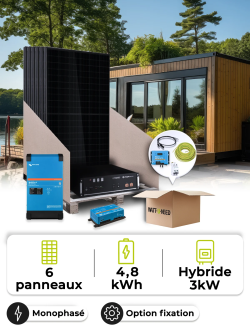


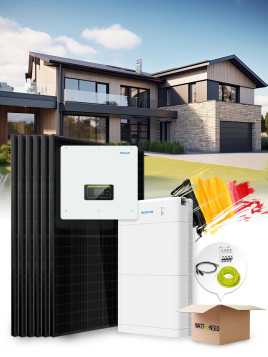


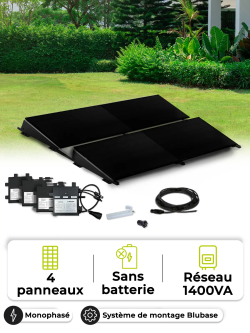


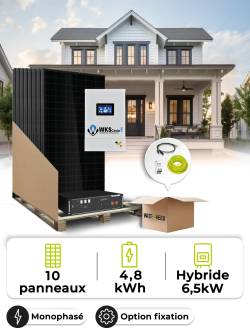


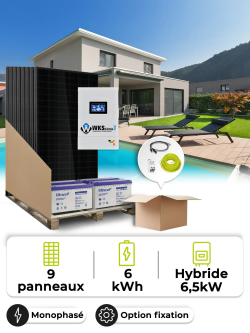


Related posts

FAQ – Solar kits
Solar kits: everything you need to know before choosing your photovoltaic system
A photovoltaic solar kit is the most straightforward way to produce your own electricity—whether you want to lower your bill, equip an off-grid site, or simply test self-consumption without major work. At Wattuneed, each kit is designed so that all components work together from day one: panels, conversion, protections, cables, and a battery if needed. The result: you save time, avoid compatibility mistakes, and start from a solid, reliable base.
The 3 main families of solar kits
Before comparing power ratings and prices, the first question to ask is simple: what is your goal?
Self-consumption solar kits
You stay connected to the power grid, but you use what your panels produce first. The idea: cover your daily “base load” (appliances, heat pump, water heater...) and buy less electricity. These kits can be set up with or without feed-in depending on the regulations in your country (France, Belgium, Luxembourg). This is the most popular solution for a home that is already connected to the grid.
Off-grid solar kits – isolated site
Here, there is no grid: your kit has to manage everything, from production to storage. This is the typical setup for a cabin, outbuilding, garden shed, mobile home, or remote land. Depending on the required power, systems are built in 12V/24V (light usage) or 230V (full residential comfort). A battery is essential here to get through the night and cloudy days.
Plug & Play solar kits
The ideal entry point to get started without an electrician or major work. You plug the micro-inverter into a dedicated outlet, face your panels south, and you’re good to go. These balcony or terrace kits are perfect for testing self-consumption and understanding how it works before investing in a full installation.
How to size your solar kit without making mistakes?
Sizing is based on 3 key figures. Take the time to estimate them before ordering—a kit that’s too small won’t cover your needs, and a kit that’s too large is wasted money.
- Panel power (Wp or kWp): the more Wp you install, the more you produce—provided you have the surface area and the right orientation. In France and Belgium, 1 kWp well oriented due south generates between 900 and 1,100 kWh/year depending on the region.
- Conversion power (inverter, in kW or kVA): this is the “engine” of your system. It converts the panels’ DC power into usable 230V AC. It must match both the PV power and your peak consumption (pump, tools, air conditioning...).
- Battery capacity (kWh): it shifts the energy produced during the day to the evening, or provides autonomy on an off-grid site. A good reference point: how many hours (or days) do you want to run without sun or the grid?
To go faster, use our solar simulator: it calculates your estimated production based on your roof’s orientation, tilt, and location.
Micro-inverter or hybrid inverter: which one to choose?
This is often the question that blocks beginners. Here’s the distinction that really matters in practice:
- Micro-inverters: each panel has its own converter. Highly relevant if you have partial shading (tree, chimney), multiple roof faces with different orientations, or if you want a modular approach. Not designed for battery storage.
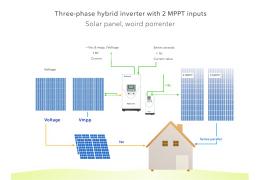
- Hybrid inverter: a single central inverter that manages PV production, grid feed-in, and battery charge/discharge. This is the go-to choice if you are considering storage—now or in the medium term. Hybrid inverters enable a scalable architecture: you start without a battery, then add one later without changing the converter.
Wattuneed tip: if you think you might add a battery within the next 2 to 3 years, go straight for a hybrid architecture. It avoids paying twice for conversion.
Do you need a battery from the start?
Not necessarily—it all depends on your use case and your budget.
- In self-consumption, you can first optimize daytime usage (dishwasher, washing machine, water heater on a timer), then add a lithium battery when you want to increase evening usage.
- On an off-grid site, the battery is generally essential from the start: without a backup grid, you need storage for nights and overcast days.
- For a backup (anti-blackout) kit, the battery is also central to the system: it takes over within a few milliseconds if the grid goes down.
What to check before placing your order
- Your available space (roof, ground, carport) and its orientation (due south = optimal, east/west = acceptable with more panels)
- Your main goal: reduce the bill, zero feed-in, full or partial autonomy
- Your grid type: single-phase (the vast majority of homes) or three-phase (often homes with heat pumps or professional use)
- Your power peaks: a heat pump, an oven, and an EV charger starting at the same time require an inverter sized accordingly
- If battery: the technology (preferably lithium LFP) and the capacity in kWh consistent with your nighttime consumption
Still unsure which kit is right for you? Our technical team offers a personalized solar study to frame your project before purchase.