Voltage
Price
OPzV and OPzS batteries
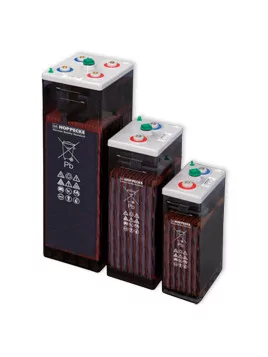
OPzV and OPzS batteries are the benchmark for long-life solar storage in professional off-grid sites, telecom installations and industrial battery banks. Thanks to their tubular plates, they reach up to 8,000 cycles at 20% daily discharge — unmatched longevity in the lead-acid world. OPzS (liquid electrolyte, DIN compliant) delivers maximum cycles with periodic maintenance. OPzV (gel electrolyte) adds maintenance-free operation. Available from Hoppecke, the world leader in industrial tubular batteries.
Choose in 30 seconds
- OPzV or OPzS: OPzV (gel) = maintenance-free, ideal for remote sites or enclosed spaces. OPzS (liquid electrolyte) = maximum cycles, periodic maintenance (distilled water), for installations with available technician.
- Record longevity: aim for a maximum 20% daily discharge to reach 8,000 cycles. At 50% daily discharge, lifespan drops to approximately 1,500 cycles.
- 2V cell format: OPzV/OPzS are generally sold as individual 2V cells to be assembled in series. For a 48V bank, you need 24 cells in series. Plan space and cabling accordingly.
- Professional applications: telecom, off-grid sites with regular consumption, off-grid datacentres, agricultural and industrial installations — this is where OPzV/OPzS outperforms all other technologies over time.
- Compact alternative: for residential use or tighter budget, see our LiFePO4 lithium batteries or our AGM/GEL batteries.


Related posts





FAQ - OPzV / OPzS Batteries
OPzV and OPzS batteries: complete guide to long-life storage for professional off-grid installations
OPzV and OPzS batteries represent the pinnacle of lead-acid technology in terms of cycle life. Originally developed for the telecommunications and railway industries, they have become the benchmark for large-capacity solar battery banks on professional off-grid sites. Their absolute strength: unmatched cycle life in the lead-acid world, conditional on rigorous sizing.
OPzS vs OPzV: the essential differences
OPzS battery (liquid electrolyte, tubular plates)
- Maximum cycles: up to 8,000 cycles at 20% discharge, 1,500 cycles at 50% — the best longevity in the lead-acid market.
- Maintenance: periodic distilled water top-up required. Proper ventilation of the installation room is mandatory.
- DIN compliance: OPzS batteries comply with DIN 40736, guaranteeing interchangeability between manufacturers.
- Ideal for: large fixed installations with available technician, telecom sites, isolated agricultural and industrial sites.
OPzV battery (gel electrolyte, tubular plates)
- Maintenance-free: no distilled water needed, ideal for remote sites or non-ventilated rooms.
- Cycles: slightly lower than OPzS under ideal conditions, but far superior to any standard AGM/GEL — typically 2,000 to 3,500 cycles depending on depth of discharge.
- Enhanced safety: immobilised electrolyte, virtually no gas emissions under normal operation.
- Ideal for: unmaintained remote sites, relay stations, mountain chalets and refuges, marine applications.
The key to longevity: sizing
The secret of OPzV/OPzS is conservative sizing. The cycle curve versus depth of discharge is very steep:
- At 20% daily discharge → up to 8,000 cycles (OPzS) — over 20 years of daily use
- At 30% discharge → approximately 4,500 cycles
- At 50% discharge → approximately 1,500 cycles
- At 80% discharge → fewer than 400 cycles
The golden rule: size your bank to never exceed 20–30% daily discharge under normal conditions. Plan for 3 to 5 days of autonomy reserve for sunless periods. Use our sizing tool to calculate optimal capacity.
2V cell format: how to build a battery bank
Unlike AGM and lithium batteries which are often sold as 12V or 48V blocks, OPzV and OPzS are sold as individual 2V cells to be assembled in series:
- 24V bank: 12 × 2V cells in series
- 48V bank: 24 × 2V cells in series
- 120V bank: 60 × 2V cells in series
To increase capacity (Ah), series groups are connected in parallel. Plan sufficient space and appropriate cable cross-sections. See our battery banks category for complete solutions.
OPzV/OPzS vs lithium: which for which application?
- Very long lifespan (15–25 years): OPzS wins if well sized and maintained — no current lithium technology can compete at this timescale.
- Initial cost: OPzV/OPzS is cheaper than lithium for large capacities.
- Energy density: lithium wins clearly — a lithium battery takes up 3 to 4 times less space for the same usable capacity.
- Large capacities (>100 kWh): OPzV/OPzS remains competitive against industrial lithium on cost per kWh.
Compare technologies with figures in our complete battery comparison.
Hoppecke: the world reference
Hoppecke is the German reference manufacturer for industrial tubular batteries. Founded in 1927, it is today Europe's leading industrial battery manufacturer. Their OPzS and OPzV range (Sun Power, Trak Power series) is designed specifically for solar and telecom applications with complete technical documentation and professional support. Wattuneed is an official Hoppecke distributor for Belgium, France and Luxembourg.