Price
AGM / GEL battery
AGM batteries and GEL batteries are sealed lead-acid VRLA batteries requiring no maintenance, suitable for solar storage, backup power and off-grid sites. AGM (Absorbed Glass Mat) excels in low self-discharge and shock resistance — ideal for irregular use (motorhome, boat, occasional backup). GEL offers better deep discharge tolerance and heat resistance for regular daily cycling. Important: both technologies should not be discharged beyond 50% of nominal capacity — beyond that, lifespan drops sharply. For more cycles and usable kWh, see our LiFePO4 lithium batteries. Available from Ultracell, Victron and Banner.
Choose in 30 seconds
- AGM or GEL: AGM = low self-discharge, shock/vibration resistant, ideal for irregular use (motorhome, boat, occasional backup). GEL = better deep discharge tolerance and heat resistance, suited to regular daily cycling and off-grid sites.
- Depth of discharge: never exceed 50% of nominal capacity — a 100 Ah battery gives you 50 Ah usable. Beyond 50%, lifespan drops sharply.
- Capacity (Ah): calculate your daily consumption in Wh, divide by voltage (12V or 24V), multiply by 2 (to respect the 50% rule), then by required days of autonomy.
- Budget vs lifespan: cheaper to buy than lithium, but 3 to 5 times more expensive per usable kWh over lifetime. Compare with our battery comparison guide.
- Need more cycles: for intensive daily use, LiFePO4 lithium batteries are 5 to 10 times cheaper per usable kWh over their lifetime.




Related posts




FAQ - AGM /amp; GEL Batteries
AGM and GEL batteries: complete guide to choosing your sealed lead-acid storage
AGM (Absorbed Glass Mat) and GEL batteries are sealed lead-acid VRLA (Valve Regulated Lead Acid) batteries. Unlike open lead-acid batteries that require regular top-ups with distilled water, AGM and GEL are completely maintenance-free and can be installed in any position. They are the benchmark batteries for small solar systems, motorhomes, boats, backup power and off-grid sites on a limited budget.
AGM vs GEL: the real differences
AGM battery (Absorbed Glass Mat)
- Low self-discharge: 1 to 3% per month — ideal for seasonal or irregular use.
- Shock and vibration resistance: perfect for mobile applications (motorhome, boat, van).
- Fast charge acceptance: handles higher charge currents than GEL.
- Price: generally cheaper than GEL for equivalent capacity.
- Limitation: handles repeated deep discharges less well than GEL.
GEL battery
- Better deep discharge tolerance: handles repeated 50% discharge cycles better.
- Heat performance: gelled electrolyte handles high temperatures better.
- Enhanced safety: virtually no gas emissions, even with slight overcharging.
- Limitation: sensitive to fast charging — never exceed the manufacturer's recommended charge current.
The 50% rule: what you absolutely must understand
The maximum recommended depth of discharge for AGM or GEL batteries is 50% of nominal capacity. In practice:
- A 12V 100 Ah AGM battery gives you 50 Ah usable (600 Wh at 12V)
- A 12V 200 Ah GEL battery gives you 100 Ah usable (1,200 Wh at 12V)
Regularly discharging beyond 50% drastically shortens battery life — from 500 cycles to fewer than 100 cycles in extreme cases. Always size in usable capacity, not nominal capacity.
How to size AGM/GEL batteries
- Calculate daily consumption in Wh (e.g. 500 Wh/day)
- Multiply by required days of autonomy (e.g. 2 days = 1,000 Wh)
- Multiply by 2 to respect the 50% limit (= 2,000 Wh nominal needed)
- Divide by system voltage (12V: 2,000/12 = 167 Ah, so 2× 100 Ah in parallel)
Use our battery sizing tool for accurate calculations including your PV production.
AGM/GEL or lithium: how to choose?
- Purchase price: AGM/GEL wins — 2 to 3 times cheaper than lithium at equivalent nominal capacity.
- Cost per usable kWh over lifetime: lithium wins — 5 to 10 times cheaper thanks to longevity (5,000 cycles vs 500) and depth of discharge (80% vs 50%).
- Seasonal or irregular use: AGM is often sufficient.
- Intensive daily use: lithium pays off in the medium term.
See our complete battery technology comparison with cost per usable kWh figures.
Brands available at Wattuneed
Ultracell
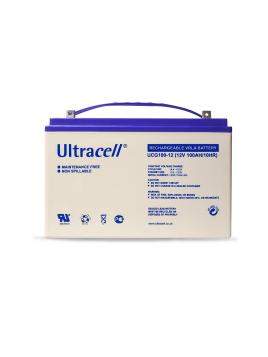
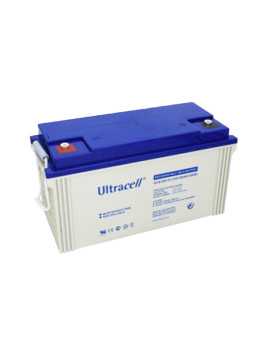
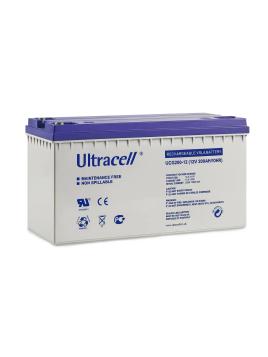
Our main AGM and GEL battery range for solar and backup applications. UCG (GEL) and UCA (AGM) series cover capacities from 7 Ah to 200 Ah in 6V, 12V and 24V.
Victron Energy
The Victron AGM and GEL range is the benchmark for demanding installations. Victron Deep Cycle AGM batteries are designed to handle repeated discharges with above-average lifespan. Compatible with the full Victron ecosystem.
Banner
Austrian manufacturer known for build quality and robustness. The Banner Energy Bull range is particularly suited to solar and backup applications with good discharge cycle tolerance.