Voltage
Brand
Price
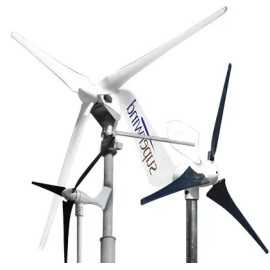
Wind turbine
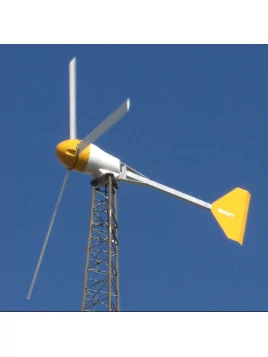
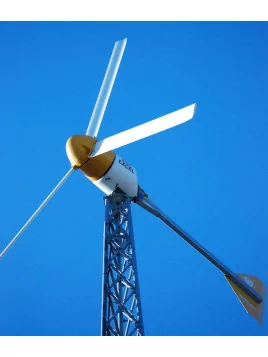
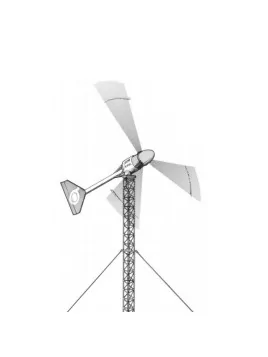
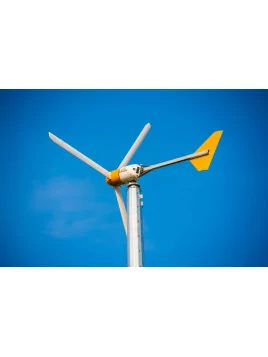
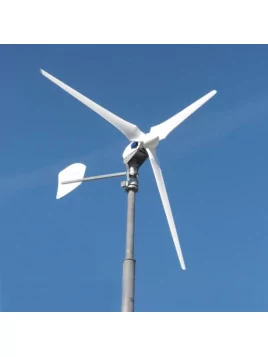
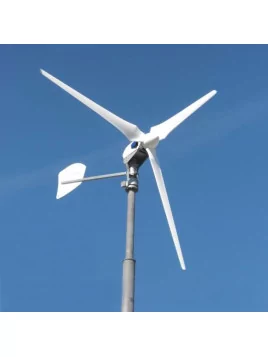
A domestic wind turbine converts wind energy into electricity to power an off-grid system (remote/off-grid site) with batteries, or certain grid-connected projects depending on the model. To make the right choice, check the power output, voltage (12/24/48V), the controller, the mast and compatibility with your storage system.
Unlike solar panels, a wind turbine generates electricity day and night, as long as the wind is blowing — making it an ideal complement to solar power in windy regions or in winter when there is little sunshine. Domestic wind turbines are particularly well-suited to remote locations (holiday cottages, cabins, off-grid homes), boats and motorhomes, as well as certain hybrid wind-solar installations.
A wind turbine’s power output depends directly on the wind speed at your site: a 400 W turbine at 12 m/s will produce only a few dozen watts in light winds. It is therefore essential to assess the local wind conditions (exposure, obstacles, planned mast height) before sizing your installation. A taller mast captures a more consistent and stronger wind — every extra metre counts.
Choose in 30 seconds
- Which voltage: 12V, 24V or 48V? The voltage depends on your existing battery bank. As a general rule: 12V for small installations (motorhomes, boats), 24V for a chalet or cabin, 48V for an off-grid home with higher consumption. The higher the voltage, the lower the line losses over long cable runs.
- What power output do I need? Estimate your daily consumption in Wh, then take into account the number of hours of usable wind at your site (generally 4 to 6 hours per day on average in Europe). A 500 W wind turbine with 5 hours of usable wind produces around 2,500 Wh/day — enough for a small, well-insulated chalet. For a house, you will need to combine several sources or opt for a 2 to 6 kW wind turbine.
- Do I have enough wind? That is THE key question. Below an average annual wind speed of 4 m/s, a wind turbine is not cost-effective. Between 5 and 6 m/s, it is a good source of energy. Above 7 m/s, the wind turbine becomes highly efficient. Check the weather data for your area or use an anemometer for a few weeks before investing.
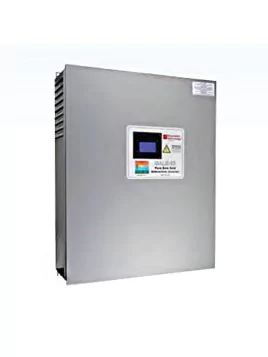
- Off-grid or grid-connected? For anoff-grid site, choose a DC wind turbine (12/24/48V) coupled with a charge controller and a battery bank. For a grid-connected installation, you will need a model designed for grid feed-in (230V AC) with a certified wind turbine inverter — and a declaration to your grid operator.
- Are the controller and the mast included? Check the contents of the package carefully. The wind turbine charge controller is essential to protect your batteries. The mast is not usually supplied — allow for a minimum height of 6 to 10 m above nearby obstacles. A short-circuit switch (brake) is also required to stop the wind turbine during maintenance or in extreme wind conditions.
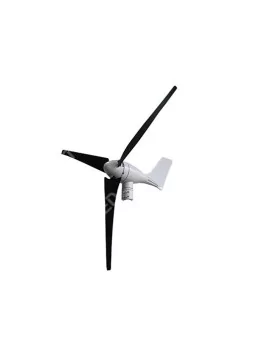


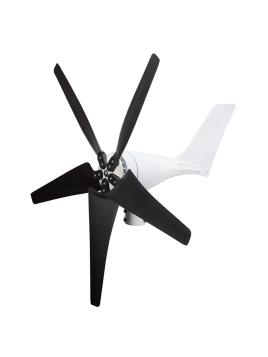


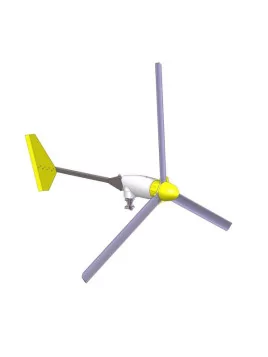









FAQ - Domestic wind turbines
How to choose the right domestic wind turbine for your needs
A domestic wind turbine can be an excellent solution for producing renewable electricity on an off-grid site, as a complement to a solar installation, or for certain grid-connected projects depending on the model. But contrary to popular belief, a wind turbine should not be chosen solely based on its rated power. The key factor is above all the actual wind available on your site.
A small wind turbine installed in the right location, on an open site and with a suitable mast, will often be more effective than a more powerful model installed too low or in an area disturbed by obstacles. Trees, buildings, terrain, turbulence and mast height all directly affect production. That is why wind power requires a more “field-based” approach than solar: every project must start with the local wind resource.
In which cases is a domestic wind turbine worthwhile?
- Off-grid site: chalet, cabin, outbuilding, tiny house, shelter, technical room or land not connected to the grid.
- Mobile or marine use: boat, van, motorhome, when the goal is to charge a battery bank.
- Hybrid solar + wind system: especially useful in winter, at night, or in windy regions where solar alone is less consistent.
A wind turbine becomes highly relevant when you need production that complements photovoltaic power. Solar performs very well during the day, especially in sunny weather; wind power, on the other hand, can continue producing when the sky is cloudy, in winter or at night, as long as there is enough wind. This complementarity is often what makes the difference in an autonomous battery-based system.
What wind turbine power should you choose?
The rated power displayed for a wind turbine is always linked to a certain wind speed. In practice, this means that a model advertised at 400 W, 1 kW or 2 kW will only reach that output under specific conditions. If the average wind on your site is weak or highly irregular, the actual production will be much lower. The right approach is therefore to first assess the site exposure, wind consistency and feasible mast height.
- Low power models: suitable for modest needs, battery maintenance charging, boats, vans or small loads.
- Mid-range power models: relevant for a chalet, an outbuilding or a small off-grid site.
- High power models: reserved for more ambitious projects, with a proper installation study and consistent equipment (mast, controller, storage, conversion).
12V, 24V or 48V: which voltage should you choose?
The choice of voltage mainly depends on your battery bank, the amount of power to be transmitted and the type of installation. For small uses, 12V may be sufficient. As power increases or greater efficiency is required, 24V and especially 48V often become more relevant. For a complete off-grid project, you need to consider the entire system: wind turbine, controller, batteries, inverter and loads.
Why the mast is almost as important as the wind turbine itself
A poorly positioned wind turbine will produce little, even if the machine itself is high quality. The higher the rotor, the more likely it is to capture steadier, stronger and less turbulent wind. In short: every extra meter matters. Before buying, you therefore need to think carefully about the location, the distance from obstacles and the mast height that is actually feasible.
Wind turbine alone or hybrid system with solar panels?
In many cases, the best approach is not to choose between solar and wind, but to combine them. A hybrid system helps smooth production over the year and improves energy autonomy. For a chalet, an off-grid site or an off-grid home, combining a wind turbine with solar panels and battery storage is often the most robust solution.
If your goal is autonomy, you can also look at our off-grid solar kits or explore all our solar kits to build an expandable installation.