Categories
Voltage
Charging power
Load current
Phase
Brand
Charge controllers
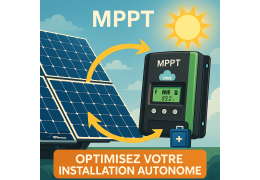
A solar charge controller protects your batteries and optimises energy transfer between your photovoltaic panels and storage. Two technologies available: PWM (simple and affordable for small systems) and MPPT (Maximum Power Point Tracking, 10 to 30% more energy recovered depending on conditions) — MPPT is today's benchmark for any serious installation. Always check the battery voltage (12V / 24V / 48V), the max charge current (A) and the max PV input voltage (Voc). Available from Victron Energy and SRNE. For MPPT sizing, see our MPPT technical sizing guide.
Choose in 30 seconds
- MPPT or PWM: choose MPPT in almost all cases — it produces 10 to 30% more energy and accepts PV input voltages well above battery voltage (overpanelling possible). PWM is suitable for very small systems (<200W) and tight budgets only.
- Battery voltage: check that the controller supports your system voltage — 12V, 24V or 48V. Most modern MPPT controllers auto-detect battery voltage.
- Charge current (A): max controller current must be ≥ PV power (W) ÷ battery voltage (V). Example: 600W ÷ 48V = 12.5A → choose a 15A MPPT minimum.
- Max PV input voltage (Voc): the open-circuit voltage of your series-connected panels must NEVER exceed the controller's max input voltage — even once. See our MPPT sizing guide for calculations.
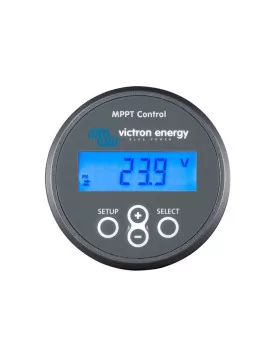
- Monitoring: Victron Energy MPPT controllers are the benchmark (VictronConnect app, Cerbo GX compatible). SRNE offers good value with integrated LCD display.














Related posts

FAQ - Solar charge controllers
Solar charge controllers: complete guide to choosing between PWM and MPPT
A charge controller is the component linking your solar panels to your batteries in an autonomous system. Its role: convert and regulate the current from the panels to charge batteries optimally without damaging them. Without a controller, a battery connected directly to panels would be overcharged whenever production exceeds consumption.
PWM vs MPPT: the honest comparison
PWM controller (Pulse Width Modulation)
- Principle: connects panels directly to the battery via a fast-switching electronic switch. Excess voltage energy is lost.
- Main constraint: panel Vmp must be close to battery charge voltage (e.g. 18V panels for 12V battery). If PV voltage is much higher, efficiency drops sharply.
- Advantages: simple, reliable, affordable. Ideal for installations ≤200W, emergency kits and tight-budget leisure projects.
- Typical efficiency: 70 to 80%.
MPPT controller (Maximum Power Point Tracking)
- Energy gain: 10 to 30% more energy recovered vs PWM, especially in non-ideal conditions (morning, evening, partial cloud cover, cold temperatures).
- Overpanelling: MPPT accepts PV input voltages well above battery voltage. You can connect panels in series to increase voltage and reduce cable losses.
- Wide input voltage range: a 48V MPPT can accept PV voltages from 100 to 450V depending on the model.
- Typical efficiency: 93 to 98%.
Essential parameters to check before buying
Battery voltage
The controller must be compatible with your battery bank voltage: 12V, 24V or 48V. Most modern MPPT controllers auto-detect battery voltage at first connection. Note: a 12/24V controller cannot work on a 48V bank.
Maximum charge current (A)
Simple calculation: max current = PV power (W) ÷ battery voltage (V). Example: 800W on a 24V battery = 800/24 = 33A → choose a 40A MPPT. Always add a 20% safety margin.
Maximum PV input voltage (Voc)
The most critical safety point. The open-circuit voltage of your series panels must NEVER exceed the controller's max input voltage — even briefly — risk of permanent destruction. Calculate Voc at minimum temperature (Voc increases as temperature drops). Our MPPT sizing guide provides detailed calculation formulas.
Brands available at Wattuneed
Victron Energy
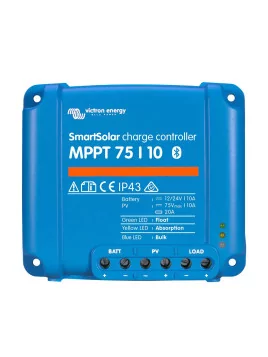
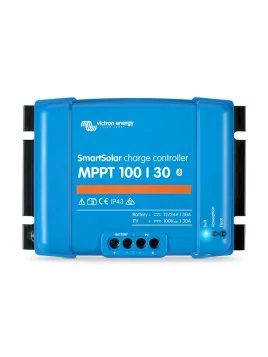
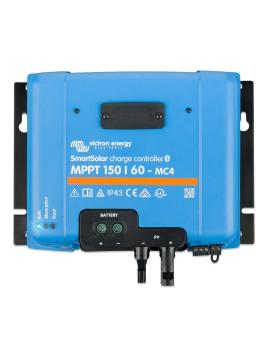
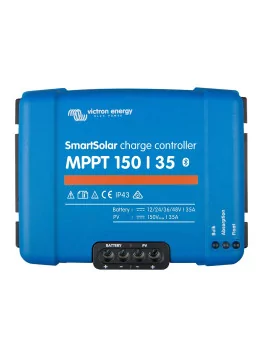
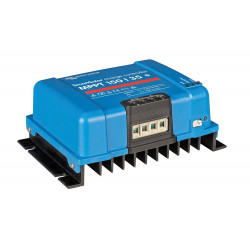
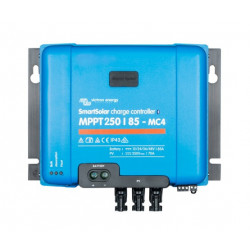
The world benchmark for quality MPPT controllers. The SmartSolar MPPT range (75/10 to 250/100) covers all installation sizes. Key strengths: native Bluetooth (VictronConnect app), full Victron ecosystem compatibility (Cerbo GX, Battery Monitor, Multi...), 5-year warranty.
SRNE
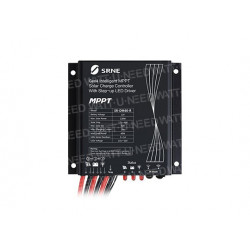
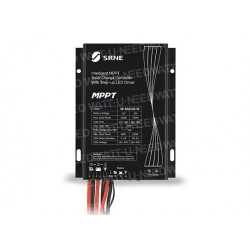
Excellent value for standard off-grid installations. Robust, with integrated LCD and LiFePO4/AGM/GEL/OPzS compatibility. Good option for remote sites on a controlled budget.