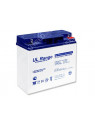
Ultracell UL 18-12 AGM batteries - 18 Ah 12 V AGM
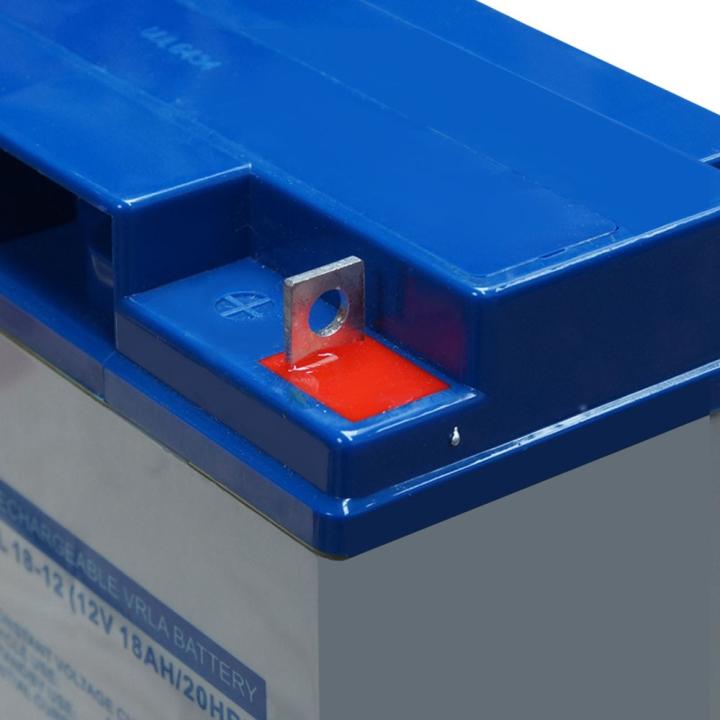
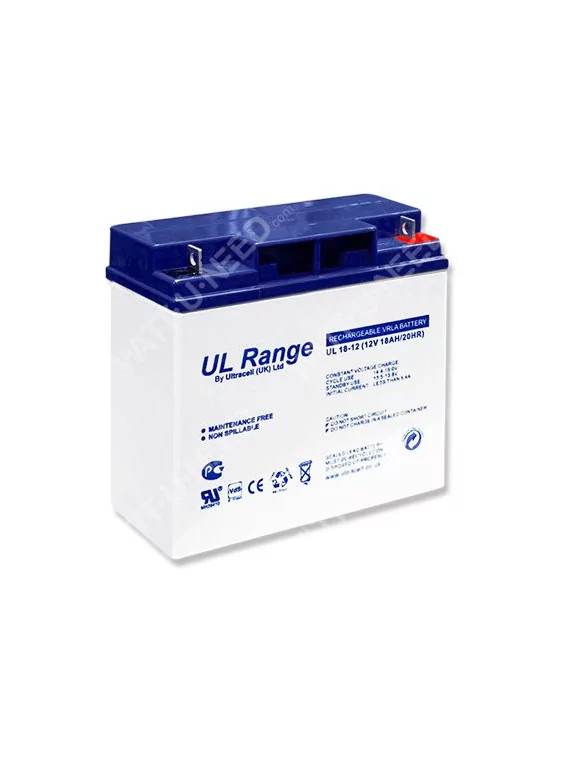
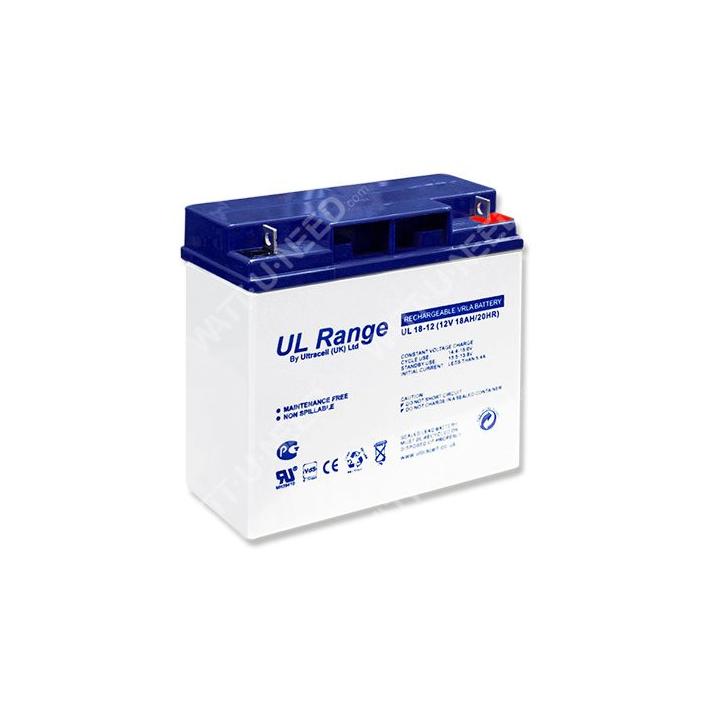
The Ultracell UL 18-12 AGM battery is a 12 V, 18 Ah battery designed for small-scale energy storage applications, particularly solar batteries and emergency power supplies. Its AGM (Absorbed Glass Mat) technology is described as leak-proof and suitable for solar applications, with a self-discharge rate of 1 to 3% per month. It measures 181.5 × 77 × 167.5 mm and has a maximum discharge current of 270 A (5 s).
- Specifications: 12 V, 18 Ah, 181.5 × 77 × 167.5 mm, maximum discharge current 270 A (5 s), internal resistance approx. 16 mΩ.
- Cells: AGM (Absorbed Glass Mat) technology with electrolyte immobilised in a fibre, and sealed battery.
- BMS + communication: Not applicable, as this is an AGM battery (no BMS or communication specified).
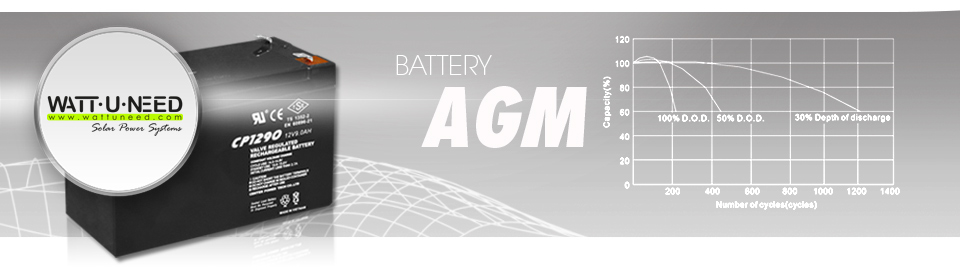
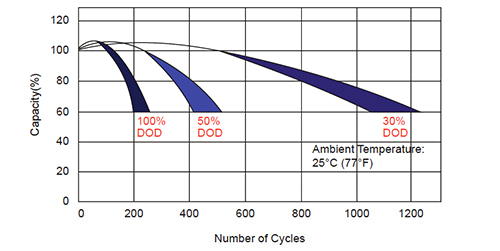
- Compatibility + scalability: Suitable for solar applications and standby use. Nominal life 5 years at 20°C, with 500 cycles at 50% discharge and 1,200 cycles at 30% discharge.
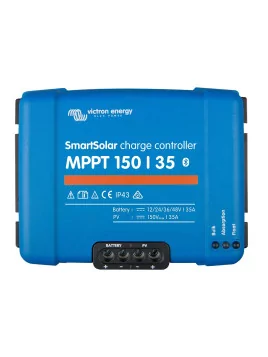
Compatible avec :

AGM Ultracell 12V 18Ah battery: Autonomy and durability for your projects
This new type of sealed battery uses "absorbed glass mat batteries" technology. This technology uses a thin sheet of boron-silicate fiber between the lead plates in the battery .This thin sheet is soaked with electrolyte (70% water and 30% acid).
Advantages
AGM batteries have many advantages compared to conventional lead-acid batteries and gel batteries :
- They are maintenance free, weatherproof.
- No gas release, shock resistant.
- Low self-discharge : 1 to 3% per month (unlike a normal lead acid battery which is discharged very quickly if not used sometimes).
- Life is increased therefore the purchase price is profitable over time, not to mention the performance gain.
- As the electrolyte is soaked into the fiber it can not sink even in case of breakage of the battery box, thus even the transport is much easier and safe. With no liquid, GM foods are not very sensitive to the damaging effects of frost.
- For solar applications, the AGM are ideal : no maintenace, no gas release, conventional loading rates which then allows to use any standard charging system, minimum maintenance during the winter.
Specifications

Comparative table of price per useful kWh over battery life at a glance!

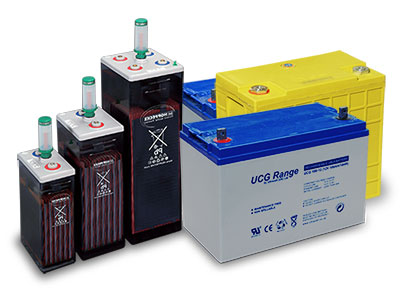
There are many different storage technologies: Gel or AGM batteries, lithium batteries, OPzS and OPsV. It's not easy to choose the right technology for your needs. Each technology has its own characteristics (size, power, cost, number of cycles and service life, etc.). With this table, you can quickly compare the price per useful kWh over the lifetime of the batteries.
C10 = 10-hour charge/discharge test.
C24 = examination of a charge or discharge in 24 hours.
Click here to see our comparison table.
Data sheet
- Voltage
- 12V
- Technology
- Agm
- Battery capacity
- 18Ah
- Rated capacity
- 11.3 AH/11.3A - (1 heure, 1.60V/cellule, 25°C / 77°F)
13.8 AH/4.59A - (3 hours, 1.75V/cell, 25°C / 77°F)
15.3 AH/3.06A - (5 hours, 1.75V/cell, 25°C / 77°F)
16.7 AH/1.67A - (10 hours, 1.80V/cell, 25°C / 77°F)
18,0 AH/0,90A - (20 heures, 1,80V/cellule, 25°C / 77°F) - Maximum discharge current
- 270A (5s)
- Internal resistance
- Approx 16mΩ
- Standby use
- No limit to initial charge current Voltage 13.5V~13.8V at 25°C (77°F) Temperature coefficient -20mV/°C Coefficient -20mV/°C
- Nominal service life at 20°C
- 5 years
- Self-discharge
- Ultracell batteries can be stored for up to 6 months at 25°C (°77F), after which a new charge is required. For higher temperatures, the time interval will be shorter.
- Operating temperature range
- Charge : 0 ~ 40°C (5 ~ 104°F)
Discharge: -15 ~ 50°C (5 ~ 122°F)
Stockage : -15 ~ 40°C (5 ~ 104°F) - Weight
- 5,32 kg
- Nominal operating temperature range
- 25 ± 3°C (77 ± 5°F)
- Cycle Use
- Initial charging current less than 5.4A Voltage 14.4V~15.0V at 25°C (77°F) Temperature coefficient -20mV/°C Coefficient -20mV/°C
- Capacity affected by temperature
- 0°C (32°F) 86%
25°C (77°F) 100%
40°C (104°F) 103%
Specific References
- UPC
- 712971127678
- EAN13
- 0712971127678