Brand
Phase
Number of MPPT
Rated output power
Inverter power in VA
Microinverters
Micro-inverters optimise production panel by panel: each photovoltaic module has its own DC/AC converter, eliminating the weak-link effect in case of partial shading or multiple roof orientations. Ideal for self-consumption, grid injection and Plug & Play kits (balcony, terrace). Available from Hoymiles, Enphase and APsystems, with or without a data transfer unit (DTU) for panel-by-panel monitoring.
Choose in 30 seconds
- Shading or multiple orientations: this is THE use case for micro-inverters. Shading on one panel doesn't affect the others — each module works at its own optimum independently.
- Plug & Play kit (balcony/terrace): micro-inverters are at the heart of these no-work-required installations. See our Plug & Play kits for complete ready-to-plug solutions.
- Power and compatibility: check that the micro-inverter power (VA/W) matches your panels. Each brand uses its own AC connectors — check compatibility before mixing brands.
- Monitoring (DTU): to track production panel by panel, add a DTU (Data Transfer Unit) compatible with your brand (Hoymiles DTU-Pro, Enphase Envoy...).
- Scalable installation: add panels at your own pace — each micro-inverter is independent and your system can grow without full reconfiguration.


Related posts

FAQ - Microinverters
Solar micro-inverters: complete guide to making the right choice
A micro-inverter is a compact DC/AC converter that mounts directly behind each solar panel. Unlike a centralised string inverter that manages all panels together, a micro-inverter individually optimises each module. Result: a fault, shade or dirt on one panel does not impact the output of the others. This technology has made solar installations on complex rooftops and balcony Plug & Play kits widely accessible.
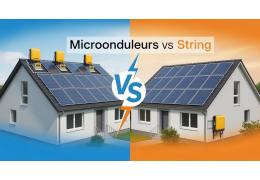
Micro-inverter vs string inverter: the differences that matter
- Micro-inverter: one converter per panel. Panel-by-panel optimisation, individual monitoring, no weak-link effect. Ideal for shaded rooftops, multiple orientations or progressive panel additions. No native battery management.
- String inverter (grid): one central inverter for all panels. More cost-effective on large homogeneous installations (same orientation, no shading). Less efficient when panels are mismatched.
- Hybrid inverter: same principle as string, but with integrated battery management. The right choice if you want to store your production.
Wattuneed tip: if your roof is uniform (same orientation, same tilt, no shading) and you don't plan to add a battery, a string inverter will often be more economical. As soon as you have shading or multiple roof sections, micro-inverters are the right answer.
Key technical criteria
Micro-inverter power (VA or W)
Each micro-inverter has an acceptable input power range. Check that your panel's peak power (Wp) falls within the manufacturer's recommended range. Generally, an overpanelling ratio of 1.1 to 1.3 is accepted (e.g. a 300W micro-inverter with a 380 Wp panel). See our MPPT sizing guide for detailed calculations.
AC connections and compatibility
Each micro-inverter brand uses its own AC connectors and cables. A Hoymiles cable is not compatible with an Enphase micro-inverter. If mixing brands, verify connector compatibility. For Plug & Play kits, everything is generally supplied and pre-wired.
The DTU: essential accessory for monitoring
The DTU (Data Transfer Unit) is the gateway that collects production data from each micro-inverter and sends it to the monitoring app. Without a DTU, you have no individual panel supervision. Each brand has its own DTU:
- Hoymiles: DTU-Pro or DTU-WLite depending on the number of micro-inverters
- Enphase: Envoy-S or IQ Gateway
- APsystems: ECU-R or ECU-C
Brands available at Wattuneed
Hoymiles
The most popular brand on the European market for value for money. Hoymiles HM and HMS micro-inverters cover power ranges from 300W to 2,000W, with a complete range of DTUs and accessories. Particularly suited to Plug & Play kits and residential rooftop installations. Compatible with most panels on the market.
Enphase
The premium micro-inverter benchmark. The IQ8 range is the most advanced on the market with a unique feature: it can operate in island mode (off-grid) during a power cut, without additional batteries. Very detailed monitoring via the Enlighten platform. Ideal for demanding residential installations with fine production tracking.
APsystems
A pioneer in bifacial micro-inverters, APsystems also offers dual and quad-input models (one micro-inverter for 2 or 4 panels), reducing the cost per panel on larger installations. A good economical alternative to Enphase for medium-sized projects.
Micro-inverters and Plug & Play kits: the perfect combination to get started
Plug & Play solar kits are built around micro-inverters: plug everything into a dedicated socket and your production starts immediately. No electrical panel modifications, no electrician required (within regulatory limits — 800W in France and Belgium). The ideal entry point to test self-consumption before investing in a full rooftop installation.